
German tourist dies in Sa Calobra – a reality check for emergencies on Mallorca's beaches
German tourist dies in Sa Calobra – a reality check for emergencies on Mallorca's beaches
A 40-year-old tourist died at the Torrent de Pareis. The emergency call, a doctor who happened to be present, a defibrillator and a rescue helicopter could not help. What does the case reveal about rescue chains on the island?
German tourist dies in Sa Calobra – a reality check for emergencies on Mallorca's beaches
Main question
What needs to change so that an emergency in places like Sa Calobra no longer ends so often in death?
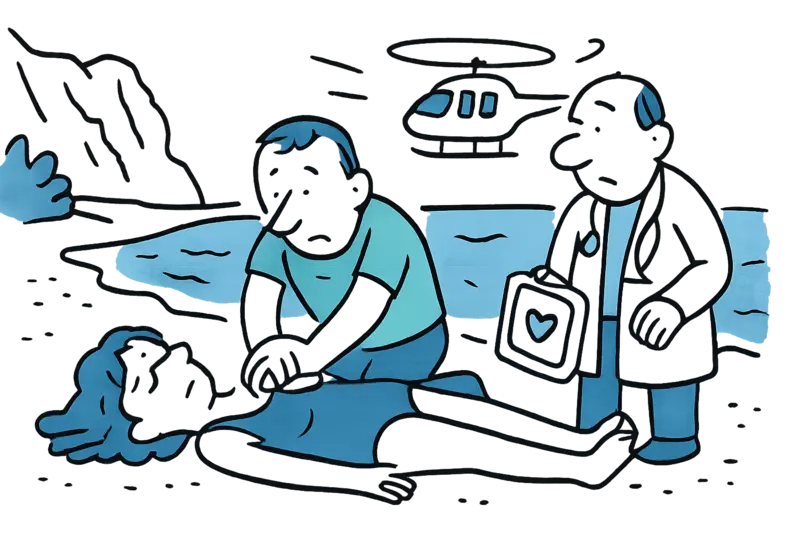
On Saturday at midday the emergency call center 112 reported a cardiorespiratory arrest in the area of the Torrent de Pareis. The local emergency service (061) was alerted, and civil protection teams from Escorca arrived first on scene. A doctor who happened to be present immediately began cardiopulmonary resuscitation and used a defibrillator. Shortly afterwards a medically equipped rescue helicopter landed, whose emergency physicians took over the measures. Despite everything, the 40-year-old German tourist died.
The facts are sparse but clear: rapid recognition, the immediate start of a layperson resuscitation attempt with a defibrillator, and professional help from the air could not save the woman in this case. That is bitter — and a reason to question the procedures soberly.
Critical analysis
In a cardiorespiratory arrest time is decisive. Each minute without effective resuscitation significantly reduces the chance of survival. In confined, hard-to-reach places such as the end of the winding road to Sa Calobra, factors slow down the rescue chain: tight parking spaces, groups of tourists, the pebble beach at the mouth of the torrent, and the steep paths. An ambulance often has to fight through traffic, helicopters need a free, safe landing site and time for the medical crew's ascent and descent, and similar incidents have occurred in busier resorts like Playa de Palma: Death at Balneario 2 – How good is Mallorca's help for people in need?.
At the same time the involvement of a doctor who happened to be present shows how important lay initiative is. But relying on luck is not a strategy. How well are AEDs (automated external defibrillators) distributed at excursion destinations? Do visitors or companions know the emergency numbers and how to describe the exact location — for example the mouth of the Torrent de Pareis or the parking bay on the MA-2141? And how reliable is mobile phone coverage in the gorge when precise coordinates are needed?
What is missing from the public discussion
We talk a lot about tourist numbers and road safety, but hardly about concrete measures to reduce deaths from sudden cardiac arrest at excursion sites. There is a lack of transparent data on response times of emergency services at hard-to-reach places, a map of publicly accessible AED locations and clear information about if and when beaches like Sa Calobra are monitored outside the season, as recent reports like Cardiac Arrest on Can Picafort Beach: Questions Remain and Ideas for the Future show. The role of private providers — excursion boats, bus companies, guides — also often goes unmentioned, even though they can be first responders and may bear responsibility, as discussed in Cardiac Arrest in Caimari: Are Mallorca's Villages Prepared for Medical Emergencies Involving Tourists?.
Everyday scene from Sa Calobra
You stand at the top of the gorge, hear the bus engines, the cries of seagulls and the soft crunch of pebbles at the shore. In the afternoon day-trippers stream down the steps; it smells of sea and sunscreen. In this idyll an emergency can go unnoticed until someone screams and the crowd parts. Then the landscape no longer matters, but the question: How quickly can helpers gain access, where is the nearest AED, who takes over the resuscitation?
Concrete solutions
1) Expand the AED network: Permanently installed, highly visible AED stations at the entrance to the torrent, in parking areas and near the pebble beach. Devices should be weatherproof and accessible around the clock. 2) Emergency signage with clear location information and QR codes that, when scanned, send exact GPS coordinates to the emergency dispatch center. 3) Training initiative: Free, short-format CPR courses and AED instructions for tourism service providers, bus drivers, boat operators and seasonal staff. 4) Landing site marking: Official, clearly marked areas for helicopters with regular inspections so air rescue can operate quickly and safely. 5) Data and transparency: Local authorities should publish response times at popular excursion sites and identify weak points together with the emergency services. 6) Cooperation: Municipalities, the island government and private providers should conduct emergency drills to rehearse procedures on site.
Concise conclusion
The death of the tourist in Sa Calobra is a personal tragedy and at the same time a wake-up call for the island. The rescue chain worked — callers, first responders, defibrillator, helicopter — and yet every help arrived too late. Other reports, such as Dead Tourist at Playa de Palma: An Accident Raises Many Questions, underline the pattern. That shows: we don't need empty platitudes, but pragmatic improvements: AEDs, better signage, targeted training and clear landing zones. Small, concrete steps can bridge the time until professional care arrives. And time is what decides between life and death.
Frequently asked questions
What steps could speed up emergency response on Mallorca's hard-to-reach spots?
Why are AEDs and training important for Mallorca's beaches?
How can visitors help emergency services by providing precise location information at Mallorca sites such as Torrent de Pareis?
What should I do if I witness a cardiac emergency on Mallorca?
Why can emergency response be slower at Sa Calobra on Mallorca?
What role do private operators play during emergencies on Mallorca?
Should Mallorca publish emergency response times and AED locations?
What concrete measures could improve on-site emergency readiness across Mallorca?
Similar News
Deadly Tractor Accident in Bunyola: What Needs to Be Done Now
In a work accident on an estate near Bunyola, a roughly 40-year-old man lost his life. His wife and a small child were o...
Head-first dive into the shallow part of Cala Fonoll: An accident and the unresolved question of responsibility
A young tourist dove into Cala Fonoll and was seriously injured. Key question: Why are clear warning signs missing at da...
Mistaken identity with fatal consequences: Brutal assault in S'Aranjassa — what's missing in the follow-up?
At S'Aranjassa a visitor to a finca was tied up, beaten and thrown out of a van. Three men have been arrested, including...
High heel slips, car accelerates: accident on Camí de Son Hugo
A woman lost a high-heeled shoe on the forecourt of the sports facility at Camí de Son Hugo. The car accelerated, mounte...
Phone Scam: How Two Hotel Employees at Playa de Palma Lost Thousands of Euros
One morning in September, two reception employees at Playa de Palma were pressured by alleged alarm-company staff — in t...
More to explore
Discover more interesting content

Can Cap de Bou

Townhouse Lleo 72
