
When the Goats Arrive: Estate in Es Capdellà Does Not Do Enough to Defend Itself
When the Goats Arrive: Estate in Es Capdellà Does Not Do Enough to Defend Itself
A German owner in Es Capdellà reports that up to 44 wild goats regularly visit his 30,000 m² property, drink from the pool and strip the garden bare. The municipality has not yet responded. What is missing is a practical approach to the problem.
When the Goats Arrive: Estate in Es Capdellà Does Not Do Enough to Defend Itself
Key question: How can owners protect their property when wild goats repeatedly take over gardens, pools and roofs?
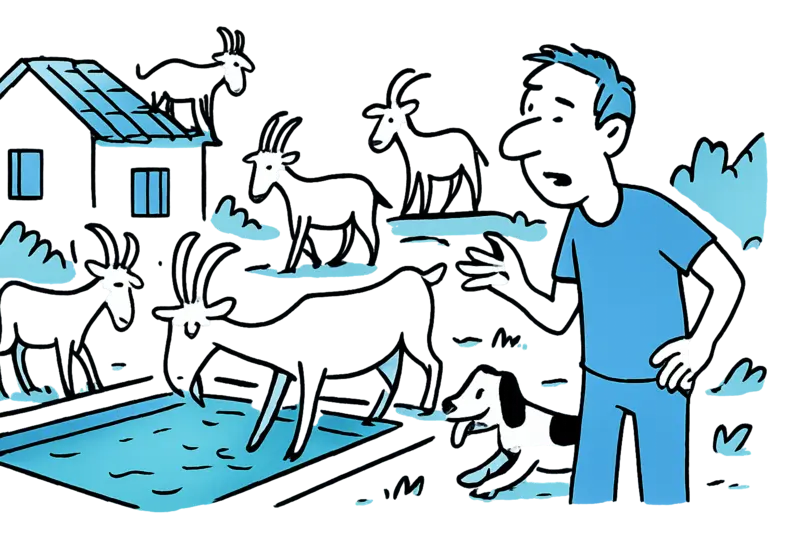
A 52-year-old German owner of an approximately 30,000-square-meter estate in Es Capdellà describes a scenario you would not expect: herds of wild goats regularly enter the grounds, drink from the swimming pool, climb onto roofs and turn planted beds into bare areas with droppings. Surveillance footage reportedly showed up to 44 animals at times. The man has already erected fences and reported the incident to the municipality of Calvià, but is still waiting for feedback.
The scene seems almost surreal: in the heat, when cicadas chirp on the slopes and the narrow village road of Es Capdellà has little traffic, you can see shadowy figures with horns at the blue pool edge. A dog accompanying the owners prefers to play with the goats rather than drive them away. For people who live or vacation here regularly, this is more than a curious anecdote — it is a practical problem with economic and hygienic consequences.
Critical analysis: the causes are multi-layered. The population of wild goats in the Balearics has grown in recent years. Feeding bans (a ban on deliberately feeding them has been in force on the islands since December 2025; Feeding forbidden: Why Mallorca's new ban needs more than signs) are intended to intervene, but they do not take effect everywhere immediately. Large, hard-to-access properties are difficult to make goat-proof with simple fences; hiking paths, wall crevices and steep terrain offer the animals plenty of hiding places. At the same time, there are often no clear points of contact for owners to obtain binding help with wildlife control (When the 'mümmels' are no longer manageable: Stray cats at Ballermann and what to do now), and there is little financial support for goat-proofing measures.
What is often missing in public discourse: hard data and a regional plan. You read about isolated cases and social media videos, but reliable data on the distribution of the animals, the times of peak visits and the ecological impacts are lacking. Also little heard is the perspective of neighbors and agricultural businesses suffering from similar problems. And finally, there is a lack of honest debate about which measures are realistic in terms of animal welfare, property rights and costs.
Everyday scene from Mallorca: imagine driving up the narrow lane toward Es Capdellà, the air smells of dry broom, children play in front of a stone facade, and suddenly a group of goats crosses a terrace, unhurried, sovereign like little kings. A neighbor calls from the fence, shakes his head and cites the municipal website — but the response does not come.
Concrete solutions
- Inventory: Joint survey of wild goat populations in affected areas by the municipality and environmental experts. Only with numbers can planning take place.
- Coordinated measures: Establishment of a municipal hotline or online reporting point for recurring cases and short decision-making paths.
- Technical assistance: Grants or low-interest loans for goat-proof fences, electrically conductive barriers at sensitive points or sturdy dry-stone walls instead of cheap wire fences.
- Humane population control: If necessary, guided relocation, sterilization or castration programs accompanied by veterinarians and animal welfare organizations.
- Preventive neighborhood solutions: Cooperative measures by estate owners (shared fences, night watch, livestock guardian dogs) and exchange of information about the animals' routes and timings.
- Simple deterrents: Motion sensors, sprinkler systems at the pool edge and robust covers for water reservoirs reduce the incentive for animals to linger near the house.
Legally, the feeding ban is a step, but it does not replace active management. Authorities must clarify who acts in which cases, which costs can be covered and how animal welfare and property protection are to be considered together (see Sa Pobla: Escaped Shepherd Dogs Kill Several Cats — Who Takes Responsibility?). Some measures are pragmatic, others require the courage to run ongoing programs and invest money.
Punchy conclusion: It is not enough to chuckle at viral videos. When goats regularly occupy roofs, pools and gardens, it is a local problem with tangible consequences. The municipality of Calvià and affected landowners now need a coordinated strategy: a combination of population data, practical technology, clear reporting channels and humane interventions. Otherwise, morning surprises at the pool — and stripped terraces and frustrated owners — will remain the norm.
Frequently asked questions
Why are goats invading gardens and pools on Mallorca, and what is driving this issue?
What practical steps can a Mallorca property owner take if wild goats start entering their estate?
What fencing options are recommended to keep goats out of homes and pools in Mallorca?
How can Es Capdellà and Calvià municipalities coordinate a response to recurring goat visits?
What role does the 2025 goat feeding ban play in managing wild goats on Mallorca?
What simple deterrents can help discourage goats from lingering near pools or gardens?
Are there funding options to goat-proof private properties in Mallorca?
What is the larger picture for neighbors and farms dealing with goats in Mallorca, and how should data be used?
Similar News
Being Seen: When an Exhibition Is More Than Pictures on the Wall
An artist prepares a small exhibition in Palma. Amid boxes, lighting cables and the sound of coffee service, encounters ...

Red warning on the mainland, yellow to orange here: What do the storms reveal about preparedness and risk?
Torrential rains caused severe damage on the Spanish mainland; a man died in Catalonia. Why was the mainland hit harder ...
Beach party or public order issue? Police clear Playa de Palma after illegal parties
During checks at Playa de Palma in mid-September several speakers were seized and dozens of fines issued. How can the co...

Caro Robens: 15 kilograms lighter — and again in the crossfire of online comments
Bodybuilder Caro Robens, who lives in Mallorca, has lost 15 kilograms. Her success on Instagram was met with applause — ...

Meager Industry in Mallorca: How the Island Can Be More Than Just Tourism
The industrial sector in Mallorca is shrinking, productivity is falling and firms remain tiny. The key question: can the...
More to explore
Discover more interesting content

Can Cap de Bou

Townhouse Lleo 72
