
Graffiti on the Ma-10: "Mallorca is not Germany" – What's behind it, what to do?
On the Ma-10 between Estellencs and Andratx the German sentence "Mallorca ist nicht Deutschland" appeared on several road edges. Why such messages are resurfacing now — and what the island can practically do about it.
Graffiti on the Ma-10: "Mallorca is not Germany" – What's behind it, what to do?
On the Ma-10, the road between Estellencs and Andratx near the Coll de Sa Gramola, graffiti in German reading "Mallorca ist nicht Deutschland" has appeared in recent days at several spots on the asphalt and on a retaining wall. On a straight stretch the message can be read plainly; on an uphill curve the same words appear again in a different arrangement. The placement of these inscriptions is not accidental: rental cars, tour buses, motorcycles and increasingly also cyclists and hikers travel this route.
Key question
Where is the boundary between legitimate criticism of overloading and the way of expressing it publicly — and does this lead to a solution or does it exacerbate the conflict?
Critical analysis
Graffiti and slogans are a symptom, not a condition. They say something about how individual residents or groups perceive the situation: crowded roads, full parking spaces in small villages, and guest behaviour that is perceived as inconsiderate. That such messages have appeared more frequently this summer is linked to larger protest actions on certain days in Palma and Sóller. Such slogans linguistically target a specific group — the use of German here is no coincidence, but an expression of a direction in the dissatisfaction.
At the same time the message is problematic: publicly scrawling on roads creates hazards for road users. On narrow mountain roads with curves and oncoming traffic the eye can be distracted; for cyclists and motorcyclists a sudden braking or evasive manoeuvre can be dangerous. At the same time, a blanket formulation like "Mallorca is not Germany" quickly shifts the debate into cultural escalation instead of translating it into concrete points of criticism.
What is missing from the public discourse
We hear a lot about anger and protest, but too rarely: concrete figures on peak loads on specific days, voices of people whose income depends on tourism, and concrete examples of "behaviours perceived as arrogant" that could be described and addressed. Also hardly debated are short-term measures that increase traffic safety and the question of how car rental companies, tour operators and hoteliers can take responsibility. Without these levels the discussion remains polarised.
A scene from the Ma-10
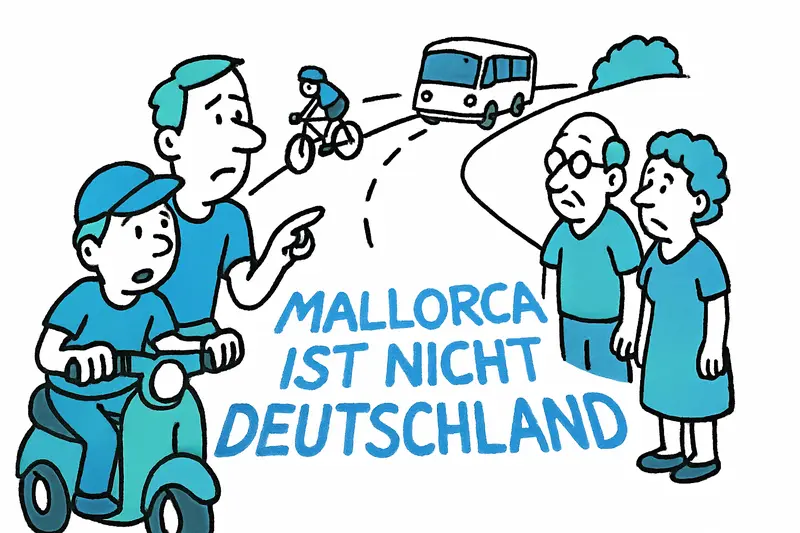
Imagine: midday, cicadas chirp, the smell of pine resin in the air. A tour bus rolls slowly up the incline, behind it a rental car with German plates, a cyclist breathes heavily, an elderly couple steps out to enjoy the view of the bay. They see the fresh black-and-white letters at the roadside. A boy on a scooter shows it to his father. In this way a symbol becomes an everyday experience — and a conversation starter, but also a hazard.
Concrete solutions
1. Immediate measures: visibly clean road edges and regular cleaning reduce the effect of slogans. The island administration can arrange faster cleaning in critical sections and inform the road authority to assess hazards.
2. Controlled presence: temporary increased presence of local police (Guardia Civil/Policía Local) in tourist hotspots can prevent vandalism and at the same time mediate in traffic problems.
3. Cooperation with the industry: car rental companies and tour operators should be required to hand out information sheets — not as a raised finger, but as a code of conduct for roads, nature protection and parking. Garages and petrol stations could also serve as distributors.
4. Local dialogue: town hall meetings in Andratx, Estellencs and the surrounding area, moderated and with participants from hotels, trade and the neighbourhood, to prioritise concrete problems (bus parking, waste, parking pressure) and find solutions.
5. Long-term planning: measures to steer visitors, targeted restrictions on bus arrivals at certain times of day and better infrastructure for cyclists and hikers on the Ma-10 could bring relief.
Why this is not just a police matter
Repressive answers alone — heavy fines, cameras, constant controls — can help in the short term but do not achieve what is needed long term: understanding on both sides. Many people on Mallorca depend economically on tourism; at the same time the burden is real. The question is how to reconcile both without resorting to cultural blanket attacks.
Concise conclusion
The graffiti on the Ma-10 are uncomfortable but also a sign: the island is approaching local limits. Those who now think only in slogans miss the chance to solve concrete conflicts. Those who only defend ignore legitimate concerns. The practicable route lies elsewhere: clean roads, a stronger presence for safety, local conversations and shared responsibility with the industry. Then there will be more time for what really matters here — encounters, not slogans.
Frequently asked questions
What is Mallorca's climate like and when is the best time to visit for sunny beaches?
What should I pack for a trip to Mallorca?
Is it safe to swim in Mallorca's sea and are beaches crowded in peak season?
What outdoor activities are popular in Mallorca?
Is Palma's old town worth a visit and what should I see?
What makes Port de Sóller a good day trip from Mallorca's capital?
How can I reach Cap de Formentor and what is there to see?
Are there family-friendly beaches near Alcúdia?
Similar News

Mercadona brings ready-made doner wrap to the chilled shelf – practical for beach days and after work
A 400-gram kebab wrap with seasoned chicken, tomatoes, lettuce, onions and a wheat flatbread lands in Mercadona's chille...
Spray on the Ma-10: When the message 'Mallorca is not Germany' reaches the Tramuntana
On a stretch of the Ma-10 between Estellencs and Andratx, German slogans have been painted on the road and embankment. A...
Heatstroke at El Toro: Why the island must be better prepared for such major events
At the El Toro viewpoint in Calvià a 74-year-old man suffered a heatstroke while waiting for the solar eclipse and had t...
When a giant tuna stirred up the beach in Marbella
A stranded, apparently injured tuna on El Ancón beach caused panic and helping hands on Saturday. What remained unresolv...
Pastel de Eclipse: Palma pastry chef bakes the solar eclipse
On Calle Pascual Ribot the traditional pastry shop Ángel is offering a limited 'Pastel de Eclipse' for the solar eclipse...
More to explore
Discover more interesting content

Boat Tour with BBQ along Es Trenc Beach

Private transfer from Mallorca Airport (PMI) to Pollensa
