
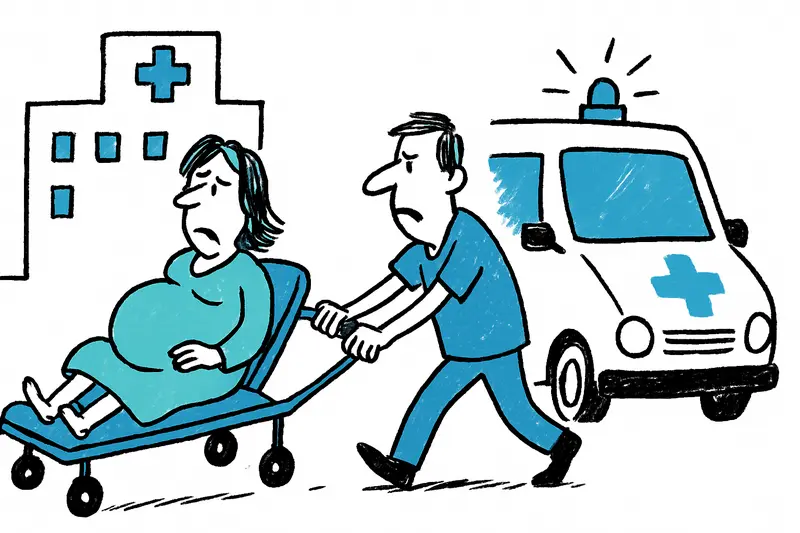
Gynecologist Shortage in Manacor: Emergency Births at Night Rerouted to Palma
Gynecologist Shortage in Manacor: Emergency Births at Night Rerouted to Palma
Due to a shortage of gynecologists, acute births that arrive at Manacor's emergency department at night are temporarily transferred to Son Espases or Son Llàtzer. Planned deliveries remain in Manacor. What does this mean for expectant mothers in eastern Mallorca?
Gynecologist Shortage in Manacor: Emergency Births at Night Rerouted to Palma
How safe is obstetric care in the east of the island if emergencies are outsourced?
The clinic in Manacor has announced that acute births that arrive via the emergency department outside core working hours — specifically between 3:00 p.m. and 8:00 a.m. — will be temporarily transferred to Son Espases or Son Llàtzer. Planned deliveries and cesarean sections are to continue taking place in Manacor. The clinic management says normal operations should resume from December 16, and assures that care is secured, a situation detailed in Hospital Manacor: When the Night Becomes a Risk.
Key question: Can pregnant women in eastern Mallorca rely on being cared for in time at night if the nearest point of care is a hospital in Palma? The question sounds simple, but for many people in the east of the island it is existential.
Critical analysis: The move reveals a fundamental problem that is not merely a short-term staffing gap, but sheds light on the structure of emergency care. When emergencies from Manacor are taken to Son Espases or Son Llàtzer, routes and time windows change: the deployment procedures of emergency services, time spent on the road, and the burden on receiving clinics. For the team in Manacor the change means additional planning effort: who stabilizes patients before transport? Who takes over follow-up care when births are interrupted? Management speaks of sufficient care — that is reassuring, but remains an abstract assurance as long as patient numbers, transfer routes and reasons for the shortages are not disclosed.
What is missing in public discourse: numbers and transparency. There is no clear presentation of how many births typically arrive in Manacor at night, how many of those are acute, how often ambulances are dispatched for transfers and how long such transports take. Also often overlooked: the responsibility for relatives who suddenly face a longer journey, and the question of how aftercare and psychological support are organized when a birth takes place at a different hospital.
An everyday scene: It is 11:00 p.m., wind rustles in the pines along the MA-15, an ambulance rolls with flashing lights into the emergency car park in Manacor. Outside stand two exhausted relatives, inside a small team prepares everything. Phone calls are made, paramedics work to achieve stable positioning — and then the decision: transfer. The sound of the siren fades toward Palma; on the return journey a gap remains at the hospital that must be filled the next morning. Nights like this occur here more often than one might think.
Concrete solutions that should be examined immediately: First, publish transparent data — number of nightly births, transfer rates, average transport times. Second, a clearly communicated transfer procedure with contacts for families so that nobody is left in the dark. Third, short-term strengthening of emergency services in the east: additional transport-capable care units and trained midwives for prehospital stabilization. Fourth, personnel policy measures: fixed-term contracts, travel allowances, support with housing searches for specialists — simple instruments that regularly help where staffing problems are acute. And fifth, a long-term island strategy: fixed on-call models, cooperation between hospitals and an expansion of telemedicine consultations for difficult cases.
It is also important to strengthen the perspective of those affected. Local information — in practices, with midwives, on the hospital website — must clearly state what to do in a nighttime emergency: where the ambulance will go, who will be informed, and what care is offered before and after the transfer. Small measures such as a national hotline for pregnant women in distress or mobile birth companion teams could cushion the gap in the short term.
Pointed conclusion: That a hospital transfers emergency births is not a trivial incident — it is a symptom, as explored in Birth Crisis in the Balearic Islands: What Does the Decline Mean for Mallorca?. The announced return to normal operations on December 16 is welcome, but must not obscure the fact that parts of the island remain vulnerable. Ambulance trips over longer distances, fragmented aftercare and lack of transparency do not solve the staffing gap. Those who live here know: medical care is more than technology and buildings. It requires staff, planning and clear information — preferably without night trips into the unknown.
Frequently asked questions
Is emergency maternity care in eastern Mallorca affected at night?
Can pregnant women in Mallorca still give birth at Manacor Hospital?
Why are emergency births from Manacor being transferred to Palma?
How long will the maternity changes at Manacor Hospital last?
Where are emergency births from eastern Mallorca taken if Manacor cannot handle them?
What should pregnant women in Mallorca do in a nighttime emergency?
Does the Manacor hospital staffing issue affect aftercare for families?
What does the Manacor birth transfer say about healthcare in Mallorca?
Similar News
Probation sentence after 575 euros taken from a wallet in Marratxí: Is returning the money a mitigating factor?
A woman took 575 euros from a wallet left at a Marratxí gas station. She confessed, returned the money and received a fo...
Fire at the Son Hugo Parking Lot: When a Neighbourhood Dispute Becomes a Fire Catastrophe
Three motorhomes in the parking lot by the Son Hugo indoor pool burned out completely. Police suspect arson following a ...

DANA on the Way: When Mallorca Will Get Wet and Stormy — and How We Should Respond
AEMET announces a DANA: From Sunday onward, locally very heavy, persistent rainfall, thunderstorms and strong winds are ...
Fire in Son Hugo: Who protects people living in caravans?
A fire destroyed several caravans in the Son Hugo parking lot. A 34-year-old was arrested. The incident raises bigger qu...
Crack in the Heart of Palma: Hole under the Cathedral Steps Causes Concern
A cavity of up to five cubic meters was discovered beneath the stairs to Palma's cathedral. Why action was taken only no...
More to explore
Discover more interesting content

Can Cap de Bou

Townhouse Lleo 72
