
Hard braking in Palma: Eight lightly injured after evasive maneuver – time for better onboard safety?
Hard braking in Palma: Eight lightly injured after evasive maneuver – time for better onboard safety?
A line 8 bus swerved on Avenida Comte de Sallent. Eight passengers were lightly injured; five were taken to Clinica Rotger. Missing from the debate: interior bus safety and traffic management on busy ring roads.
Hard braking in Palma: Eight lightly injured after evasive maneuver – time for better onboard safety?
Driver swerved, several people fell; SAMU 061 ambulances tended to the injured on site
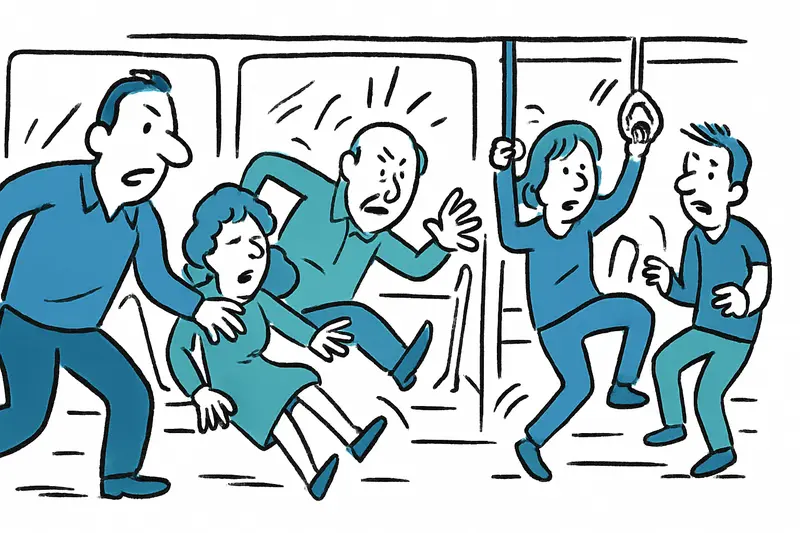
On a typical morning on Avenida Comte de Sallent, where cafés are already serving espresso and delivery vans set the pace, a bus ride ended abruptly for several passengers. A city bus on line 8 had to swerve sharply shortly after 7 a.m. because a car suddenly entered its lane. To avoid a collision, the driver performed an emergency stop. The bus did come to a halt, but several people inside lost their balance and fell. The episode was covered in local reporting such as Eight Injured after Hard Braking in Palma – Heated Debate over TIB Working Conditions.
Older passengers and those standing are particularly at risk in such maneuvers. In total, eight people sustained minor injuries. SAMU 061 ambulances arrived quickly; five of the injured were taken to Clinica Rotger, two to Poliklinik Miramar and one person to the Juaneda center for further care. The Policía Local recorded the incident, and officers from the accident investigation unit looked for traces and sequences that made the maneuver necessary.
Scenes like this are rare in Mallorca; serious bus accidents are the exception. Yet incidents such as Dangerous braking maneuver on the Ma-20: When will authorities finally act effectively? show that abrupt maneuvers can recur under different conditions.
Still, the incident shows clearly: a quick-thinking driver can prevent worse outcomes, but protection focused on the bus interior often falls out of view. On a crowded urban line, in the morning among office workers, schoolchildren with backpacks and tourists with rolling suitcases, a single sudden brake can have a domino effect.
Key question: How can evasive maneuvers be prevented or their effects on passengers minimized?
A sober analysis reveals several factors: the mixed traffic on ring and access roads, the driving behavior of private cars, spatial constraints at certain stops and the equipment of the buses themselves. City buses in Palma are designed to move many people quickly; seating is limited, handholds and poles are available, but not all passengers use them consistently. In addition, the interior often offers little protection against lateral forces.
What is usually missing in public discussion is the debate about measures inside buses. Rarely is there talk of additional handrails, energy-absorbing padding on seat backs or information campaigns that raise awareness among standing passengers about holding on. Instead, the debate quickly turns to questions of blame between the car driver and the bus driver – important, but only part of the picture.
A typical morning on Comte de Sallent: bicycle bells, the roar of a delivery van, a vendor's voice. These small things add up to an environment where sudden swerving can become necessary. Where a two-wheeler or a wrongly positioned car cuts into the lane, the distance, reaction time and the bus's interior safety features determine the injury patterns.
Concrete measures that could have a quick effect:
- More handholds at eye level and additional grab poles in the center aisle;
- soft, shock-absorbing coverings on edges and seat backs;
- visible notices drilled in at doors and entry points ("Please hold on");
- regular safety training for drivers with scenarios that consider interior dynamics;
- speed and parking controls at critical points on the ring road as well as markings that make unexpected lane changes by cars more difficult;
- a short awareness campaign on buses, especially during morning rush hour, promoting considerate behavior.
Many of these steps are relatively inexpensive or can be introduced gradually. Unlike major road reconstructions, they are pragmatic: they protect where people actually get injured – inside the bus. Authorities, the city bus operator and local stakeholders could work together on this; pilot projects on heavily used routes like line 8 would not require long debates. Coverage of other local collisions, for example Son Gotleu: Five Injured After Bus Collision – A Wake-Up Call for Palma's Streets, has already prompted calls for practical safety measures.
One last point: small acts of solidarity. If passengers in the morning, instead of leaning on each other like dead weight, offer each other a secure handhold, the risk of injury drops immediately. It sounds trivial, but it is practical and quickly implementable. A driver can swerve, a car can turn incorrectly – the next emergency stop cannot always be prevented. But we can mitigate the consequences if vehicle, infrastructure and fellow passengers are better coordinated.
Conclusion: The incident on Avenida Comte de Sallent is a wake-up call. Not everything can be solved technically, and questions of blame are complicated. Still, with relatively simple measures, injuries from emergency braking could be significantly reduced. Palma is not a testing ground for carelessness; a little more attention inside buses and a few pragmatic adjustments would have an immediate visible effect.
Frequently asked questions
What is the best time of year to visit Mallorca for beaches and outdoor activities?
What are easy day-trip options from Palma for a Mallorca itinerary?
Is Mallorca good for swimming year-round?
What should I pack for a Mallorca trip?
Are there family-friendly beaches in Mallorca?
What’s the best way to get around Mallorca—train, bus, or car?
Where can I taste authentic Mallorcan dishes in Mallorca?
Do I need a rain plan for Mallorca in shoulder seasons?
Similar News

Half a Million Passengers: Saarbrücken–Palma Remains a Heartfelt Connection
Since 2017 Eurowings has regularly connected Saarbrücken with Palma: on Friday the 500,000th passenger from Mallorca arr...
Who pays when boats run aground? The Port de Pollenca case and the public cost trap
A damaged sailboat lay for nine months on the Tamarells beach in the port of Port de Pollenca, until the municipality re...
Nine Months on the Beach: Why Pollenca Ultimately Removed the Stranded Sailboat
A single-masted vessel lay on Tamarells beach since the storm 'Harry' in January. After the owner became insolvent, the ...

Iris Berben live in Mallorca: Award and Talk at the Evolution Film Festival
German actress Iris Berben is coming to the Evolution Mallorca International Film Festival: presentation of the Evolutio...
Serious Accident in Son Ferriol: A Car Falls from the Roundabout — What's Wrong with This Spot?
A 77-year-old driver fell on Saturday morning with his car from the upper part of a roundabout in Son Ferriol down to th...
More to explore
Discover more interesting content

Can Cap de Bou

Townhouse Lleo 72
