
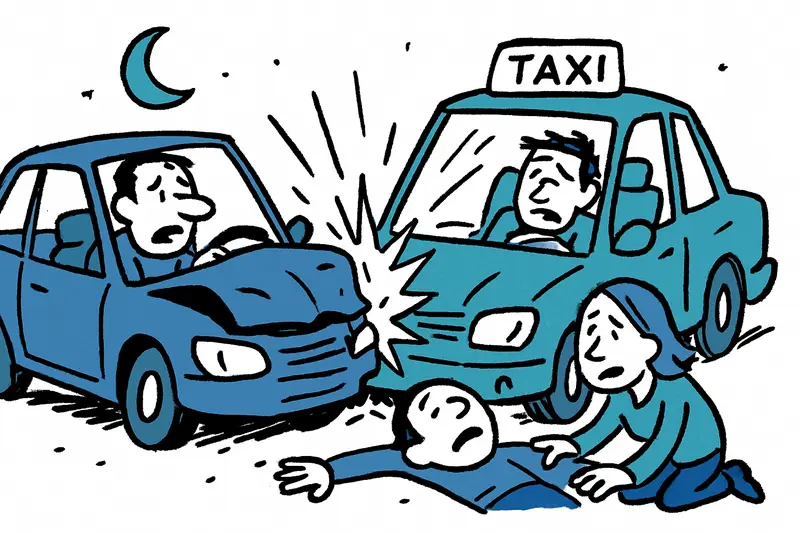
Nighttime Head-on Crash on Camí dels Reis: Three Injured — Who Is Liable, Who Acts?
Nighttime Head-on Crash on Camí dels Reis: Three Injured — Who Is Liable, Who Acts?
Shortly after midnight a car collided head-on with a taxi on the Camí dels Reis. Three people were injured, and the 19-year-old taxi driver was trapped. Why such accidents keep occurring here and which measures we really need.
Nighttime Head-on Crash on Camí dels Reis: Three Injured — Who Is Liable, Who Acts?
Shortly after midnight on one of Palma's main arteries
Shortly after midnight blue lights flashed on the Camí dels Reis. A taxi and a car collided head-on. Three people suffered injuries, some serious. According to emergency crews, the young taxi driver, 19 years old, was alone in the vehicle and had to be freed from the wreckage by the fire brigade. The cause of the accident has not yet been determined.
Key question: Is the core of the problem individual offenders and chance — or road planning, shift schedules and nighttime enforcement?
It is short, blunt and uncomfortable: in many accidents the first phrase heard is “cause of the accident unclear.” That leaves the incident in a gray zone of speculation and fear — as seen in other incidents, for example Head-on crash near Manacor: Two Dead, Questions Remain.
From everyday experience we know: on weekends there are often empty plastic cups lying around, worn road markings barely reflect, and the central median is narrow in many places. If speed is high enough and two vehicles appear from areas with limited visibility in opposite directions, a single moment of inattention is enough.
What is often missing in the current debate is a view of the interaction between people, road and organization. Three levels that are often treated separately but together increase the likelihood of accidents:
1) The road: How good is the lighting really? Where are guardrails or structural separations between opposite lanes missing? Are lane markings reflective enough at night? Parts of the Camí dels Reis are winding, with access roads to commercial and residential areas — a classic place for limited visibility.
2) The people: Young drivers or tired night workers are risk factors. For taxi drivers, long shifts, shift changes in the early morning hours and often dense urban traffic add up. This increases the propensity for mistakes without necessarily placing blame on any single person.
3) The organization: How good is nighttime presence by police and emergency services? Do fire and rescue teams arrive quickly enough at hard-to-see locations? Was the extraction of the trapped driver in this incident carried out promptly? Such details determine the severity of injuries.
Concrete solutions that could be implemented relatively quickly in Mallorca are practical and usually cheaper than grand promises:
• Make accident concentration maps public and prioritize hotspots: When road segments are systematically analyzed, targeted measures can be implemented — for example renewing lane markings or installing additional lighting.
• Mobile nighttime speed checks and targeted traffic controls on weekends: visible presence creates deterrence and also safety for pedestrians and cyclists.
• Better marking of access roads and clear, reflective center markings as well as physical separations where space allows: not a cure-all, but an effective brake on head-on collisions.
• Pay more attention to working and rest times for night professions: taxi drivers and delivery workers need concepts to prevent fatigue — this can be achieved through industry agreements, incentives for shift rotation, or information campaigns.
• Improve emergency training and equipment for first responders and fire brigades: faster rescue can reduce the consequences of injuries. That means not just more personnel, but also targeted exercises on typical wrecks.
What has so far been underrepresented in public debate is the responsibility of road planning. In Mallorca people often talk about behavior — alcohol, phones, speed — but less about how road design can reduce accident risk; this is a point also raised after incidents like Fatal accident in Alcúdia: Who is responsible — and what needs to change?.
A typical scene: At night a shift worker trudges along the quiet Camí dels Reis, a few cars rush by, taxis stop briefly, honk, and move on. Then, a few minutes later, the crunch of broken glass, the voices of helpers, the routine of rescue crews. Such nights shape people here more than statistics do.
In the end there is a concrete step we should demand: more transparency and speed in processing these accidents. Not to find someone to blame, but to learn from each event. Police investigations will determine how the crash occurred, as in the case reported in After head-on crash in Palma: Fleeing and many questions – 31-year-old dies. In parallel, we should work to make similar situations less likely — through better roads, more controls and rethinking practices in industries with night work.
Conclusion: The nighttime accident on the Camí dels Reis not only shows the suffering of those affected but also gaps in planning and organization. The most important question remains: do we accept the causes as unchangeable risks, or do we invest in measures that protect lives? In Mallorca the answer must be: act, before the next night shift brings the same picture.
Frequently asked questions
What should you do after a car accident in Mallorca at night?
Why do head-on crashes happen on Mallorca roads like Camí dels Reis?
Is it more dangerous to drive in Mallorca at night?
Who is usually responsible after a head-on crash in Mallorca?
What makes Camí dels Reis in Palma risky at night?
How can Mallorca reduce serious road accidents at night?
Are taxi drivers in Mallorca at higher risk of accidents during night shifts?
What should Mallorca drivers check before driving after midnight?
Similar News

"Expensive chaos" and many open questions: What clients can do when a lawyer suddenly stops responding
Several clients complain that a well-known German lawyer in Mallorca has been unreachable for months. Key question: What...
TV tip: 'The Last Problem' — Mallorca as the setting of a classic crime
A classic whodunit on Mallorca: A new miniseries set in spring 1959 brings storm, an isolated hotel and a dense web of s...
Nipping Sea Creatures: Why Bathers in Cala Major and Elsewhere Should Be Cautious
In Cala Major, bathers have reported being nipped by small fish. What is behind it, how can problems be avoided — and wh...
Forced eviction in Santa Catalina: When a 65-year-old slept in her car and showered on the beach — a question of responsibility
The story of Pilar López from Santa Catalina represents a problem affecting many Mallorcans: How can an island with a bo...
New traffic rules from October 1: What Mallorca visitors and locals need to know
From October 1, 2026, Spain will implement far-reaching changes to traffic regulations. Important for Mallorca: greater ...
More to explore
Discover more interesting content

Can Cap de Bou

Townhouse Lleo 72
