
Gate Conflict in Ibiza: What Happens When Passengers Try to Rush the Door?
Gate Conflict in Ibiza: What Happens When Passengers Try to Rush the Door?
A 31-year-old Swiss woman was arrested at Ibiza airport after attempting to forcibly board a plane to Barcelona after the gate had closed. A reality check on security, staff workload and practical solutions.
Gate Conflict in Ibiza: What Happens When Passengers Try to Rush the Door?
Key question: How do airports protect staff and passengers without violating travellers' rights?
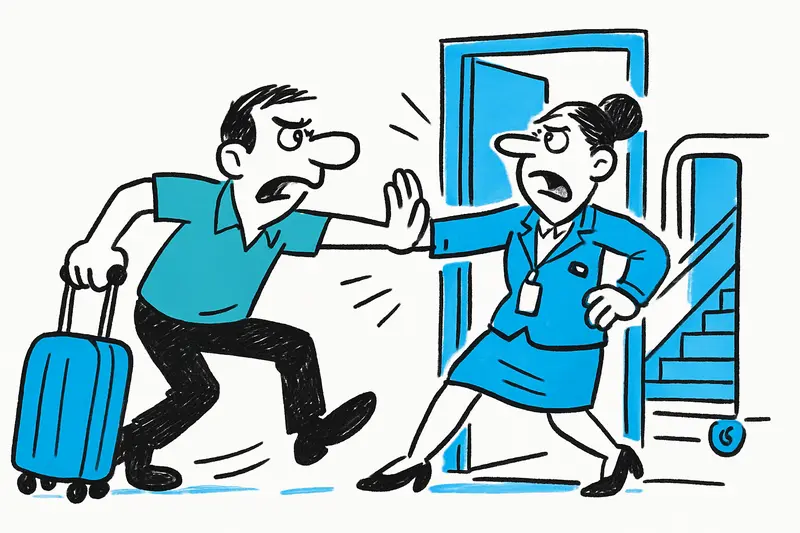
Shortly after the turnaround of a domestic flight to Barcelona, an incident at Ibiza airport got out of control. A 31-year-old woman from Switzerland attempted to board after the aircraft door had been closed. According to local security forces, she allegedly pushed a ground staff member aside and forced her way through the door; the Guardia Civil finally found the woman on the aircraft's ladder where she was trying to gain access. When officers intervened, she refused to leave the area and behaved aggressively towards the responders. The woman was arrested.
At first glance such events may seem like isolated cases: a stressed traveller, a missed flight, an escalation. For the people who work in terminals every day, however, they are part of a larger problem — similar disputes have escalated elsewhere, for example Carry-On Dispute at the Emergency Exit: Why a Loud Row Reveals More Than Bad Manners. When frustration, alcohol or misunderstandings are added, it can take only seconds for a routine boarding to turn into a dangerous situation, as in the case where No boarding to Palma: Ryanair stops intoxicated passenger at Memmingen Airport.
Important to note: there is a legitimate reason why doors are closed after the boarding time. Airlines and staff must adhere to schedules, security checks and connection rules. At the same time many passengers instinctively ask in stressful moments: "Can I still get on?" This expectation often clashes with clear security protocols. The incident in Ibiza shows how quickly this can become a security issue — and how vulnerable ground employees are.
What is often missing from public debate is the perspective of the employees themselves. At check-in or at the gate are people who often handle two or more flights a day, work shifting schedules and face repeated confrontations. There is often a lack of measurable data on how many incidents occur per year in a terminal, how many reports are filed or how many employees receive psychological support. Without these numbers, the discussion remains superficial: assigning blame instead of examining the system; past incidents such as Hidden in the lavatory: the Zurich stowaway and what it means for Mallorca travelers underline the point.
An everyday image: on a windy winter morning in Palma, Passatge de Mallorca, suitcases rattle over the cobblestones, taxi drivers grumble about delayed ferries, and in the cafés on the Plaça visitors sit with their last messages on their phones. The arrival hall in Ibiza feels similarly tense: rolling luggage, announcements, the metallic voice of the loudspeaker. All of this forms the backdrop when a voice gets louder and two people clash — it is not just a news item, but real working people with short breaks and fixed routines.
Concrete solutions that could have a quick effect can be grouped in three areas: prevention, protection and sanctions. Prevention means better, clearer and multilingual information before and during boarding: visible countdown displays, repeated clear announcements and personalized SMS notices for travellers with online check-in. Protection includes physical and organisational measures: more staff at the gate during peak times, protected areas for ground personnel, fixed procedures for handling late passengers (for example coordinated handover to a desk team instead of arguing at the door), and mandatory de-escalation training for all airport employees. Sanctions concern both legal action in the event of physical assault and contractual consequences: in cases of aggressive behaviour, automatic bans from specific airlines or airports for a defined period, combined with mandatory training for repeat offenders.
Technology can help: cameras and audit trails document procedures so that it is clear afterwards what happened. Apps for ground staff could request support quickly in critical situations. It is important to protect personal data and ensure the lawful use of such technologies.
Finally, a public debate is needed beyond outrage: who pays the costs for a missed flight? How are employees compensated if they are physically attacked? What reputational damage does an airline suffer when passengers become aggressive? Transparent rules and sanctions would make expectations more realistic — on both sides of the gate.
Our conclusion: the case in Ibiza is not merely a curiosity but a warning sign. Airports and airlines must design working conditions and procedures so that frustrated travellers cannot become a danger and ground staff are protected. At the same time travellers need clear information and an awareness that the right to transport does not include the right to physically harass staff or other passengers. Only with combined measures — better communication, more protection and clear consequences — can similar incidents be avoided in the future.
Frequently asked questions
What happens if you try to board after the gate has closed at Mallorca or Ibiza airport?
Can airport staff in Mallorca refuse late boarding even if you are already at the aircraft door?
What should you do if you miss a flight from Mallorca or Ibiza?
How safe are airport gates for staff and passengers in Mallorca?
Why do airports in Mallorca use security staff when boarding gets tense?
What kind of passenger behaviour can lead to police intervention at Palma airport?
What can airports in Mallorca do to prevent gate conflicts?
Is it common for passengers to get into trouble at airports in Ibiza and Mallorca?
Similar News
More water than last year: Mallorca's reservoirs breathe easier
September rain refilled the Tramuntana's reserves: overall fill around 35 percent, Cúber at 40.42 percent, Gorg Blau at ...
Three Luxury Hotels in Banyalbufar: Lots of Money, Many Questions
A Danish investor plans three exclusive accommodations in Banyalbufar — including the historic Son Valentí. The announce...
2.1 tonnes of cocaine on sailing yacht off Spain's coast – a reality check for the coastguard
A 14-metre yacht was seized with 2.1 tonnes of cocaine. Who monitors the ports, how does the international hunt succeed ...

Heat Bonus in Mallorca: 100 Euros Extra for Outdoor Staff at MarSenses
MarSenses pays employees who worked outdoors in August an extra €100 as recognition. Lighter uniforms, reduced hours for...
Renovating in Mallorca: What You Really Can Do Without Neighbour Consent
Many think they can do whatever they want in their apartment. That's partly true — but only as long as structural elemen...
More to explore
Discover more interesting content

Can Cap de Bou

Townhouse Lleo 72
