
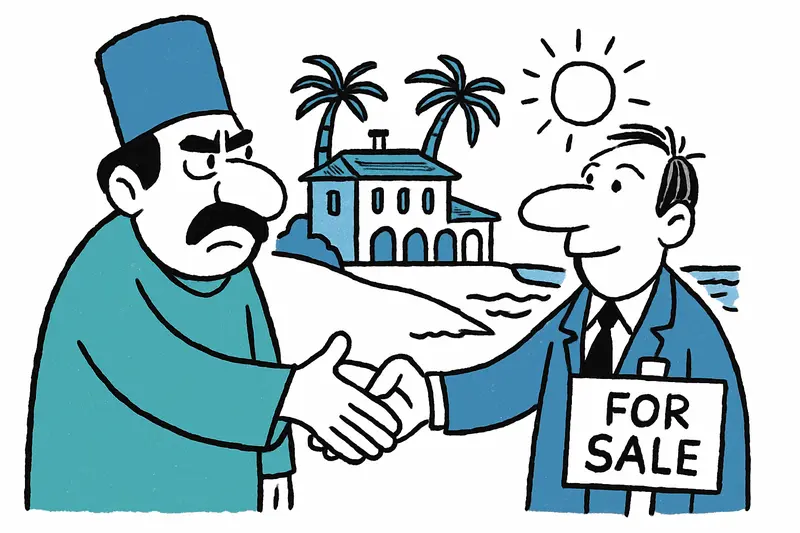
Why now? The Iranian royal family is selling all Mallorca properties
Why now? The Iranian royal family is selling all Mallorca properties
At an unusual moment, the heirs of the former Shah are selling their villas near Cala Rajada and their estate in s'Alqueria Blanca. A reality check: what does this mean for the island and which questions remain open?
Why now? The Iranian royal family is selling all Mallorca properties
A sale package at a sensitive moment – between history, discretion and new risks
The news reads like a signal: the heirs of the last Shah have sold their remaining villas on Mallorca – including a seaside estate near Cala Provençals (Cala Rajada) and a discreet house in s'Alqueria Blanca, Santanyí. The timing coincides with the recent escalation in Iran. That raises the simple but sharp question: why now?
A reality check helps: principles of wealth management, foreign-policy risks and local market mechanics interact. High uncertainty in countries of origin often leads owners to create liquidity or reduce risks. On Mallorca, luxurious properties have historically been in demand; at the same time, the island is no longer an anonymous refuge as it was in the 1970s, as recent notary figures confirm in Almost every second property in the Balearic Islands in foreign hands – what does this mean for Mallorca? Nameless buyers, stricter anti-money-laundering checks and public attention change the calculus.
Political uncertainties alone are not a sufficient explanation. Practical motives also play a role: selling real estate provides cash, reduces administrative burden and minimizes legal risks, for example in the face of sanctions or changed inheritance laws (Real Estate and Inheritances in Mallorca: Act Smart Now Before Rules Change). There is also a cultural component: the family was known for particular discretion – which makes sudden sales all the more noteworthy. Observers get the impression that the combination of geopolitical tension and growing transparency in international markets acted as an accelerant.
What is missing in the public discourse so far is more transparency about buyers, price and transaction handling. On Mallorca it is not only the sale itself that determines local consequences, but who the buyers are: a local investor, a foreign family, an anonymous corporate structure – each option has different impacts on the neighborhood, tax revenue or building development. Also little examined is how local administrations deal with sudden turnover in sensitive locations: are permits reviewed, are coastal protection clauses upheld, do conversions to tourist use arise?
A small everyday scene makes the situation tangible: on a fresh morning in Cala Rajada, when fishing boats slowly chug into the harbor and the first coffee steams on the promenade, the issues are still resident parking, delivery traffic and the noise of some private parties. For people who live here, the sale of a celebrity estate is less politics than a tangible change – a new face in the neighborhood, different cars, more security personnel when notable guests arrive. Such details cut through the abstract debate and remind us that luxury disposals have immediate local consequences.
Concrete proposals for handling such events: first, municipal offices and the land registry should work more closely together to better trace buyers' identities – of course within the framework of applicable data protection and legal provisions. Second, a mandatory disclosure for transactions in sensitive zones such as coastal strips or protected areas is needed to prevent possible misuse. Third, a local fund could be considered into which a contribution flows from sales in highly sought-after locations; this could co-finance infrastructure, parking or nature conservation projects. Fourth, emergency plans for international owners should be offered: clear guides to the sale process, tax obligations and secure money transfers.
A particularity of the history described here deserves a note: already in the 1970s members of the family carried out extensive renovations on a villa in the area – at that time without regular building permits. Such cases remind us how easily long-ago construction work can burden today's legal situation. Authorities should examine legacy cases and factually process any breaches instead of letting them be forgotten.
In conclusion: the sale of the royal estates is not a mere real estate act, but an indicator of changed international conditions that directly affect Mallorca. Those who know the island know: when discreet owners withdraw from the market, it opens opportunities – but also raises new questions that must be answered locally. More transparency, targeted controls and pragmatic local solutions would prevent decisions made behind glass doors from blindsiding the neighborhood.
Frequently asked questions
Why are the Iranian royal family selling their Mallorca properties now?
What happens to luxury villas in Mallorca when foreign owners sell them?
Are property sales in Mallorca becoming more transparent?
What should buyers know before purchasing a property in Mallorca?
What makes Cala Rajada properties especially noteworthy?
Is s'Alqueria Blanca in Santanyí a discreet area for buying a home?
Can old building permit issues still affect a Mallorca villa sale?
What do sudden luxury property sales mean for Mallorca neighborhoods?
Similar News

The Maricarmen Case: Why an Eviction Is Forcing Spain's Housing Debate
Images of an 87-year-old woman on a stretcher have sparked a debate in Spain that also runs deep in Mallorca. Who protec...
Parking dispute in Els Hostalets: When a gap leads to violence
A parking dispute on Calle Aragón escalated into a mass brawl at night. Why do trivial conflicts here turn bloody so qui...

Bodycams in Palma: More clarity needed so surveillance doesn't become the norm
Palma's local police equip UII officers with Axon Body 4 cameras. Useful for evidence collection — but specific rules on...
When the Bread Door Closes: Why Maria de la Salut Lost Its Last Bakery
The only bakery in Maria de la Salut, a sales outlet of Forn de ca'n Joan Terès from Palma, has permanently closed. What...
Ancient Piece Brought to Light: Guardia Civil Recovers Roman Anchor Fragment off North Coast of Mallorca
Divers from the Guardia Civil recovered a massive iron piece from Roman times off Mallorca's north coast. The roughly 35...
More to explore
Discover more interesting content

Can Cap de Bou

Townhouse Lleo 72
