
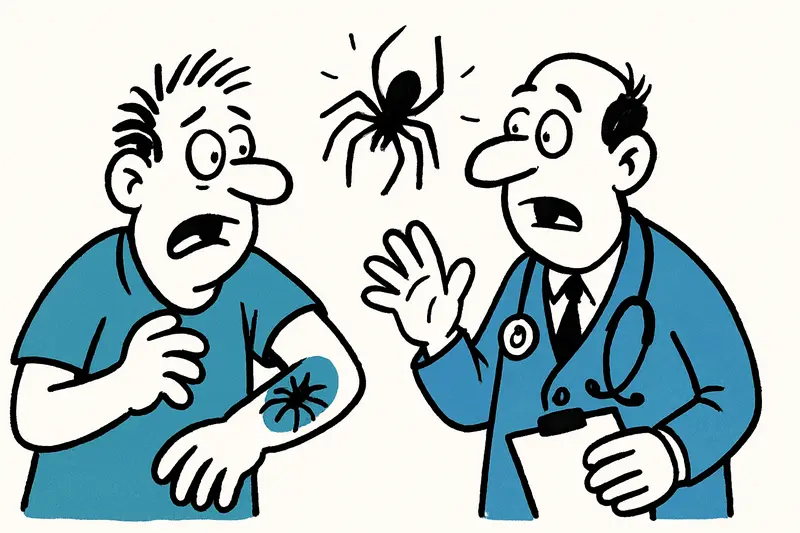
'It ate my skin away' – What a spider bite in Mallorca reveals about our health system
'It ate my skin away' – What a spider bite in Mallorca reveals about our health system
A case from Palma shows: bites from the brown violin spider can lead to severe necrosis. Why are they often treated incorrectly — and what needs to change immediately?
'It ate my skin away' – What a spider bite in Mallorca reveals about our health system
Leading question: Why do many practitioners in Mallorca know too little about the brown violin spider — and what consequences does that have for those affected?
It is a grey morning on the Passeig del Born. A delivery van honks, the café next to the pharmacy smells of freshly brewed coffee, and a nurse hurries across the street to the bus. These small scenes show how quickly everyday life and medical emergencies can merge: a woman from Palma spends ten days in hospital after a spider bite because the wound was initially treated incorrectly. This is not an isolated horror scenario, but the drop that reveals a whole box of open questions.
The spider Loxosceles rufescens – known on Mallorca as the brown violin spider or recluse spider – is common here. At the same time, comprehensive knowledge among parts of the medical staff apparently seems lacking. In the concrete case the patient reported an initially inconspicuous sting on the thigh: over time fever, burning pain and a growing necrosis developed. Only after several misdiagnoses and the incision of the presumed "abscess" did the correct inpatient treatment with intravenous antibiotics and wound care follow. A recent report details an alleged practitioner, Instagram offers and a patient with necrotic tissue in the emergency room.
Critical analysis: biology and practice collide here. The main problem was not only the complicated course of the disease, but the incorrect initial care. Puncturing or squeezing can push infectious bacteria deeper under the skin or reveal preexisting cavities, which worsens the situation. At the same time there is no reliable, publicly accessible statistic on bites of this spider species in the Balearic Islands — operations are performed in the fog. This lack of monitoring contrasts with rising reports of wildlife encounters, such as snake encounters in Mallorca.
What is missing from the public discourse: a clear, locally adapted guideline for initial care; mandatory continuing education for emergency departments and general practitioners; and a reporting procedure so that cases can be recorded and evaluated. Without this data, it remains unclear how often misdiagnoses occur and in which situations surgical interventions become necessary. The connection between entomology and medicine is also patchy: biologists who know the behaviour and distribution of the spider are not systematically involved in the training of medical teams.
Everyday scene from Mallorca: imagine a summer night in an old town flat, the window is open, a radio crackles somewhere, a cat jumps through the hallway — the recluse spider likes dry, sheltered hiding places. It can occur in houses, cars, even in cavities under stones and in toilets. This makes it invisible and increases the likelihood of surprising contacts; bite marks and investigations appear in many settings, from clinics to the shoreline, as shown by a dead shark with pronounced bite marks found on Palma's city beach.
Concrete solutions: first, we need a simple obligation to report or at least a voluntary registry in Balearic clinics to record the extent of so-called loxoscelism. Second, regional guidelines should be developed: clear recommendations summarising first aid, antibiotic dosing in suspected secondary infection and when immediate inpatient admission is necessary. Third: compulsory short training sessions for staff in emergency departments and general practices, carried out in cooperation with specialist biologists. Fourth: an information campaign for the population – leaflets in health centres, notices in pharmacies, short explanatory videos on the health authority's websites; signs to explain the symptoms (more severe pain than from insect stings, pronounced heat of the skin, increasing burning) and what not to do (do not lance or squeeze yourself).
Also pragmatic aids for those affected: take photos of the bite, mark the area, if possible keep the animal or a photo of it, and explicitly tell the doctor that a spider bite is possible. Local biologists could offer quick identifications from photos to give practitioners rapid hints.
Who bears responsibility? It is a systemic failure on several levels: lack of medical awareness, no binding monitoring and too little exchange with zoology experts. This costs health and trust – and in individual cases almost a limb. On the street in front of the hospital you can hear the beeping of an ambulance; that is reminder enough that prevention and networking are not abstract demands but can save lives.
Punchy conclusion: We do not need panic, but urgently need precision. More knowledge in emergency departments, binding reporting routes and simple information offers for the population would catch such cases earlier. Until then: if you have an unusually painful, hot-feeling sting wound, do not hesitate to seek medical help — and please do not tinker with it yourself.
Frequently asked questions
What should I do if I think I’ve been bitten by a spider in Mallorca?
How can I tell if a spider bite in Mallorca is more serious than a normal insect bite?
Is the brown violin spider common in Mallorca?
Where do spider bites from the recluse spider happen most often in Mallorca homes?
Why can spider bites be misdiagnosed in Mallorca?
What should doctors in Mallorca avoid doing with a suspected spider bite?
Why is better reporting of spider bites needed in Mallorca?
Should I take a photo of a spider bite in Mallorca before seeing a doctor?
Similar News

Are the Balearic Islands the Southern Border of Europe? A Reality Check on Immigration
The Balearic Islands are again calling for EU aid after a sharp rise in arrivals by sea. Conflicting priorities between ...

"Expensive chaos" and many open questions: What clients can do when a lawyer suddenly stops responding
Several clients complain that a well-known German lawyer in Mallorca has been unreachable for months. Key question: What...
TV tip: 'The Last Problem' — Mallorca as the setting of a classic crime
A classic whodunit on Mallorca: A new miniseries set in spring 1959 brings storm, an isolated hotel and a dense web of s...
Nipping Sea Creatures: Why Bathers in Cala Major and Elsewhere Should Be Cautious
In Cala Major, bathers have reported being nipped by small fish. What is behind it, how can problems be avoided — and wh...
Forced eviction in Santa Catalina: When a 65-year-old slept in her car and showered on the beach — a question of responsibility
The story of Pilar López from Santa Catalina represents a problem affecting many Mallorcans: How can an island with a bo...
More to explore
Discover more interesting content

Can Cap de Bou

Townhouse Lleo 72
