
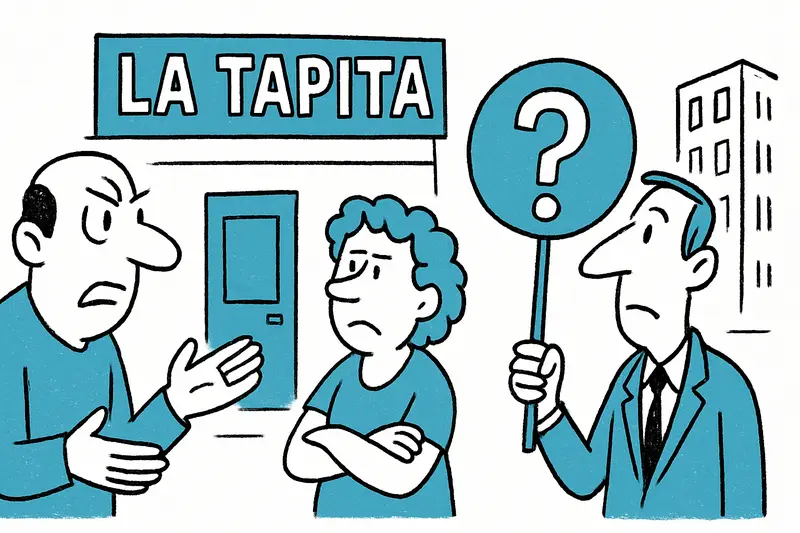
'La Tapita' loses its home: Who will protect Palma's last affordable meeting places?
'La Tapita' loses its home: Who will protect Palma's last affordable meeting places?
The bar 'La Tapita' on Simó-Ballester Street will close at the end of December. For neighbors, police officers and small businesses this is more than the loss of a venue: another step toward displacement.
'La Tapita' loses its home: Who will protect Palma's last affordable meeting places?
Key question: Who decides the future of our neighborhoods — investors or the people who live and work here?
On December 31 a small, noisy corner of Palma will disappear: the bar 'La Tapita' on Simó-Ballester Street opposite the National Police station will close. Change of ownership or a planned demolition — the building that has housed the bar for many years and a number of other small businesses appears to be facing a fundamental change. For the bar owner, Morad Baquir, who has run the place for 19 years, an era of hard work is ending: his days began early and were long, and the everyday headline is almost comically modest — the tortilla here uses 35 eggs and seven kilos of potatoes per batch. On December 18 at 4:00 p.m. there will be a farewell party before the doors close for good.
The loss does not only affect regulars. Next to the bar the photo shop 'Foto Centro' is also affected, a store that has produced passport photos for Palma for almost half a century. The building also houses three floors used by a language school — 'Mallorca Works' now find themselves without rooms. Apartments in the building have already been vacated. Such chains of closures change a neighborhood faster than one might think.
Critical analysis: What is happening here is not an isolated case — similar closures include Can Comas on Aragón Street. Simó-Ballester Street was long a piece of everyday Palma: crafts, small shops, affordable eateries; this pattern mirrors other parts of the Old Town where Palma's affordable local pubs still hold out. In recent years, rising rents and investor interest have dramatically reduced the range of affordable options, as with an iconic pizzeria in Palma's Lonja threatened with closure. The fact that a regular pub opposite the police station is disappearing has a certain symbolic sharpness: when even the people who work around the clock to ensure safety can no longer find an inexpensive place for a coffee or a sandwich, it becomes clear that this is about more than just a single venue — it's about the social infrastructure of a neighborhood.
The debate about how to deal with vacant inner-city spaces is often framed in two directions: economic return versus cultural value. But the perspective of those who use these places every day is frequently missing: neighbors, bus drivers, shopkeepers, pensioners, pupils and yes — also police officers. Public discussion focuses on returns, permits and investors. Rarely are the long-term consequences considered: fewer meeting places, longer walks for an affordable lunch, loss of jobs in small businesses, and less social mix.
What is missing from the public discourse: concrete figures and alternative plans. There is hardly any transparent information about whether the building has been sold, to whom and whether demolition plans have already been approved. Reliable information about tenants' legal options in such cases is also lacking — the uncertainty eats away at the affected businesses. On-site conversations reveal rumors about investors and new development projects, but little solid information from owners or municipal authorities; similar information gaps have been visible in cases like Palma's new kiosks closed again.
An everyday scene from Palma: In the morning Simó-Ballester Street still appears unspectacular — garbage collection, a delivery van unloading fresh bread, and a few officers straightening their dark coats. Around half past seven a group stands in front of 'La Tapita', smokes briefly, orders a coffee, laughs about the shift, about an operation from yesterday. An older man from the house across the street picks up his weekly photos at 'Foto Centro'. Children from the language school climb the stairs, and the smell of fried potatoes is in the air. These scenes form the social texture of a neighborhood — and they are in danger of fading.
Concrete approaches: First, the city administration should demand disclosure: reveal whether a sale has taken place, who the buyer is and what plans have been submitted. Transparency creates the ability to act. Second, protective or priority categories for traditional trades could be examined — not a universal measure, but a tool against short-term displacement. Third: support measures for affected small businesses — mediation for replacement spaces, low-interest transitional solutions or temporary rent subsidies — would cushion the loss of social infrastructure. Fourth: cooperative models — tenants, residents and employees could explore whether joint purchase or interim use is possible. And fifth: a local map of affordable offers, maintained by the municipality or neighborhood initiatives, makes visible what is disappearing and strengthens solidarity.
All this requires political willingness to take risks and the determination not to leave planning solely to the market. It is not only a matter of aesthetics or nostalgia; it is about everyday justice. The calculation for the city is: when meeting places disappear, everyday users pay with longer journeys, higher expenses and a poorer social life — and the attractiveness of a neighborhood for local people declines.
Pointed conclusion: The closure of 'La Tapita' is more than the end of a bar. It is a warning light. If clear rules and practical support do not come soon, we risk losing from Palma a city where life still takes place alongside tourist offerings — replaced by sterile profit-driven buildings. Those who make decisions in the coming weeks decide not only about bricks and costs: they decide whether Palma remains a place where people can get their coffee around the corner.
Frequently asked questions
When is the best time to visit Mallorca for sunny days and fewer crowds?
What is Mallorca's weather like throughout the year?
Do I need a car in Mallorca or can I rely on public transport?
Is the sea warm enough for swimming in Mallorca and when?
What should I pack for a Mallorca trip?
Are Mallorca beaches safe for swimming?
Do I need to speak Spanish to travel around Mallorca, or is English enough?
What are good day trips from Palma de Mallorca for a mix of history and scenery?
Similar News

Million Heist at Bulgari: Who Is Responsible for Palma's Security Gaps?
Three men stole jewelry worth around one million euros – the crime series began at the end of September and was likely c...

Who pays the bill? Tourists, prices and the reality in Mallorca
Rising costs are felt by travelers and locals alike. A walking observation through Palma's old town shows how tourists e...

Phone robbery at Playa de Palma: Two juveniles arrested — a reality check
On Monday morning three young women were attacked at Playa de Palma; two youths snatched a phone from one of them. The N...

It keeps growing: Illegal waste dump on the Ma-15 near Son Gual angers residents and motorists
On the Palma–Manacor expressway, near the former Los Últimos Mohicanos restaurant and the Son Gual development, an illeg...

When the State Pays Late: Why Ryanair Is Now Claiming Interest from Spain
A court in Madrid has ruled that the state must pay interest to Ryanair for delayed reimbursements of the resident disco...
More to explore
Discover more interesting content

Can Cap de Bou

Townhouse Lleo 72
