
When the Needle Falls Silent: Palma Loses La Veneciana — and More Than Just Thread
When the Needle Falls Silent: Palma Loses La Veneciana — and More Than Just Thread
The haberdashery La Veneciana on Carrer Ample de la Mercè is up for sale. Why a shop with customers and history is nevertheless headed for a handover — and what Palma would need to do so that such stores remain more than memories.
When the Needle Falls Silent: Palma Loses La Veneciana — and More Than Just Thread
Leading question: How could an almost century-old shop with more than 100 customers a day end up in the handover drawer?
Sometimes a look down Carrer Ample de la Mercè, very close to the Mercat de l’Olivar, says it all: vans rumble by, market women call out prices, in the morning the air smells of fresh bread and coffee. Between them are the display windows of La Veneciana — needles, buttons, ribbons, those small things that help hold a city together in small ways. But now there are signs in the windows: clearance sale, handover. This echoes recent headlines such as End of an Era in Palma's Streets: Mercería Àngela Closes After 340 Years. The owner, Pere Arbona, says more than a hundred customers come in daily. Still, the family’s third generation faces the question of whether to continue the business or hand it over to a successor.
On paper everything seems to be running, but reality is more complicated. The retailers' association of the Balearics observes that local shops do not benefit from tourism to the same extent as other sectors. Customers increasingly spend their money on experiences; operating costs are rising; classic seasonal highs like Easter, according to the association, now only bring turnover at previous-year levels with falling profitability. If a shop whose roots can be traced back to after the 1929 market crash finds itself in this situation, it is not an isolated case — it is a warning sign, as detailed in When Rent Eats More Than Profit: Palma's Small Shops on the Brink.
The critical analysis reveals several layers: first, consumption habits are changing. Textile and handicraft supplies can be conveniently ordered online, plus there are discount providers and an almost endless selection on the internet. Second, rising rents, energy costs and bureaucracy are squeezing small shops; in Palma many retail premises in tourist areas have become particularly expensive. Third, there is often a lack of targeted support to help small retailers occupy their niche both digitally and locally — with an online presence, click-&collect or shared delivery structures.
What is often missing in the public discourse is the cultural function of such businesses. A haberdashery is not an attraction in the classical tourism sense, but it conveys everyday knowledge: who sews, repairs and saves; who sews a button back on, extends the life of a garment. This know-how disappears quietly when the shops close. There is also no honest accounting of vacancy costs for owners who demand high rents even though the retail space remains unused for months.
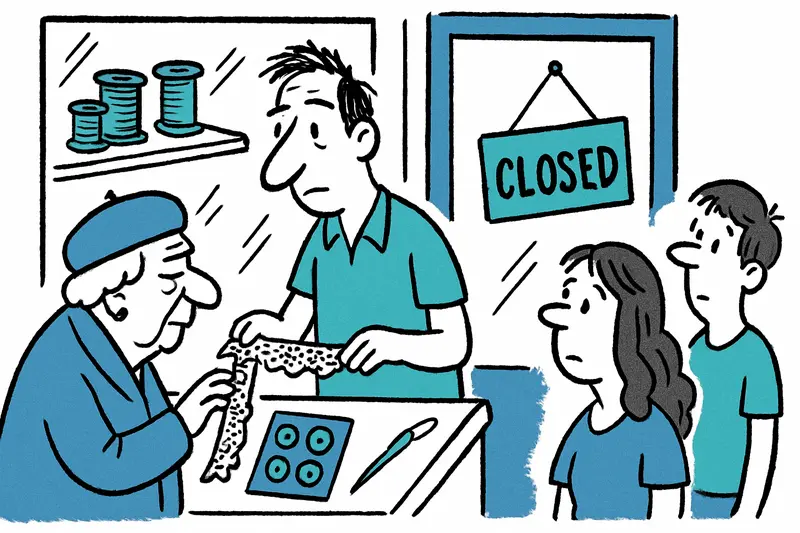
A scene: in the morning, when the market pulses, an older woman stands in front of La Veneciana and Pere Arbona shows her the latest delivery of lace ribbons. Young people from a sewing class peer into the shop with curiosity. The conversations sound ordinary — "don't you need a spare button?" — and yet they stand on thin ice when the sign "handover" hangs in the window.
Concrete solutions are not rocket science, but decisions are needed at several levels. The city administration could consider vacancy charges for permanently unused storefronts and at the same time offer temporary rent subsidies when successor generations or social entrepreneurs move in. A city-wide support program for the digitization of small businesses — with shared online platforms, simple booking software for workshops and training in customer retention — would give many shops breathing space. Cooperation between market operators (Mercat de l’Olivar) and adjacent retailers could launch joint initiatives: repair Sundays, upcycling workshops, local handicraft markets that show tourists everyday life instead of souvenir kitsch. Other recent closures underline this urgency, for instance When the Margherita Moves Out: Iconic Pizzeria in Palma's Lonja Faces Closure.
Property owners are also called upon: long-term, indexed lease agreements instead of short-term rent explosions create planning security. Tax incentives for renovating historic shopfronts and grants for energy efficiency measures reduce operating costs. And consumers — yes, us who live here — can help with small habit changes: buy locally, choose repair over disposal, attend sewing classes and thereby keep demand visible.
This is not a romantic "things were better before" narrative. It is about urban economic diversity. If Palma allows only large retail chains and experience offers to shape the center, the city will lose its dense social nodes. La Veneciana is a test case: a shop with regular customers and history stands on the threshold of a handover despite having visitors. Neighbourhood closures like End of a Neighborhood Era: Can Comas on Aragón Street Closes After 29 Years illustrate the stakes and demand more determined action from the city, owners and customers.
Conclusion: When the needle falls silent, it is not merely the loss of a shop but a bit less everyday life in Palma. Those who do not see this will be walking through a neatly polished, soulless city center in ten years. Those who want to act should start with rental conditions, cooperation and visible support. La Veneciana may find a new owner — whether the city gains from it remains an open question.
Frequently asked questions
Why are so many small shops in Palma struggling to survive?
What kind of shop is La Veneciana in Palma?
Where is La Veneciana located in Palma?
Why do local shops in Palma not benefit from tourism as much as restaurants or hotels?
Can you still buy sewing supplies in Palma if small shops keep closing?
What can Palma shoppers do to help keep traditional shops open?
What is the Mercat de l’Olivar area like in Palma?
Why are closures like La Veneciana seen as a warning sign for Palma?
Similar News

Nipping Sea Creatures: Why Bathers in Cala Major and Elsewhere Should Be Cautious
In Cala Major, bathers have reported being nipped by small fish. What is behind it, how can problems be avoided — and wh...
Forced eviction in Santa Catalina: When a 65-year-old slept in her car and showered on the beach — a question of responsibility
The story of Pilar López from Santa Catalina represents a problem affecting many Mallorcans: How can an island with a bo...
New traffic rules from October 1: What Mallorca visitors and locals need to know
From October 1, 2026, Spain will implement far-reaching changes to traffic regulations. Important for Mallorca: greater ...

More water than last year: Mallorca's reservoirs breathe easier
September rain refilled the Tramuntana's reserves: overall fill around 35 percent, Cúber at 40.42 percent, Gorg Blau at ...
Three Luxury Hotels in Banyalbufar: Lots of Money, Many Questions
A Danish investor plans three exclusive accommodations in Banyalbufar — including the historic Son Valentí. The announce...
More to explore
Discover more interesting content

Can Cap de Bou

Townhouse Lleo 72
