
Almond Harvest 2025: Between Concern and Opportunity for Mallorca's Landscape
The 2025 almond harvest yielded around 1.3 million kilograms — about ten percent less than in 2024. In the orchards around Campos, relief mixes with concern. What is needed now to make almond farming more resilient.
Almond Harvest 2025 Concluded: Relief with Questions in Tow
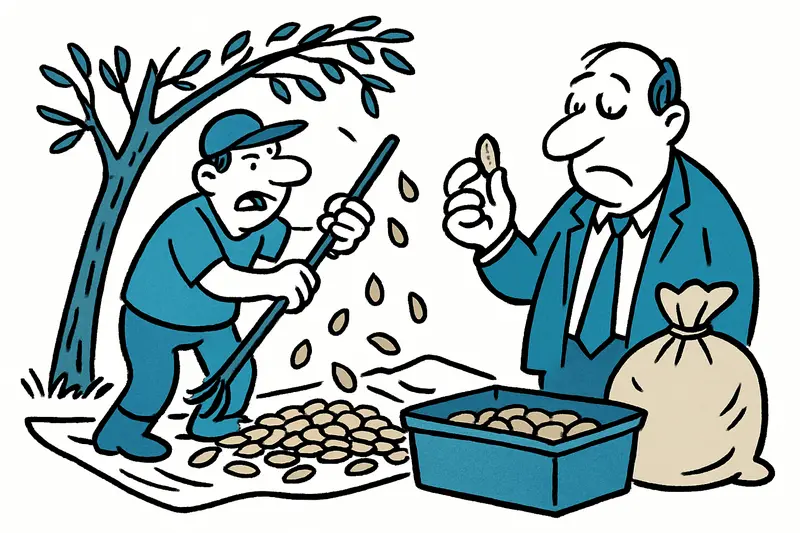
On one of the last autumn mornings you could still hear the rattling of tractors; the access roads around Campos were full of sacks and nets. Under the trees family members knocked the last fruits out of the nets, then calm settled again over the orchards. The tally: around 1.3 million kilograms of almonds — nearly ten percent less than the previous year. A local report, Almond Harvest 2025: Between Yield Declines and New Opportunities, details the harvest and its implications. Relief that the harvest is in. And at the same time that uneasy feeling when you hear the rustling leaves and already start adding up the numbers in your head.
Key Question: How Do We Make Almond Farming on Mallorca More Resilient?
That is the question being discussed in the bars of Campos and in the cafés of Palma. It is not just the raw figures. The causes are everywhere: irregular spring rainfall, a short heat spike during flowering, later rain that delayed the pods. Some trees simply bore fewer fruits this year. Climatic fluctuations have long since become the norm — but the weather does not explain everything.
More Than Just Weather: Aging Farms and Lack of Processing
Public discussion often centers on climate and prices. Two other problems, however, remain in the background: the aging of farm management and the lack of processing and marketing structures on the island. Many farms are small, inherited, and run by older owners. Young people are more likely to move to Palma or into the hospitality industry. At the same time the nut usually leaves the island raw. Roasting, packaging, brand building — the value-adding steps often take place on the mainland; FAO on agro-industries and value addition outlines approaches to develop local processing.
Water Is More Than Pipes: Rights, Storage, Priorities
Water management sounds banal, but it is not; see FAO guidance on water management in agriculture. It is not just about drilling and pipes, but about ownership rights, regional storage and local coordination. Who gets the water in dry summers? Who bears the costs for infrastructure? These questions determine cultivation decisions and livelihoods — and are rarely negotiated at the market tables.
Rising Prices — What Does That Mean for Restaurants and Guests?
Less supply drives prices up. Traders report significantly higher purchase prices, and direct marketers signal the same. The local cooperative therefore calls for increased procurement by hotels and restaurants. Direct sales to the hospitality industry would stabilize incomes and shorten supply chains. But that requires reliable quantities, quality standards and fair, long-term contracts. For guests, this concretely means: almond dishes and snacks could become more expensive. Unpleasant for the wallet, but positive for the island: every euro spent on local products is more likely to stay in Mallorca and secure jobs as well as the cultural landscape.
Concrete Steps That Make Sense Now
There are pragmatic measures that could show quick effects. Support for micro-roasteries and packaging businesses would benefit the island; shared storage and drying capacities — for example in regions like Campos — could reduce losses. Grants for drip irrigation and rainwater storage are as important as a simple origin label that is visible in hotels and on markets. Cooperations between cooperatives and hotel chains, with long-term purchase agreements, would dampen price volatility.
In addition, advisory programs for young farmers, financial incentives for climate-resistant varieties and an expansion of crop insurance against weather extremes are needed, and EU risk management tools for farmers can support such measures. EU rural development funding for agriculture and regional funds are available; what matters is that they are used in a targeted, fast and low-bureaucracy manner.
Between Tradition and Value Creation: Seizing Opportunities
It is not an either-or. Many Mallorcans have already begun to cultivate mixed crops, use ground cover and exchange seed. Smaller initiatives show how trees can be cultivated to better withstand dry periods. In the market it is noticeable: hand-roasted, natural almonds are finding more buyers. This is an opportunity for higher value creation directly on site — and for a Mallorca that sells not just postcard images but real products.
When you drive past an orchard in the morning, you don't just hear the rustling leaves but also the quiet mental arithmetic of the farmers: was the work worth it this year? The answer should not depend solely on the weather. If politics, the hospitality industry and producers come together now, this year's smaller harvest can become an opportunity — for more stable incomes, stronger regional products and a more resilient cultural landscape. A small tip at the end: on your next market visit, ask for the origin stamp. It helps more than you think — and usually tastes better.
Frequently asked questions
Why was Mallorca’s almond harvest smaller in 2025?
What does the 2025 almond harvest mean for prices in Mallorca?
When is the almond harvest in Mallorca usually finished?
Are almonds from Mallorca becoming more expensive in shops and restaurants?
Why is almond farming in Mallorca struggling beyond the weather?
How is water management affecting almond growers in Mallorca?
What can hotels and restaurants in Mallorca do to support local almonds?
Where in Mallorca are almond growers talking about these problems most openly?
Similar News
Cala Rajada: Why the "Sharky's" Keeps Closing — a Reality Check
The "Sharky's" at Cala Agulla is vacant again. High takeover price, expensive rent and a damaged reputation: What is rea...

Palma at the Limit: Four Cruise Ships, Full Parking Garages — Where to Put the City?
Over the long weekend Palma burst at the seams in several places: four cruise ships in the port, kilometer-long queues a...
MotorWorld Inn near Palma: Food, Ambience and Why It's Worth a Visit
A restaurant that blends car passion and food: we tried MotorWorld Inn near Palma. Atmosphere, dishes and a few tips for...
Handover by the Water: Why 'Sharky’s' in Cala Rajada Is Up for Sale Again
A sports bar at Cala Agulla, opened in 2024, closed shortly after, briefly revived in 2026 — now the venue is up for tak...

Sant Salvador: The Christ That Becomes a Touchstone for Memory Politics
A statue, 33 applicants and a ministry under review: Why the crowned Christ on the mesa near Felanitx has suddenly becom...
More to explore
Discover more interesting content

Can Cap de Bou

Townhouse Lleo 72
