
Full‑force collision with car: Two bikers injured on MA-3100 — what's missing and how we can prevent such accidents
Full‑force collision with car: Two bikers injured on MA-3100 — what's missing and how we can prevent such accidents
On the MA-3100 at Camí Vell de Pina two motorcyclists crashed head-on into an Opel: one seriously injured, both taken to Son Espases. Why do such accidents keep happening on Mallorca's secondary roads — and what must change immediately?
Full‑force collision with car: Two bikers injured on MA-3100 — what's missing and how we can prevent such accidents
Evening hour, tight bend, two motorcycles destroyed — one rider seriously injured, rescue teams racing against time
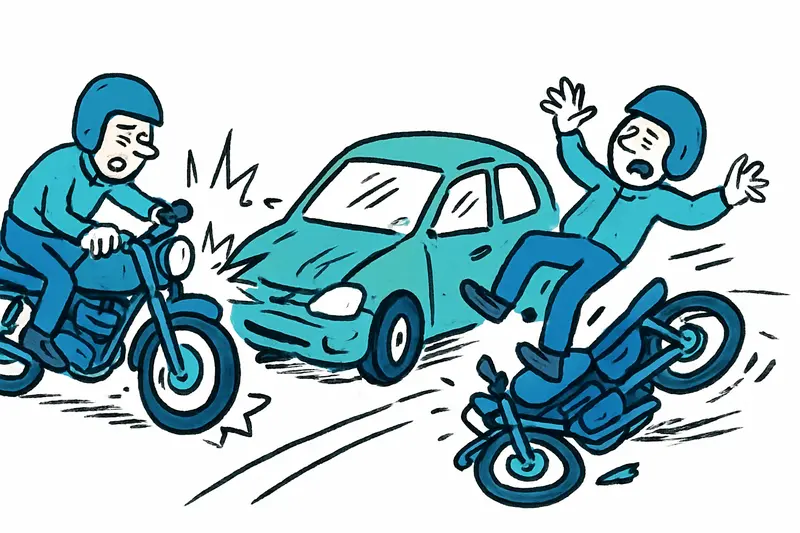
On Saturday at around 18:30 a severe collision occurred on the MA-3100 between Algaida and Santa Eugènia, near Camí Vell de Pina: two men on large‑capacity motorcycles collided head‑on with an Opel Astra Caravan traveling toward Algaida. Both bikers were injured, one seriously. The victims were taken by several SAMU‑061 ambulances to Son Espases hospital and admitted for inpatient care. The car driver was uninjured.
The location: a narrow, winding country road, harvested fields on both sides, the day's heat still hanging in the air — thermometers showed 34 °C that afternoon. The sound of cicadas mixed with squealing tires; after the impact there was a smell of petrol in the air. Debris and vehicle parts blocked the roadway; civil protection volunteers, the Algaida police and the Guardia Civil cordoned off the road until road workers from the island council brigade cleared the remains of the motorcycles and the car. A tow truck removed the wrecks, and the traffic police are now investigating the cause of this severe accident.
Key question: Why do group rides on Mallorca's secondary roads repeatedly end in serious collisions — and what is being done about the dangerous hotspots?
The facts are clear, and so are the patterns: summer heat, tight curves, stretches without continuous center lines and groups of motorcyclists riding at speed. These elements alone do not condemn anyone, but they do create increased risk. That around ten motorcycles were riding together that evening is not a trivial detail: in a group riding behavior changes, overtaking maneuvers become riskier, and attention focused on the rider ahead can reduce anticipation. This pattern has been documented previously in Why Are So Many Motorcyclists Dying on Mallorca? A Reality Check after the Llucmajor Accident.
What is often left out of the public discussion is that infrastructure and traffic enforcement on many island routes are not set up for a high frequency of motorcycles. Narrow carriageways, missing pull‑outs, poor curve markings and unclear access points — these are real problems. Added to this are staffing gaps for targeted police patrols at busy times and a lack of locally adapted prevention work for group rides. Several recent incidents, including Three serious accidents in one night: What's wrong with Mallorca's country roads?, show the same infrastructure weaknesses.
A scene from everyday life: on a hot Saturday afternoon you often see groups of bikers at the petrol station in Algaida studying maps, drinking coffee, discussing the best route to the coast. You hear laughter, feel the anticipation. This is exactly where prevention must start — not only at the accident site afterwards. Locals know the dangerous curves, but visitors often underestimate them. And the low, bright evening sun causes glare; that changes sight lines and reaction times.
Concrete measures that can be implemented immediately:
- More targeted traffic controls on weekends on routes with high motorcycle frequency, especially in the evenings and in good weather.
- Improve visibility of critical curves: reflective posts, additional lane markings and clearer signage, plus short‑term mobile warning signs at motorcycle meeting points.
- Create small escape bays and sections with reduced speed limits in particularly accident‑prone curves; where structural measures are possible, consider rumble strips and pavement improvements.
- Information campaign for group rides: local motorcycle shops, tourism actors and municipalities could jointly distribute simple rules of conduct (spacing, group division, riding speed, communication signals), supplemented by voluntary safety trainings.
- Faster clearance and rescue protocols: clear access routes for emergency services and defined assembly points; regular drills with volunteer helpers from island communities can relieve the first minutes after a crash.
These proposals are not a cure‑all; they are pragmatic and based on what is possible locally. Some measures cost little but require political attention and coordination — for example between the island council, affected municipalities and the Guardia Civil. Other serious head‑on crashes, such as the one on the MA-1 in Paguera, underline the need for coordinated action and targeted prevention Serious Head-On Crash in Paguera: Why Does the MA-1 Remain So Dangerous?.
What is missing from the public debate is a balance between assigning blame and prevention. It is of little use to focus solely on blame after every serious accident. We need an honest debate about road conditions, how groups ride and how rescue procedures function. Equally necessary is the voice of everyday people — the baker on the main street, the bus driver, the cyclist — who see daily where it becomes dangerous.
Conclusion: This accident is a painful reminder: two destroyed motorcycles, one severely injured person, families worried. Mallorca has too many narrow, winding roads that become risky under routine riding and group mobility. With more visible prevention, better infrastructure and targeted education for group rides we could see these scenes less often. Short term: fewer accusations, more measures at the spots we already know — the MA‑3100 is one such place.
I was not at the scene that evening, but the descriptions and the photo of the wreckage speak a clear language. Let us hope the traffic police's investigation quickly clarifies how the head‑on collision could have occurred — and that the island learns from it before someone else risks their life on Mallorca's narrow roads, as in the Fatal accident near Capdepera: motorcycle collides with microcar on MA-4040.
Frequently asked questions
When is the best time to visit Mallorca for good weather and outdoor activities?
What should I pack for a Mallorca trip across seasons?
Can I swim in Mallorca year-round?
What are the top beaches in Mallorca for families?
How can I get around Mallorca without a car?
Is driving in Palma or other towns easy for visitors?
Is Serra de Tramuntana good for hiking, and what should I know?
What are some family-friendly activities to do in Mallorca?
Similar News
Released with Conditions: The Plus Ultra Suspicion and a Mallorcan Finca as Residence
A Dutch entrepreneur, sought in connection with the Plus Ultra case, was extradited to Spain after his arrest in Germany...

Haute Nuit in Puerto Portals: Fashion, Art and Indulgence by the Water
On October 2 the Lobster Club in Puerto Portals will be transformed into a stage for curated fashion, art and culinary e...

Magaluf: Watchtower Alarm – Lifeguards Pull Unconscious Beachgoer from the Water
After a drama in the late afternoon, two lifeguards at Magaluf beach rescued an unconscious 44-year-old man. He was stab...

Turquoise in the City: How dangerous is the color play of the Sa Riera?
The Sa Riera in Palma suddenly turned turquoise — a pretty motif, but behind the effect lies a discharge of saline waste...

Jeckliner at Sunnesching: Cologne spirit sets sail from Palma
In September 2027 the Mein Schiff 2 briefly becomes a floating carnival stage: four days with Cologne bands, comedy and ...
More to explore
Discover more interesting content

Can Cap de Bou

Townhouse Lleo 72
