
Palma already hangs the lights in July – why the early Christmas village raises questions
Palma already hangs the lights in July – why the early Christmas village raises questions
In Palma, workers are hanging strings of lights in the tree canopies in the July heat, while a Christmas lottery commercial is being filmed in Santa Catalina and a historic nativity scene was unveiled after a €400,000 restoration. Why does the city start so early — and what remains under discussion?
Palma already hangs the lights in July – why the early Christmas village raises questions
The key question
Why does Palma begin installing the Christmas lighting in the middle of high summer, when most people are thinking of the beach and ice cream — and what are the consequences of this approach for labor, energy consumption and the city's appearance?
Brief description of the situation
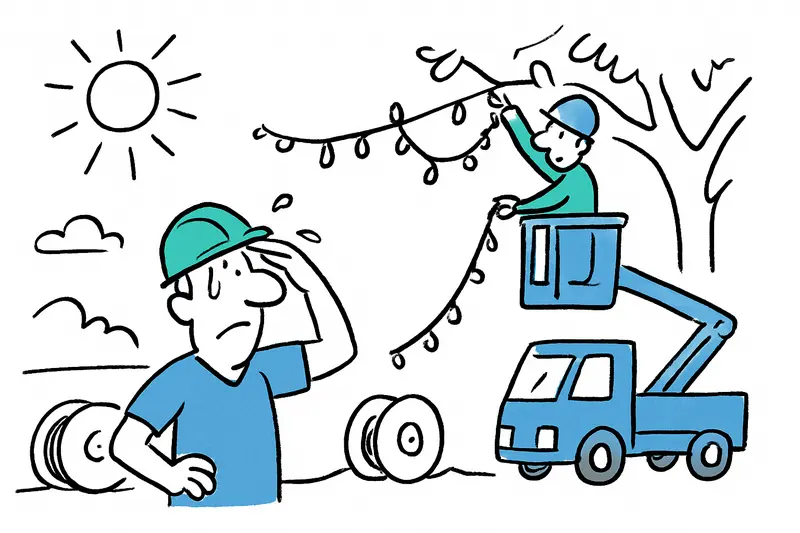
In the narrow streets of the old town you can currently see workers on lift platforms, cable drums and strings of lights among the tree canopies. At the Mercat de Santa Catalina, spot footage for the national Christmas lottery was produced in June. And at the Church of the Annunciation on Plaça de l'Hospital, the elaborately restored 15th-century nativity scene was presented to the public on July 1 — a cultural asset for which more than €400,000 was spent.
Critical analysis
The official explanation: the illumination must be completed in time because the light festival is to begin on Black Friday, November 27. That sounds pragmatic but has two sides. First, people are working at temperatures above thirty degrees, often with strong sunlight and reflected heat between the walls. Second, it creates the impression that the city is turning into a year-round Christmas set — at least visually already in July. Visible installation phases that stretch over months change the city's appearance for longer than necessary.
What is missing from the public discourse
There is little discussion of the climatic and labor-law aspects. How are the teams protected against heat? Is there a mandatory maximum temperature for working at heights? The energy question is also largely absent: which types of lamps are used, what is the expected consumption and how does that fit with the island's climate strategy? Finally: why were last season's lights only taken down in March — what explains such long storage or delayed dismantling?
An everyday scene from Palma
Anyone walking past the Passeig des Born these days hears the deep drone of the lift platforms, the clinking of carabiners and the occasional calls of the fitters. A café owner on the Rambla says his tables are emptier earlier in the evening because tourists prefer to sit by the sea. A market vendor at the Mercat de Santa Catalina smiles wearily: the camera crews are disruptive but also help her because more people stop and take photos.
Concrete solution approaches
- Schedule installation windows in cooler months: autumn nights are significantly safer for work at height. - Mandatory use of energy-saving LED systems and transparent disclosure of expected additional costs or savings. - Heat protocol for workers: shorter shifts, timely breaks, water stations, medical checks during heatwaves. - Public communication: publish municipal schedules and project plans, including duration of installation and storage times. - Extend the usable life of decorations: more modular systems that are easier to swap and repair, instead of installing entirely new setups every year.
Pointed conclusion
It is legitimate for Palma to be well prepared for the festive season. But preparation must not become a permanent presence that overlooks energy issues and people working in the heat. If the city plans more transparently and pays attention to pragmatic protective measures, the anticipation of Christmas can be combined with responsibility — without the entire old town looking like an advent calendar already in July.
Frequently asked questions
Why are Palma's Christmas lights installed in July?
What safety concerns arise for workers installing Palma's lights in July?
How is energy usage addressed for Palma's early Christmas lights?
Why does the installation appear to stretch over months in Palma?
What public discussions are missing about Palma's Christmas lighting?
What practical steps could Palma take to improve the Christmas lighting project?
What cultural assets are involved in Palma's Christmas preparations?
How should Palma balance festive prep with energy concerns and worker safety?
Similar News
Failed before the first flight: How Fischer Air's plans for Palma were ground down
Announced routes, repeated postponements and now apparent insolvency: Why the Fischer Air project for Mallorca is not me...

Seconds in the Water: 19-year-old Fights Her Way Out of Flooded Car in Palma
A 19-year-old managed to rescue herself from her half-submerged car after sliding under the Verge de Lluc underpass. Res...

Between Dream and Reality: Thorsten Legat and the Challenges of FC Germania Mallorca
The former Bundesliga pro has assembled a colorful squad in a short time. But how realistic is the grand plan for promot...

Arrest warrant at check-in: Why two travelers at Cologne/Bonn Airport suddenly had to pay
At Cologne/Bonn Airport, federal police in mid-September found two German passengers subject to enforcement measures. Bo...
Balearic Islands as a New Route: A Reality Check on Rising Boat Migration
For the first time the Balearic Islands are ahead of the Canary Islands in boat arrivals. What do the numbers really say...
More to explore
Discover more interesting content

Can Cap de Bou

Townhouse Lleo 72
