
Why Mallorca Tops Evictions — and What It Means for Everyday Life
Why Mallorca Tops Evictions — and What It Means for Everyday Life
The Balearic Islands lead Spain's eviction statistics: 14.2 cases per 100,000 inhabitants in the third quarter. Behind the numbers are overburdened courts, vulnerable tenants and gaps in the data. A look at causes, missing debates and practical steps on the ground.
Why Mallorca Tops Evictions — and What It Means for Everyday Life
14.2 evictions per 100,000 inhabitants in the third quarter – the figures and the gaps
The newly published figures from the General Council of the Judiciary (CGPJ) show: between July and September, 210 evictions were actually carried out in the Balearic Islands. That corresponds to 14.2 court-enforced residential evictions per 100,000 inhabitants — more than in any other autonomous region of Spain, a trend discussed in Living in Crisis: Why Tenants Are Now Paying the Price on the Balearic Islands. A total of 679 eviction orders had been issued, but less than a third of these were enforced.
This gap — many orders, few executions — explains part of the problem. Courts are overloaded, while the law protects vulnerable groups: single parents, people in need of care and similar cases cannot be left homeless without protection. That makes constitutional sense, but it complicates the statistics.
At the same time, foreclosures on mortgages follow their own rhythm: only 26 new foreclosure procedures based on mortgages were initiated (down 16 percent), while banks increased their lawsuits to enforce such loans by 6.4 percent. In addition, there were nine evictions for other reasons, such as unlawful occupations — and the Balearics were also at the top in civil procedures against squatters. The available figures do not capture all cases: bank and corporate procedures as well as criminal measures are missing from the overview.
Other areas of concern: payment-order proceedings fell by around 70 percent — a possible effect of a law that mandates a conciliation procedure. And the number of personal insolvencies rose significantly: 471 people sought access to the debt-relief mechanism in the third quarter, an increase of 77 percent. Corporate insolvencies remained relatively low (22 firms, up 15.8 percent).
Key question: Why are the numbers rising even though many eviction orders are not enforced? The simple answer: the crisis is playing out on many levels at once. There are legal protection mechanisms, a stalled enforcement apparatus and economic pressures that affect tenants and owners alike.
Critical analysis: On the supply side, there is a lack of affordable housing. Short-term rentals, speculative vacancy and a construction practice that often focuses on high-yield projects narrow the market for permanent housing, a pressure explored in Airbnb Puts the Balearic Islands Under Pressure: Deleting Illegal Listings — What It Means for Mallorca. On the demand side are people with precarious jobs, seasonal workers or households with debts whose incomes no longer cover rising living costs, an issue set out in Rent-price shock 2026: How Mallorca is heading toward a social crisis. The judiciary, in turn, has processes that take months to years, and the implementation of evictions often fails due to organizational and social hurdles.
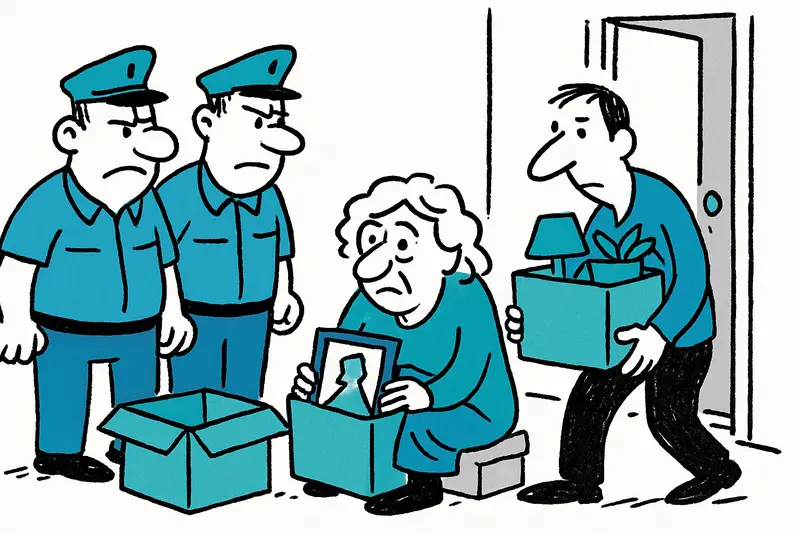
What is often missing in public debate: the perspective of the affected neighborhood. One example: on a grey morning in front of an apartment block near Passeig Mallorca, emergency vehicles are parked. The scent of coffee from a bar mixes with the smell of cleaning products. Neighbors stand wrapped in blankets, boxes of secondhand goods are carried out of the building one by one. An elderly woman sits on a stair and holds a box with family photos. The police talk to the social worker, who is trying to find short-term accommodation. Such scenes show that evictions are never just about property, but about people, networks and everyday infrastructure.
What has been lacking so far: complete, transparent data (including bank and corporate procedures), binding regional strategies for using vacant spaces, and quickly available emergency housing. With these, authorities, tenant protection groups and courts could plan better from the outset.
Concrete solutions for Mallorca:
1) Strengthen data transparency: Uniform recording of all enforcement procedures (courts, banks, companies, criminal cases) and monthly publication of the figures.
2) Pool judicial capacity: Special housing and household chambers or accelerated procedural windows in which social services and the judiciary work together to find solutions before an eviction.
3) Immediate help for those affected: Municipal emergency shelters, transition assistance and an obligation for social services to accompany every enforcement.
4) Vacancy management: Municipal purchase programs or interim-use models for vacant apartments, combined with temporary rent subsidies.
5) Regulate short-term rentals: Stricter controls and incentives to provide long-term housing instead of holiday apartments.
6) Preventive debt counseling: Expansion of free legal and debt advice, rapid mediation instead of immediate lawsuits.
A pointed conclusion: the figures are not a random product of a harsh season — they reflect structural mismatches. Those who argue only about enforcement numbers miss the real task: securing housing and protecting people from social collapse. In Mallorca, between tourist buses and local transport problems, this often plays out in inconspicuous everyday scenes. If administration, judiciary and politics do not cooperate more closely, the gap between court orders and lived neighborhood reality will remain wide — and that is costly for society.
Frequently asked questions
Why are evictions so high in Mallorca compared with other parts of Spain?
What do eviction figures in Mallorca actually measure?
Can tenants in Mallorca be protected from eviction if they are vulnerable?
Why are more people in Mallorca seeking debt relief?
Is Mallorca still affected by mortgage foreclosures?
What happens during an eviction in Mallorca?
How does the shortage of affordable housing affect life in Mallorca?
What solutions are being discussed for Mallorca’s housing crisis?
Similar News

Mistaken identity with fatal consequences: Brutal assault in S'Aranjassa — what's missing in the follow-up?
At S'Aranjassa a visitor to a finca was tied up, beaten and thrown out of a van. Three men have been arrested, including...
High heel slips, car accelerates: accident on Camí de Son Hugo
A woman lost a high-heeled shoe on the forecourt of the sports facility at Camí de Son Hugo. The car accelerated, mounte...

Phone Scam: How Two Hotel Employees at Playa de Palma Lost Thousands of Euros
One morning in September, two reception employees at Playa de Palma were pressured by alleged alarm-company staff — in t...
When the Wallet Becomes a Danger: Attack in Peguera and Lessons for Mallorca
In Peguera, two women are said to have stolen the wallet from a 75-year-old German couple. When the victim intervened, t...
Plata stays Plata: Young people take over, Llonguets remain
A small bar on Carrer de l'Argenteria will continue: Tolo Serra hands the place over to young Mallorcans at the end of t...
More to explore
Discover more interesting content

Can Cap de Bou

Townhouse Lleo 72
