
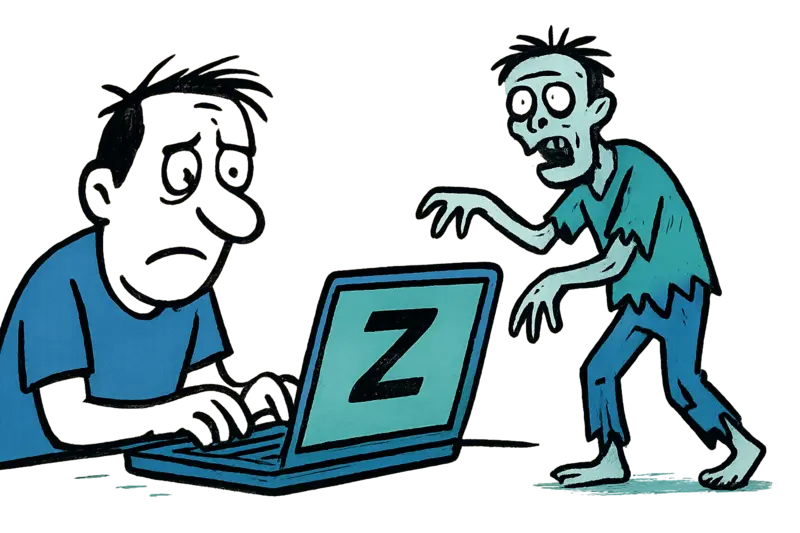
When Palma Becomes a Zombie Zone: 'Mallorca Z', AI and the Thought Experiment with Side Effects
When Palma Becomes a Zombie Zone: 'Mallorca Z', AI and the Thought Experiment with Side Effects
A Mallorcan lawyer built a strategy game over a weekend using AI that treats the island as the scene of a zombie crisis. A thought experiment — and a warning sign for politics, tourism and civil society.
When Palma Becomes a Zombie Zone: 'Mallorca Z', AI and the Thought Experiment with Side Effects
Key question: What does an AI game assembled in a few hours say about our ideas of crises, responsibility and tourism in Mallorca?
On the Passeig del Born you hear delivery vans honking in the morning, on the Plaça Major older women chat about the weather, and in summer ferries and cruise ships crowd the harbor. A local lawyer chose exactly this picture as the game board: in his game Palma is turned within hours into a zone where decisions about evacuation, hotel requisitions and the prioritization of tourists or locals determine life and death.
The story is quickly told and even more quickly cobbled together — thanks to today's AI tools, such as the AI-powered tool to promote more sustainable travel, that can generate graphics, text and logic in a short time.
On the one hand this is fascinating: what used to take weeks or months can now be presented as a complete scenario over a weekend. On the other hand, it is a wake-up call. A game that simulates realpolitik mixes legal questions with ethics, public communication and the tourism economy — areas where a false impression can quickly create real fears.
My critical analysis: the project deliberately provokes. Provocations on the streets, like recent provocative poster campaigns in Mallorca, further complicate public reaction. It reveals how thin the dividing line is between a fictional experiment and the possible normalization of extreme scenarios. It mentions measures such as contact apps, a state of emergency and hotel requisitions — all real instruments that in practice involve high legal hurdles and social costs. In a game these instruments appear as switches; in reality they are complex processes with court proceedings, political negotiations and human suffering.
What is often missing from public debate is a sober discussion about how AI tools are used and what responsibility developers bear when they choose local identities as settings. The regional government's plans for a digital twin of the Balearic Islands make these questions more urgent, since municipal data and representations could be reused in simulations without context. Similarly, debates about AI cameras planned for Plaza de España and Parc de Ses Estacions show how technology in public spaces raises trust issues.
An everyday scene from Palma: one late afternoon a mother stands on the Paseo Marítimo, her child with sand on their knees, the harbor lights blinking ahead. She hears on the radio about a cyber simulation in which hoteliers are forcibly conscripted. She forces a smile but thinks of her neighbor who sleeps in a small hotel room all year and depends on the season. Such everyday images make abstract controversies concrete.
Concrete solutions I consider sensible:
1) Transparency requirement for AI projects with local references: Developers should disclose whether real maps, locations or municipal data were used and what measures were taken to avoid stigmatization.
2) Labelling requirement: Clearly visible notices in games that address real places so that users immediately recognize the fictional character and local authorities are not unnecessarily alarmed.
3) Involvement of local stakeholders: When real communities are depicted, involving representatives (municipalities, hotel associations, emergency services) would be a responsible practice — not to censor, but to provide context.
4) Educational offerings: Workshops in schools and cultural centers about media literacy and the limits of simulations — so that young people can distinguish game mechanics from real legal situations.
5) Platform and age rules: App stores and game platforms should apply stricter evaluations and age ratings for games with potential for real local harm.
On a small scale the island administration can also act: train public crisis communication, test scenarios — but not as a mere thought experiment, rather with clear legal frameworks so that the population is not later surprised by fictional assumptions.
What remains open and often unspoken: who takes responsibility if such a game stirs up fears or spreads misinformation? Technologies are tools. They change how stories are told, but they do not replace the responsibility of developers, operators and platforms.
Concise conclusion: It is welcome that creativity and technology open new spaces — but on an island whose everyday life depends on tourism and small communities, the line between provocation and responsibility should be narrow. A game may provoke; it must not, however, trivialize the reality of people's lives.
Frequently asked questions
How could AI-generated crisis simulations influence Mallorca's tourism planning?
What safeguards help prevent misinterpretation when AI games use real places in Mallorca?
Why is involving Mallorca communities important when depicting them in AI games?
What is the risk of portraying crisis measures as simple switches in AI simulations set on Mallorca?
What concerns arise when Palma's Paseo del Born is used in an AI crisis scenario?
Why is Plaça Major in Palma often featured in AI crisis thought experiments, and what should be considered?
How should small towns like Santanyí be treated when depicted in Mallorca AI simulations?
What should guide the depiction of Portocolom in Mallorca AI crisis scenarios?
Similar News
Learning to Wait: How Leisure Is Making Space Again on Mallorca
Waiting doesn't have to be lost time. A mild October day in Palma shows how small pauses slow down our lives — and what ...
Cala en Brut: Body in the Sea — a Fatal Autumn Day and What’s Missing
In Cala en Brut (Ciutadella) a man's body was recovered during storm Dana "Adam". Why do autumn storms in the Balearics ...
When the road is gone: Port de Valldemossa cut off after storm 'Adam'
After heavy rains a retaining wall gave way and two sections of mountain road MA-1131 became impassable. Why are rural p...
Crypto Promises, Ferry, Arrest: How Investors in Mallorca and the Neighboring Islands Fall into the Trap
A Swiss man wanted under a German arrest warrant was captured in Ciutadella. The case raises questions about cross-borde...
Santa Catalina loses a piece of everyday life: Why Xoriguer must now close — and what it means for Palma
The Xoriguer on Calle Fábrica, a venue with Basque roots and almost half a century of tables and stories, stands empty b...
More to explore
Discover more interesting content

Can Cap de Bou

Townhouse Lleo 72
