
When Mallorca Goes to Nairobi: SFM Technicians Train Kenyan Railways
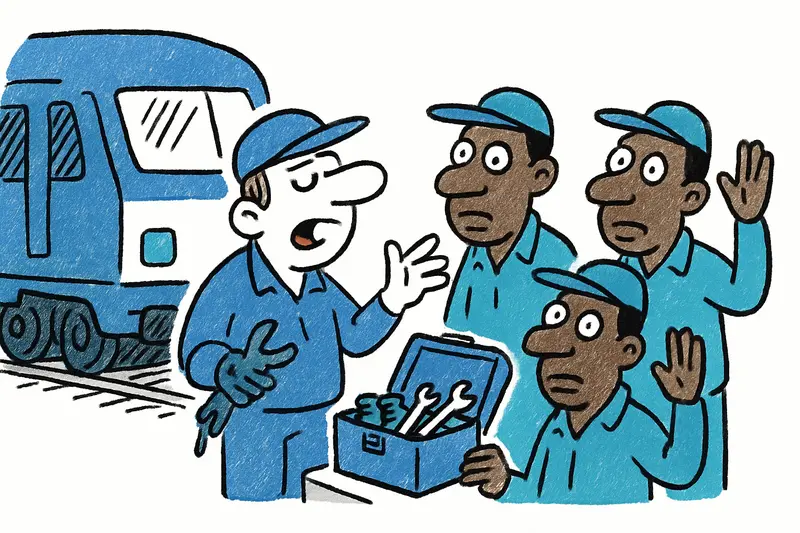
Three SFM technicians traveled to Nairobi in August to train Kenyan colleagues on integrating eleven used trains. What began as a single delivery has become a lasting partnership — hands-on, quiet and full of wrenches.
When Mallorca Goes to Nairobi: SFM Technicians Train Kenyan Railways
Early in the morning at Son Sant Joan Airport, before the terminal cafés had really opened, three technicians stood at the gate with grease-stained gloves and a suitcase full of spare parts. Not a trip into the Serra, but work: in August a small team from the Mallorcan rail company SFM flew to Nairobi to assist on site with the integration of eleven trains that had been sold to Kenya in 2020.
From sale to neighborhood help: how it came about
The vehicles had already begun a second life when they changed hands in 2020 for around €9.6 million. On Mallorca, people know these trains from everyday life — the squeal when shunting, the sound of doors at the terminus, the markings on the workshop floor. In Nairobi, however, the climate is different, the routes are different, and the workshop routine is different. The Kenyan Railways Corporation (KRC) reported a need: support in maintenance, electronics and the special techniques you only learn through experience. The response from Mallorca was pragmatic: ten days of intensive training.
What was really learned — not lectures, but getting your hands dirty
About forty KRC employees worked in simple halls with SFM’s workshop manager, an experienced chief driver instructor and a specialized mechanic. Amid rattling generators and the smell of diesel, brakes were checked, control electronics measured, and daily visual inspections explained. It was not about general knowledge, but about the small everyday procedures: how to quickly assess a brake cylinder seal, which fault messages are reliable and which only sound an alarm because a sensor is miscalibrated.
Important to the Mallorcans was not only repair instruction one to ten, but the Kenyans’ ability to develop training modules themselves. A suitcase with documents, checklists and a commitment to further technical consulting should make the local team more independent — so that the next generation of mechanics does not have to wait for foreign help every time, an issue also discussed in More Staff for Mallorca's Trains: Is That Really Enough?.
More than a technology transfer: relationships, funding, outlook
The trip is not a one-off event. As early as 2024 the Kenyans requested help to modernize their workshops — financed in part from a Spanish fund for trade and development. At the end of September another SFM team is scheduled to return to Nairobi to train the next group of KRC employees. What started as a single delivery has thus become a lasting connection between two railway worlds.
On Mallorca, where the tram rushes punctually past Passeig in the morning and fishing boats gurgle quietly in the harbor, hardly anyone thinks of Nairobi’s workshop halls; local debates about service hours and schedules are explored in Night trains from 2027? Mallorca's late homecomings under scrutiny. Yet the same basic rules apply: a lubricated bolt, a clean contact, a reliable checkpoint so that a train stands safely at night. Not a big spectacle, but solid work — oil changes, checklists and the simple wish that people arrive safely and on time.
A small touch of Mallorca in Nairobi — and why that's a good thing
The images are everyday: a Mallorcan tool in a Kenyan hand, a handwritten maintenance plan next to a tablet with diagnostic software. Not a postcard of palms, but a piece of everyday life that reaches beyond the island’s borders. This type of cooperation brings more than technology: it builds trust, fosters local responsibility and creates knowledge that remains even when the SFM technicians are back on the plane.
What remains? An example of how locally gathered know-how can travel far. For Mallorca it is a small pride — not boastful, more like the quiet hiss of a pneumatic tool in a workshop — and for Nairobi a stronger basis to operate its own tracks reliably. That the next suitcases are already being packed for September is in the end no surprise: good craftsmanship likes to travel further.
Frequently asked questions
Why did SFM technicians from Mallorca travel to Nairobi?
What kind of training did the Mallorcan rail team give in Nairobi?
How much did the trains from Mallorca sell for?
Why do trains from Mallorca need special training in Kenya?
How long did the SFM training in Nairobi last?
Will SFM return to Nairobi after the first training visit?
What does this rail cooperation mean for Mallorca?
What was the main goal of the Mallorca-to-Nairobi rail project?
Similar News

From the Ruhr Area to the Tramuntana: Thorsten Legat and the FC Germania Mallorca Adventure
The former pro has not only taken the coaching role on Mallorca but also moved into a small island shared house, set amb...
Silent Conquest: What Mallorca's Wildlife Can Do Against Introduced Snakes
For years non-native snakes have been appearing on Mallorca. Who monitors the import routes, how effectively do authorit...
Stolen motorcycles in vacant factory: Guardia Civil finds 19 vehicles
In Inca, investigators discovered 19 motorcycles stolen between April and June. In an abandoned factory near Selva, many...
Storm in Majorca: 75 Responses, Uprooted Trees and Beached Boats – Who Will Draw the Lessons?
A sudden thunderstorm swept over the islands on Thursday evening, leaving uprooted trees, damaged boats and disrupted su...
Daily new boats: Mallorca and the Balearic Islands under pressure from rising arrivals from Algeria
For months, arrivals of boat migrants from Algeria have remained at a high level. Places are lacking, unaccompanied mino...
More to explore
Discover more interesting content

Boat Tour with BBQ along Es Trenc Beach

Private transfer from Mallorca Airport (PMI) to Pollensa
