
Real-time for Mallorca's Water — a Step, But Is It Enough?
Real-time for Mallorca's Water — a Step, But Is It Enough?
The Balearic government is spending €2.7 million on a digital real-time water map. What the technology can do — and which issues in managing Mallorca's water remain unresolved.
Real-time for Mallorca's Water — a Step, But Is It Enough?
Key question: Can a €2.7 million project of sensors and smart meter technology really fix the central weakness in Mallorca's water management?
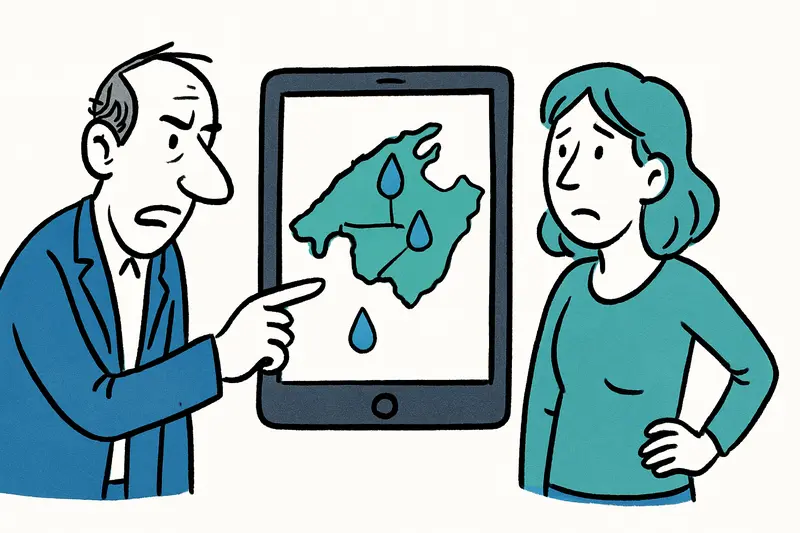
The Balearic government is investing €2.7 million in a digital mapping system that should deliver real-time data via measuring probes in reservoirs and smart water meters, as described in Mallorca Becomes a Water-Weather Station: Can Probes Really Tame the Drought? and in Mallorca se convierte en estación hídrica: ¿Pueden las sondas frenar la sequía?.
That sounds sensible. And on the coastal road toward Gorg Blau, when the wind moves over the cypresses in the early morning and anglers prepare their nets, the logic is easy to hear: real-time data creates room for decisions. But data are not automatically control. This is exactly where the debate gets stuck.
Critical analysis: Technology solves measurement problems, but not automatically the political and practical ones. First: who manages the data, and how open is it? A monitoring dashboard is of little use if authorities do not translate the information quickly into concrete measures — for example restrictions, allocation adjustments, or financial incentives for saving. Second: measuring probes and smart meters are vulnerable — to miscalibration, poor network coverage in mountainous areas, and vandalism. Who will bear the long-term maintenance and replacement costs? Third: the project addresses reservoir data well, yet the balance between surface water supply (reservoirs) and groundwater (wells, legal and illegal withdrawals) remains complex. More accurate measurement of withdrawals is a first step; control and enforcement are another.
What is missing in the public debate: a) the question of access and transparency: citizens, municipalities and agricultural cooperatives should be able to view the data. b) a clear roadmap for integrating smart meters on private land — especially for small irrigation wells. c) a plan for infrastructure upkeep: sensors are expensive to purchase, but even more costly when they fail and spare parts are not funded. d) security issues: connected systems need protection against manipulation.
Everyday picture: on the way to Llucmajor you regularly encounter vans delivering water barrels and farmers talking at the field edges. For them, "real-time" does not only mean a display on a screen, but tight hours in which irrigation must be planned or cut back. Without clear information and fair rules, mistrust arises: who has priority, who will be checked, who pays for the technology?
Concrete solutions that go beyond sensors: firstly, an open data portal with hourly and daily values and clear interpretation aids for municipalities and farmers. Secondly, a stepped subsidy program for retrofitting small wells with smart meters — combined with advice on water-saving irrigation. Thirdly, regional maintenance contracts and decentralized spare-parts depots so failed sensors do not remain offline for months. Fourthly, mandatory checks and audit procedures by independent bodies to uncover manipulation or measurement errors. Fifthly, expansion of the communications infrastructure (LoRaWAN, mobile network transmitters at critical sites) and clear cybersecurity rules for the new systems.
Another important puzzle piece is involving island society: water councils at municipal or comarca level can set local priorities and act as mediators when reserves are scarce. Technical data must be linked with social rules — who receives water for drinking in droughts, who for vital agriculture, and where compensation mechanisms might be conceivable?
Conclusion: the digital real-time water map is a useful tool and a necessary step toward modernization. However, without clear rules on transparency, responsibilities, maintenance and the social allocation of resources, the project remains only a half victory. In Mallorca, where water repeatedly becomes a market-day topic, two things are needed at once: good measurement data and institutions that turn them into fair decisions. The €2.7 million is seed capital — and now comes the harder part: turning bits and gauge readings into real everyday security for people and fields.
Frequently asked questions
Is Mallorca investing in real-time water monitoring?
Will smart water meters solve Mallorca’s drought problem?
What are the main problems with real-time water data in Mallorca?
How could Mallorca use water data more fairly during droughts?
Can sensors in Mallorca’s reservoirs and wells be trusted?
What should farmers in Mallorca know about the new water monitoring system?
Why is access to water data important in Mallorca?
What needs to happen after Mallorca installs the new water technology?
Similar News

The End of the Cheap Ride? Why Mallorca Is Hit Harder by the Fuel-Price Shock
Gasoline and diesel average close to two euros per liter. What this means for commuters, supply chains and renters in Ma...
Relaxed liquid rules in Munich: What Mallorca travelers will notice
At Munich Airport the 100-milliliter rule will be lifted at all checkpoint lanes — thanks to new CT scanners passengers ...

For 45 Years on Mallorca — and Then This: How a Market Visit in Santa Ponsa Became a Lesson
A woman who has lived on the island for decades lost money and important documents at the Mercat Setmanal in Santa Ponsa...
10 percent surcharge on the beach: How legal and transparent is the extra charge at Playa de Muro?
A German part-time resident noticed days after a restaurant visit in Playa de Muro that the bill included a flat ten per...

Body near the Llevant Market: What this death says about our city
A man was found dead on Sunday afternoon near the Llevant Market. Police say the death appears natural. The scene raises...
More to explore
Discover more interesting content

Can Cap de Bou

Townhouse Lleo 72
