
Mobile Phones, Boarding, Civil Guard: When Filming at the Airport Leads to Removal
Mobile Phones, Boarding, Civil Guard: When Filming at the Airport Leads to Removal
Two digital nomads filmed a dispute over excess baggage in Madrid and were then barred from the flight by Ryanair. Who is allowed to film at the airport — and who decides how much say passengers have?
Mobile Phones, Boarding, Civil Guard: When Filming at the Airport Leads to Removal
Key question: How much trust must a passenger place in ground staff and an airline when they are only documenting events with their phone?
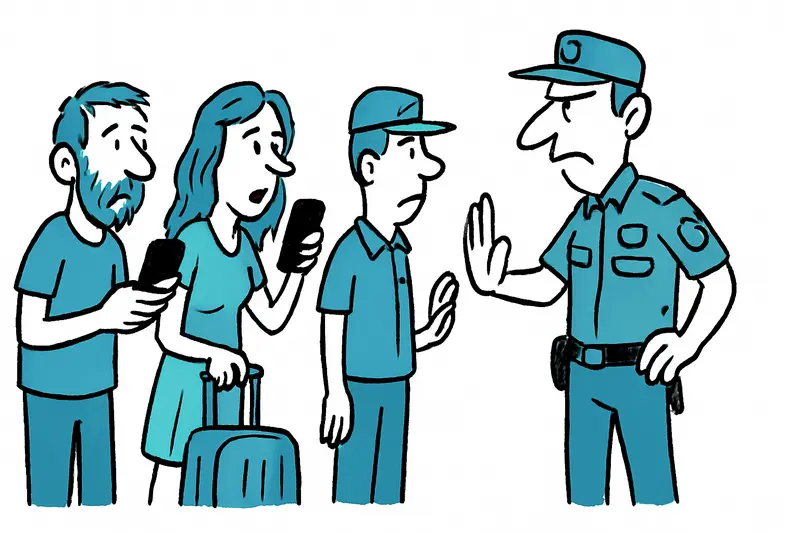
In July the boarding of a Ryanair flight from Madrid to Catania ended abruptly for two travellers: the two, known as influencers and digital nomads, had recorded with their phones a confrontation at the gate between another passenger and members of the ground staff while also filming themselves commenting. According to them, an employee then prohibited them from boarding; later the Civil Guard escorted the two off the plane — at the airline's request.
That is the sober chronology as presented by those affected: security checks and boarding had already taken place, the recordings were made at the gate and on the jet bridge. The affected parties later demanded that footage from CCTV at the gate and on the bridge be secured. They filed complaints with Ryanair and the airport operator. Such disputes have parallels in the reporting of Flash shoot at Palma Airport: When the terminal briefly becomes a film set — and who should pay.
On Mallorca I heard similar accounts this week at the bus stop in front of Son Sant Joan airport: suitcases that appear oversized at the front, a stressed employee, a loud remark, and in the end travellers arguing for a long time about their right to film. Check-in halls are in summer a place of many small conflicts; the Ryanair Hand Luggage Checks: Between Efficiency and Frustration at Palma Airport is a recurring flashpoint.
Critical analysis: legal situation meets everyday practice. Legally: filming is allowed in public areas of an airport if no restricted security zone is affected. That security checkpoints have their own rules is well known. What matters, however, is how staff and airlines act in concrete situations. Ground staff and cabin crew have, under current law, the authority to exclude passengers from a flight if their behaviour is judged disruptive, aggressive or endangering. What is missing is a transparent standard procedure that documents which behaviours justify removal and how quickly a decision must be recorded.
In the present case it is one person's word against another's: the affected parties say staff tried to take their phones away; the airline did not comment. Such cases threaten to become PR battles if no independent clarification takes place. And here lies an open point in the public debate: only rarely are airports or airlines systematically required to investigate incidents neutrally and promptly and to provide removed persons with a written explanation.
What is often missing from reports: the perspective of ground staff. Long shifts, high passenger volumes, summer heatwaves and language barriers make the job at check-in tough. This exhaustion affects perception and decisions — and it has an immediate impact on travellers who feel they were treated unfairly. A typical scene in Mallorca, as reflected in Carry-On Dispute at the Emergency Exit: Why a Loud Row Reveals More Than Bad Manners, is: it is 9:00 a.m., sea breeze blows into the hall before check-in, taxi drivers shout prices — and the controllers are already at their limit. That is no excuse for misconduct, but a context that is often absent from debates.
Concrete solutions: First, there should be a binding, written rule stating when an airline may exclude someone without issuing a written justification — and when it must immediately provide a written notice. Second: CCTV footage relevant to an incident should be temporarily secured on request and made accessible to an independent body. Third: airports and airlines should provide mandatory de-escalation and documentation training for their ground staff; simple digital forms could provide a quick, verifiable justification. Fourth: travellers should be more clearly informed about their rights at boarding — a small information sheet at the gate would already help.
What the public often misses: the decision not to transport someone is rarely purely legal; it is situational, human, and sometimes caused by stress. Without clear transparency, what remains is an unpleasant aftertaste: regulations against experience, video against memory.
Conclusion: Filming at the airport is not per se prohibited, but practice shows that the right to document and the power structures at the gate can collide. For Mallorca this means concretely: in a high tourist season, when the hectic pace increases, we need clearer rules and more transparent processes. Otherwise, after incidents like this, those affected and other travellers are left with the feeling that referees decided without visible rules.
In the end there is a simple demand: more clarity, more documentation, a little less arbitrariness. That would make everyday life at airports more bearable — for passengers and for the people working behind the counter.
Frequently asked questions
Is filming allowed at Mallorca airports?
What should I do if I’m told to stop filming or I’m not allowed to board at a Mallorca airport?
Do travellers have rights to CCTV footage after an incident at Mallorca airport?
How are conflicts at Son Sant Joan airport typically handled?
What information should gate staff provide about rights at boarding in Mallorca?
What training could Mallorca airports implement to prevent incidents like these?
Why is transparency important in airport incident handling on Mallorca?
How can Mallorca airports improve clarity during busy tourist seasons about filming and removal rules?
Similar News

Towel on It, Chair Gone? How Hotels Can Regulate Reservations of Sun Loungers
After a deadly dispute in Greece, the question has resurfaced in Mallorca: Are hotels allowed to ban or sanction the pra...
Illetas: Police Officer and Two Lifeguards Rescue Two Female Tourists from the Sea
Late on Friday afternoon emergency responders entered the water off the coast of Illetas: a local police officer and two...
Inca: Severely injured female dog found in garbage bags in a container – who has seen anything?
In Inca, a severely injured female dog was discovered wrapped in two garbage bags inside a container on Avenida Rei Jaum...

Pre-Nit de l’Art in Palma: Champagne, Spray Can and Studio Flash in the Old Town
Red carpets, a photographers' stand and live performance: the Pre‑Nit de l’Art filled Galerie Mensing with around 400 gu...
Failed before the first flight: How Fischer Air's plans for Palma were ground down
Announced routes, repeated postponements and now apparent insolvency: Why the Fischer Air project for Mallorca is not me...
More to explore
Discover more interesting content

Can Cap de Bou

Townhouse Lleo 72
