
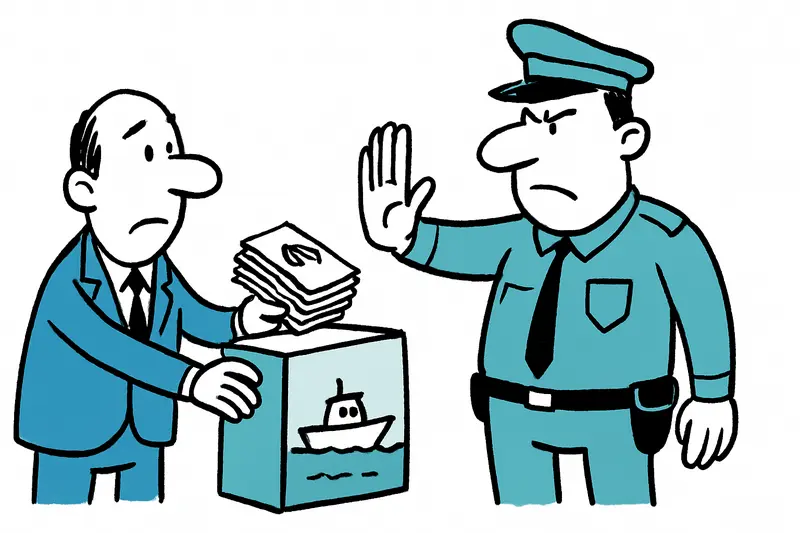
How a Shell Company Used Mallorca as a Money-Laundering Facade – a Reality Check on 'Operation Náutica'
The National Police dismantled an international money-laundering network that allegedly funneled more than nine million euros through a fake boat rental on Mallorca. What lies behind it, how could it work, and what is missing from the public debate?
How a Shell Company Used Mallorca as a Money-Laundering Facade – a Reality Check on 'Operation Náutica'
Key question
How could a gang apparently funnel more than nine million euros through a network of shell companies and fake online shops – and why was Mallorca part of the cover?
Summary of the facts
Investigators from the National Police in Palma carried out the so-called 'Operation Náutica' after two years of work, Major Raid in Palma: What the Investigations Mean for the Island. Nine people were arrested in Catalonia; raids in Sitges and Barcelona seized luxury goods worth around two million euros, as reported in Raid on Mallorca: Network of Drug Trafficking and Money Laundering Shakes Palma and Surroundings. According to authorities, the network allegedly laundered more than nine million euros. The investigation began with information from the German public prosecutor's office. The gang reportedly used an alleged boat rental based in Mallorca which in reality was a mailbox company with no boats, staff or business premises. The registered director was a homeless man. In addition, investigators identified 16 companies involved, 54 people, 26 fake websites and over 3,500 defrauded German customers; seized items included sports cars, jet skis, gold bars, 18 luxury watches, jewelry, POS terminals and more than 100 bank cards, details echoed in Drugs, Millions and Suspected Abuse of Office: What the Major Operation in Mallorca Reveals. In addition to money laundering, suspected offenses include membership of a criminal organization and document forgery.
Critical analysis
On paper it sounds like a classic pattern: mailbox company, front men, layered accounts, siphoning into crypto. But the details show why such constructions can work for so long. Mallorca is not an end in itself for fraudsters – it offers an economic environment that makes certain concealment attempts appear more natural. Tourist bookings, short payments by holidaymakers and many small service providers create transaction patterns that initially attract less suspicion from authorities. It is also notable that specialized advisers and service providers apparently helped establish the legal and economic facades. Such professional support is not marginal; it is often the backbone of modern money laundering.
What is missing from the public debate
Debates usually focus on spectacular seizures – cars, watches, gold. Less visible is how the everyday logistics of deception work: registered companies without real operators, cards and POS terminals that redirect consumer and business payments, and the constant use of front men. The role of small local service providers, who can unintentionally act as intermediaries, is rarely examined. And: the warning chains between law enforcement in Germany, Belgium and Spain deserve more attention – they exist but are not always fast enough.
A commonplace scene from Palma
On a hot morning on Passeig Mallorca, espresso cups clink, delivery scooters make their rounds, and a tour bus spits out new passengers. Between the sunshades the word 'boat rental' appears harmless: flyers handed out at the port, a kiosk selling tickets. It was precisely this ordinary scene that apparently provided cover. Such scenes show: shell companies are easier to hide here because the noise of tourism swallows many small clues.
Concrete solutions
1) Better registry checks: commercial registries must verify beneficial owners and backers more quickly. Simple plausibility checks – proving genuine business premises, active operational phone numbers, staff lists – would reveal shell companies early. 2) Financial institutions and payment service providers: banks should aggregate and report unusual patterns involving many small tourist payments with unusual outflows. 3) Strengthen cooperation: collaboration with the German public prosecutor's office, Belgium and Europol helped – these networks need more resources and standardized procedures for cross-border tips. 4) Local awareness: common offerings such as boat rentals or ticket sales should be easier for authorities to check; inspections in tourist centers could also include administrative spot checks. 5) Prosecution of professional facilitators: legal and corporate advisers who knowingly set up structures should be targeted more intensively.
Practical first steps for tourists and small businesses
For tourists: be suspicious of unusual payment requests, check account movements carefully and report bank fraud immediately. Small businesses in the island economy should document their payment flows carefully – so that a third-party transaction cannot appear as their own.
Concise conclusion
The raids and arrests are a success for investigators, as also discussed in From Investigator to Suspect: How an Ex-Head of Drug Enforcement Rocked Mallorca. But they are not an endpoint: as long as money laundering follows real everyday patterns and can obtain professional advice, the risk remains. Mallorca is not automatically to blame for such cases, but the island logic and tourist everyday life undoubtedly offer a convenient backdrop for criminal constructions. To permanently stop this, one must address everyday weaknesses – not just the glittering outcomes.
Frequently asked questions
What is the best time of year to visit Mallorca for warm weather and outdoor activities?
Are the beaches in Mallorca suitable for swimming, and when is the water typically warm enough?
What should I pack for a week in Mallorca to stay comfortable in different areas?
What are the easiest ways to get around Mallorca without a car?
What are some family-friendly activities to do in Mallorca?
How does Mallorca's climate affect outdoor dining and evening plans?
Are there any must-do day trips from Palma de Mallorca?
What should I know about Mallorca’s beaches regarding safety and etiquette?
Similar News
Mini-tsunamis in Mallorca: Harmless natural phenomenon — or an underestimated danger?
Two harbor towns in Mallorca recorded unusual water level fluctuations. An analysis: How rissagas form, who is at risk —...
Stinging jellyfish in Cala Banyalbufar: Why everyone suddenly fled the water
In Cala Banyalbufar, Pelagia noctiluca washed up in droves. A personal account of why this is no coincidence, what is of...
New low-pressure trough brings rain — and the heat remains: What's missing in Mallorca?
A short, intense window of showers hit Mallorca, yet the air remained muggy and warm. Key question: Why does rain hardly...

Klaus-Michael Kühne has died: The entrepreneur who gave Mallorca a second home
He first arrived on the island at 60; later the holiday house became Castell Son Claret – a hotel, a music venue and an ...

Buying Instead of Moving Away? Why Every Fourth Property Owned by Balearic Residents Isn't Located Here
Almost a quarter of the apartments purchased by Balearic residents are located on the Spanish mainland. A concise analys...
More to explore
Discover more interesting content

Boat Tour with BBQ along Es Trenc Beach
Private transfer from Mallorca Airport (PMI) to Pollensa
