
55 Degrees on the Apron: Who Protects the Ground Handlers at the Airport?
55 Degrees on the Apron: Who Protects the Ground Handlers at the Airport?
Workers at Son Sant Joan Airport complain about extreme temperatures, insufficient drinking facilities and vehicles without air conditioning. A union is demanding rapid protective measures — but who bears the responsibility?
55 Degrees on the Apron: Who Protects the Ground Handlers at the Airport?
Leading question: Are the existing protective measures at Son Sant Joan Airport sufficient to safeguard employees from health risks during peak heat?
At midday, when the sun is over Son Sant Joan and the apron smells of hot asphalt, work continues here by the minute: baggage carts roll, tugs roar, ramp teams push containers. Exactly in this phase, between about 12:00 and 16:30, most flights arrive and depart — and according to the union USO many employees are in what is likely the hottest shift of the season. Measurements from work areas indicate that spot values around 55 °C were possible. That sounds like a headline, but for those affected it is everyday life.
The accusations: vehicles left for hours in the sun do not all have functioning air conditioning. Drinking water is available, often in bottles, but fixed, easily accessible taps in the secure area are rare: there are only a few drinking water stations concentrated at certain terminals and the baggage yard; staff amenities are limited (see Palma Son Sant Joan: Airport canteen remains closed — 15,000 employees on hold). In addition, according to USO, some machines — so-called APUs (auxiliary power units) on parked aircraft — are running even though ground power and onboard air conditioning could have been used. These heat sources increase the burden on those who work on the apron.
Critical analysis: The problem is multi-layered. First, operational peaks collide with the day's thermal maximum. Second, infrastructural gaps are visible: unevenly distributed drinking points, few shaded areas and poor ventilation in vehicles. Third, a conflict arises between airlines' operational habits (for example running APUs) and the protection interests of ground personnel. Legally, Spain has clear requirements for risk assessments and prevention of heat-related risks; in practice, however, there is sometimes a gap between requirements and implementation.
What is often missing in public discourse: conversations mainly focus on delays, take-offs and landings — less on the people who organize everything before and after the flight (see Palma before the departure chaos: Ground staff strike plans put the island to the test and Ryanair Ground Staff Strikes: What Mallorca Needs to Know). Risks such as exhaustion, heat cramps or circulatory collapses only enter debates when a serious incident occurs (for example Another accident at Palma Airport: Worker falls on construction site — who protects the employees?).
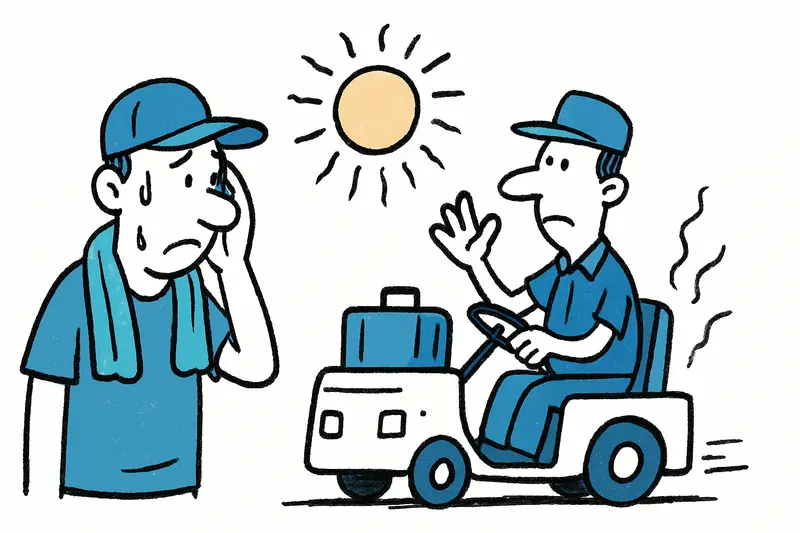
An everyday scene that makes the problem tangible: On a hot June afternoon a colleague stands at the edge of the apron, his cap pulled over his ears, a towel at his neck. Between two aircraft he takes a short break, the Bluetooth radio murmurs replacement waves; beside him the asphalt steams. A baggage cart driver waves, his hands rusty-brown and dusty from work. No shade far and wide, only the shimmering air above the tarmac.
Concrete measures that could take effect immediately: more and better distributed drinking water stations in the secure area — permanently installed taps, not just bottles; additional temporary sun awnings at heavily used stands and loading zones; mandatory air-conditioning maintenance for vehicles used in passenger operations; consistent use of ground power and ground air conditioning instead of APUs whenever possible; clear shift planning with heat-adapted breaks in air-conditioned rooms and shorter rotation assignments on the apron.
Further measures with medium-term impact: installation of temperature and humidity sensors at relevant workplaces, binding emergency protocols for heat-related incidents, cross-company agreements between Aena, airlines and handling firms as well as training to recognize heat symptoms. Public regulatory bodies should check compliance with prevention duties and be able to sanction violations. Collective bargaining provisions for compensation for special heat exposure would also be conceivable.
A point on responsibility: Aena as infrastructure operator can in principle create framework conditions — for example the approval and enforcement of ground power use or the provision of infrastructure for drinking water and shade. Operational decisions (such as switching off the APU) lie with the airlines; the practical implementation of break and rotation schedules is the responsibility of ground handling employers. Without a coordinated approach by all parties, daily burdens will change little.
Pointed conclusion: This is not about alarmism, but about everyday safety. When people have to lift suitcases and service aircraft at over 50 degrees of asphalt heat, it is an occupational medical challenge that requires planning and clear responsibilities. Small steps — more water, shade, air-conditioned break rooms — can be implemented quickly and would provide noticeable relief. Those who continuously handle aircraft at Son Sant Joan should not only be heard when something serious happens.
For Mallorca this means: Heat here is not an abstract phenomenon; it sits on the backs of those who supply the island with flights every day. That deserves more attention — and concrete actions, not just warm words.
Frequently asked questions
When is the best time to visit Mallorca for good weather and manageable crowds?
What should I pack for a Mallorca trip?
Can I swim safely at Mallorca's beaches?
What are good ways to get around Mallorca without a car?
What cultural highlights should I see in Mallorca?
What Mallorca dishes or foods should I try?
Is Mallorca family-friendly for a vacation with kids?
What makes a good day trip from Palma?
Similar News
Mini-tsunamis in Mallorca: Harmless natural phenomenon — or an underestimated danger?
Two harbor towns in Mallorca recorded unusual water level fluctuations. An analysis: How rissagas form, who is at risk —...
Stinging jellyfish in Cala Banyalbufar: Why everyone suddenly fled the water
In Cala Banyalbufar, Pelagia noctiluca washed up in droves. A personal account of why this is no coincidence, what is of...
New low-pressure trough brings rain — and the heat remains: What's missing in Mallorca?
A short, intense window of showers hit Mallorca, yet the air remained muggy and warm. Key question: Why does rain hardly...

Klaus-Michael Kühne has died: The entrepreneur who gave Mallorca a second home
He first arrived on the island at 60; later the holiday house became Castell Son Claret – a hotel, a music venue and an ...

Buying Instead of Moving Away? Why Every Fourth Property Owned by Balearic Residents Isn't Located Here
Almost a quarter of the apartments purchased by Balearic residents are located on the Spanish mainland. A concise analys...
More to explore
Discover more interesting content

Boat Tour with BBQ along Es Trenc Beach

Private transfer from Mallorca Airport (PMI) to Pollensa
