
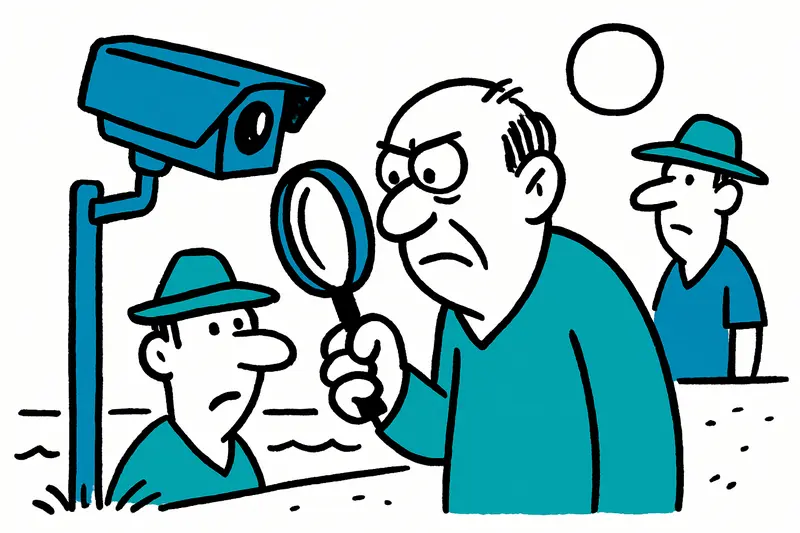
More Surveillance at Playa de Palma – Who Monitors the AI?
More Surveillance at Playa de Palma – Who Monitors the AI?
The city is expanding video surveillance at Playa de Palma: eleven new AI cameras will monitor beach and traffic areas 24/7. A good idea — but who oversees the algorithms and the data?
More cameras, more questions: Playa de Palma under scrutiny
The city planning department is installing eleven additional surveillance cameras at Playa de Palma, placed at five points along the promenade and the beachline, similar to recent deployments described in Digital Eyes on Mallorca's Beaches: Protection or Surveillance?. That brings the total to 21 devices that will in future monitor operational areas, beach sections and traffic routes around the clock. The purchase is being paid for from the tourism tax (Ecotasa); the investment for the cameras themselves is just over €90,000 and is part of a larger security package totaling several million euros, as reported in Palma steps up: More cameras, drones and the big question of privacy.
Key question
How much surveillance does a holiday strip need — and who keeps the AI-supported systems themselves in check?
Critical analysis
Technically, AI-supported cameras offer advantages: they filter out disturbances, report crowds early and reduce simple false alarms. In practice this means fewer idle patrols and faster responses to concrete dangers. But this is precisely the challenge: "fast" must not be confused with "opaque." What matters is which analysis functions are activated — pure object detection or also biometric methods like facial recognition and behavior prediction? Without clear public rules, this remains a black box.
Legally, data protection law in Spain and the EU applies; large-scale or high-risk data processing requires a Data Protection Impact Assessment (DPIA). Transparent information obligations for the public, defined deletion periods and protocols for who has access to the recordings are also necessary. On these points public debate has so far been thin: efficiency and cost are often discussed, but the technical details and the control of the algorithms rarely are, as local coverage such as When Palma's squares are watched: AI cameras, new jackets and the question of trust shows.
What is missing in the public discourse
Fewer buzzwords, more detail: there is a lack of a clear presentation of the concrete functions and limits of the AI used, an open schedule for data protection reviews, a map showing the exact camera locations and binding information on how long images are retained, and lessons from Digital Eyes on Mallorca's Beaches: Protection or Surveillance? on small cameras and sensors at beach access points. It must also be clarified who maintains the systems, whether third-party companies are involved in analysis and which oversight bodies — legally independent — check error rates and possible biases of the algorithms.
An everyday scene
Imagine a Saturday night: the promenade fills up, music echoes from the bars, taxi drivers maneuver, holidaymakers drag suitcases across the paving stones. A group of young people stops, two argue — after a minute a notification lights up somewhere in the control center. Whether the result is a real danger or just noise depends on how the AI was trained and who makes the final decision. For residents and night-shift workers it already feels different: the low hum of cameras that never quite goes away.
Concrete solutions
1) Publication of a Data Protection Impact Assessment (DPIA) before the systems go into full operation. It must describe the functions, risks and the planned deletion period.
2) Limitation of AI functions: no biometric identification without a legal basis; behavior analysis only in clearly defined, time-limited pilots.
3) Transparency obligations: visible notices on site, a public map of camera locations and an easily accessible information page with technical details and responsible parties.
4) Independent audits: regular technical and data protection reviews by an external, neutral body; results made public.
5) Clear access rules: logging of all access to recordings, roles with defined powers and sanctions for misuse.
6) Citizen participation: local consultations with residents, business owners and social organizations before expanding surveillance.
Conclusion
More cameras do not automatically mean more security — at least not in the long term if transparency and control are lacking. The technology can help detect problem cases more quickly; but it can also undermine trust if the consequences are not handled openly and transparently. People who live or work outdoors at Playa de Palma have a right to know what data is collected, how long it is kept and who watches over it. Without these answers, a security measure can easily become a constant intrusion into everyday life.
Frequently asked questions
Why are there more surveillance cameras at Playa de Palma?
How many cameras will monitor Playa de Palma now?
Are AI cameras in Mallorca allowed to use facial recognition?
What data protection rules apply to surveillance cameras in Palma?
When is Playa de Palma most heavily monitored by cameras?
What should visitors to Playa de Palma expect from the new cameras?
Who checks whether the AI cameras in Mallorca work properly?
How long can surveillance footage from Playa de Palma be kept?
Similar News

More water than last year: Mallorca's reservoirs breathe easier
September rain refilled the Tramuntana's reserves: overall fill around 35 percent, Cúber at 40.42 percent, Gorg Blau at ...
Three Luxury Hotels in Banyalbufar: Lots of Money, Many Questions
A Danish investor plans three exclusive accommodations in Banyalbufar — including the historic Son Valentí. The announce...
2.1 tonnes of cocaine on sailing yacht off Spain's coast – a reality check for the coastguard
A 14-metre yacht was seized with 2.1 tonnes of cocaine. Who monitors the ports, how does the international hunt succeed ...

Heat Bonus in Mallorca: 100 Euros Extra for Outdoor Staff at MarSenses
MarSenses pays employees who worked outdoors in August an extra €100 as recognition. Lighter uniforms, reduced hours for...
Renovating in Mallorca: What You Really Can Do Without Neighbour Consent
Many think they can do whatever they want in their apartment. That's partly true — but only as long as structural elemen...
More to explore
Discover more interesting content

Can Cap de Bou

Townhouse Lleo 72
