
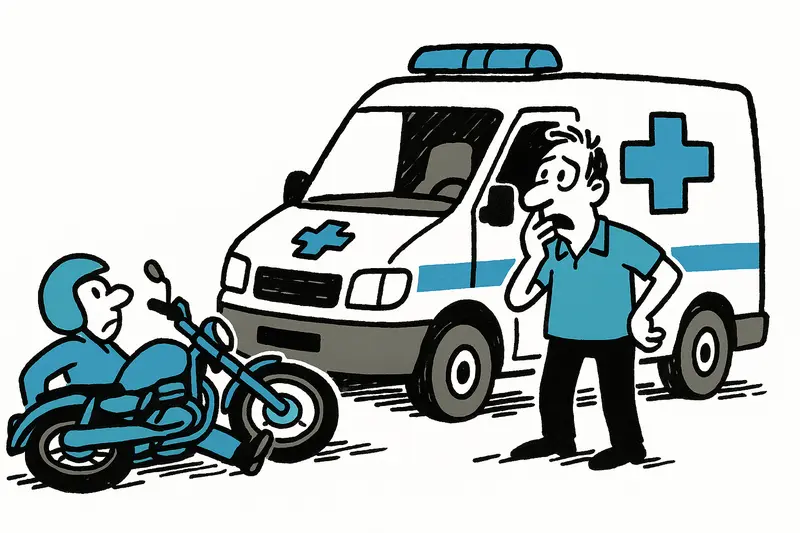
Son Castelló: Private ambulance under influence of drugs — motorcyclist dies
A private ambulance whose driver tested positive for cocaine was involved in an accident in Son Castelló. A motorcyclist died. How could an emergency vehicle become a danger?
Crash in Son Castelló: When an ambulance itself becomes a danger
Yesterday at around 13:10 an ear‑splitting impact broke the usual midday calm in the industrial area, as reported in Fatality in Son Castelló Accident – Fleeing Car Occupants Raise Many Questions. On Calle Industria two vehicles lay on their side, and paramedics and bystanders crowded the scene. The 66‑year‑old motorcyclist was resuscitated at the site but later died — despite rapid rescue efforts.
Regulars at a café on the small plaza recalled the clinking of glass, the whistling of barrier tape and the constant drone of forklifts that is part of everyday life here. An espresso was left half‑drunk; neighbors watched from balconies, some with tears in their eyes. The question that later hovered on people's lips: How can a vehicle that is meant to save lives itself become a deadly danger?
The driver: positive drug test, investigations ongoing
Police sources confirm that a preliminary drug screening for the driver of the private ambulance returned a positive result for cocaine. He was temporarily detained and questioned at the scene. Roads were closed for hours and traffic was diverted, as noted in Fatal crash at Son Castelló: More than an accident on the road to Sóller. Investigators are securing evidence, analyzing camera footage and interviewing numerous witnesses — yet the investigation alone does not address all the concerns of local people.
Many in Son Castelló are shaken in two ways: grieving for the deceased and their relatives, who lay flowers and candles on the plaza; and a sense that trust in the emergency services has been damaged. On social networks some report narrowly avoided incidents involving private emergency vehicles. In an area where delivery vans constantly honk and technicians with oil‑stained hands work on vehicles, skepticism toward privately run services is growing.
Key question: Why could an ambulance that is supposed to save lives become a danger?
This question is not only legally relevant; it strikes at the heart of what a promise of help means. Whoever calls the emergency number expects trained professionals and reliable equipment. When that image is shaken by an incident like the one in Son Castelló, the issue is bigger than one driver: it concerns structures, oversight and responsibility.
Too rarely discussed in the public debate are the working conditions under which private ambulance services operate. Flexible contracts, long shifts, inadequate supervision or missing routine checks are not footnotes but potential risk factors. Equally neglected is the question of which vehicles are actually allowed to use special privileges and how their use is logged.
What is often neglected: systemic weaknesses rather than blaming individuals
It is easy in moments like these to condemn a single person. That pains relatives and can be justified. But the debate should also examine structural causes: How are private providers licensed? Are mandatory trainings, psychological suitability assessments or random drug tests in place? Are deployment data recorded and centrally evaluated? In Son Castelló voices were heard today that pointed exactly to these gaps.
Concrete steps that make sense now
1) Regular and unannounced drug tests for personnel who use special privileges. Such tests must be contractually anchored and legally secured so that they are effective.
2) "Black box" recordings in emergency vehicles: GPS, speed, use of blue lights and sirens as well as dashcam data should be routinely saved to make accidents traceable, as discussed in Spotlight on Son Castelló: Why the occupants fled — and what the municipality must do now.
3) Uniform standards for training, continuing education and psychological suitability — also for private providers. Uniform means: the same examinations, the same minimum requirements.
4) Transparency and oversight: a public register of approved providers, regular audits by the health authority and clear reporting channels for citizens' complaints.
5) Public awareness: education on how to behave around vehicles with blue lights and what rights emergency vehicles have. Less haste on the road often means less risk.
Outlook: investigations, consequences, need for reform
Legal action against the driver is possible, as are disciplinary measures against the operator of the vehicle. But criminal proceedings alone are not enough to restore trust. In Son Castelló people lay flowers today and ask questions. If authorities, operators and citizens seek dialogue, the crisis can become a turning point — for clearer rules, better controls and reliable standards.
The loud bang yesterday will reverberate in the neighbors' ears for a long time. The answer to how such tragedies can be prevented in the future must be noticeably louder than the drone of forklifts on Calle Industria.
Frequently asked questions
What should drivers know about road safety around emergency vehicles in Mallorca?
Are private ambulance services in Mallorca subject to the same controls as public ones?
What happens after a serious traffic accident in Mallorca?
Can drug use by a driver affect an accident investigation in Mallorca?
Why is Son Castelló often mentioned in traffic and road safety news in Mallorca?
Is it normal to see candles and flowers after a fatal accident in Mallorca?
What safety checks should ambulance providers in Mallorca carry out regularly?
How can Mallorca reduce risks involving emergency vehicles on the road?
Similar News
First Day, First Consequences: What Palma's Rent Freeze Really Means
A new decree stops a planned eviction in Palma — but what really changes for tenants and landlords? A reality check with...
When Housing Becomes a Matter of Survival: Mallorca Between Rental Frenzy and Everyday Life
The case of 87-year-old Maricarmen showed that on Mallorca many people's lives are poised between affordable and uninhab...
Autumn in Mallorca: When Melancholy Gets a Window
Why autumn quietly tightens here — and how to make use of the mood: walks, culture, candles and the light from Palma to ...
Near-miss on Lanzarote: Landing Ryanair Jet and Iberia Takeoff — what really went wrong
On Lanzarote there was a dangerous incident: A Ryanair flight (FR5910) from Dublin landed on runway 03 while an Iberia E...
Eurowings introduces new Premium Business seats on Mallorca routes
From December 1, selected Eurowings flights to Palma and other destinations will feature eight particularly generous sea...
More to explore
Discover more interesting content

Can Cap de Bou

Townhouse Lleo 72
