
Motorist ends up on pedestrian bridge to Son Espases – how does this happen?
Motorist ends up on pedestrian bridge to Son Espases – how does this happen?
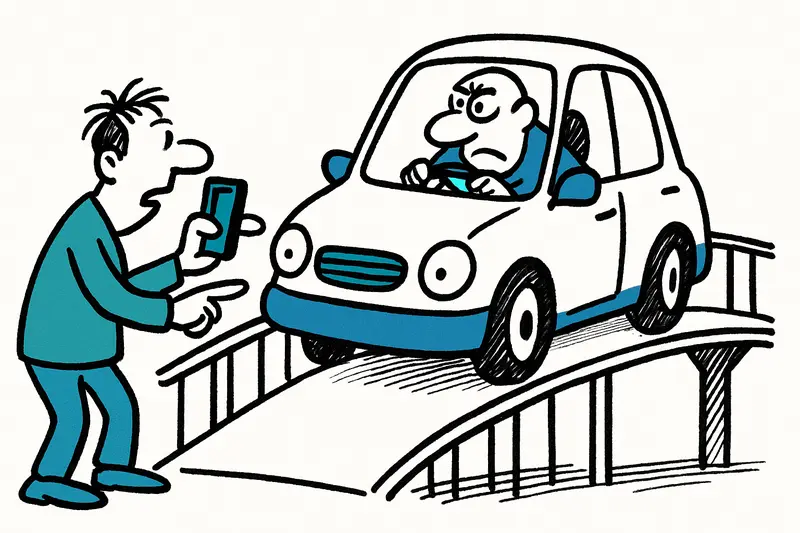
A small white car drove onto a narrow connection intended only for pedestrians and cyclists to the Son Espases hospital. The driver reversed, a passerby filmed. A curious scene — and an indication of weaknesses in signage and urban planning.
Motorist ends up on pedestrian bridge to Son Espases – how does this happen?
A curious wrong turn, loud reactions online and the question of simple solutions
Late in the evening only the distant hum of the ring road could be heard, a cool March wind blew over the dry-stone walls that frame the narrow access to Son Espases hospital. Then the unusual sight: a small white car rolls onto the narrow link that is actually meant only for pedestrians and bicycles. A passerby pulls out his phone and films; you can hear an annoyed exclamation. The driver engages reverse and tries to steer the car gently back out. Whether everything ended without damage remains unclear – what is certain is that the video is now circulating on social networks and has sparked a debate.
Main question: How can a car get onto such a pedestrian passage that was explicitly not built for motor traffic? The answer is not unanimous, but several factors likely combine: inappropriate routing by navigation devices, unclear signage at the approaches, visibility problems at dusk, and an urban layout that can lead drivers to seek the shortest line to their destination – even if that line goes over a pedestrian bridge.
Critical analysis: The video is only the visible tip. A car driving onto a purely pedestrian passage is primarily an indication of everyday failures: missing or misleading signs, no physical barrier to deter cars, and infrastructure that must remain open for delivery and emergency services but should be protected from private vehicles. Many also underestimate the role of navigation services: if map data is not clear, the motorist follows the route the device suggests – not necessarily the signs on site.
What is often missing in public discourse: People quickly moralize – "reckless" or "careless" – but rarely address concrete technical and organizational causes, nor is it often asked how often such wrong turns occur, as in Wrong-way crash near Llucmajor: motorcyclist severely injured — what's going wrong on the road to Cap Blanc?, whether the bridge has already suffered damage, or whether access routes for emergency services are endangered by such maneuvers. Eyewitness comments do not replace systematic inspection of danger points by traffic planners and the hospital administration.
An everyday scene from Palma that explains how this can happen: Someone comes along the MA-20 after a long day at work, the light is low, the GPS voice says "turn right", a construction detour shifts the familiar signs, and suddenly one finds themselves in front of a narrow ramp that appears like an access road in the headlights. People on foot see the car coming and hold their breath. These small dramas are part of street life that we witness daily – and which could often be defused with simple measures.
Concrete approaches that should be examined immediately: physical barriers such as retractable bollards or folding gates accessible only to emergency vehicles; additional reflective signs and road markings clearly indicating "Pedestrians / Bicycles only"; a visual check and, if necessary, correction of map data by major providers; better lighting at critical crossings; and an information campaign by the hospital and the municipality informing suppliers, taxi firms and visitors about clear access rules. It would also be important to document incidents so patterns emerge and priorities can be set.
Practical steps could look like this: test temporary bollards in the short term, plan structural adjustments in the medium term, and carry out a review of all hospital accesses along the ring road in the long term. Municipalities could also offer anonymized reporting tools through which residents can report recurring problems at certain spots. Such reports are often the first building block for a sustainable solution, as illustrated by the Nighttime accident on the Paseo Marítimo: alcohol, a tripping hazard and many questions.
Conclusion: The image of a car on the pedestrian bridge is curious, but not just an internet meme. It is a symptom: a small, clear reminder that traffic routing, signage and digital maps must work together so people arrive safely – whether on foot to the hospital or on four wheels. A bit of pragmatism, a few bollards and clearer signs would do more here than outrage in the comments. If we take the problem seriously, incidents like this can be prevented before someone is really harmed, as tragic cases show: Car Plunges into Ciutadella Harbor Basin: Who Could Have Prevented It?.
Frequently asked questions
How can a driver end up on a pedestrian bridge at Son Espases in Mallorca?
What should I do if my GPS in Mallorca suggests a road that looks too narrow for a car?
Why are pedestrian and bicycle access routes in Mallorca sometimes hard to understand for drivers?
What safety measures can prevent cars from entering pedestrian-only areas in Mallorca?
Is the pedestrian bridge to Son Espases in Palma safe for walkers and cyclists?
What time of day are wrong turns like this more likely in Palma?
Should hospitals in Mallorca review their access roads for private cars?
How can Mallorca drivers avoid getting into trouble with hospital access roads?
Similar News

More water than last year: Mallorca's reservoirs breathe easier
September rain refilled the Tramuntana's reserves: overall fill around 35 percent, Cúber at 40.42 percent, Gorg Blau at ...
Three Luxury Hotels in Banyalbufar: Lots of Money, Many Questions
A Danish investor plans three exclusive accommodations in Banyalbufar — including the historic Son Valentí. The announce...
2.1 tonnes of cocaine on sailing yacht off Spain's coast – a reality check for the coastguard
A 14-metre yacht was seized with 2.1 tonnes of cocaine. Who monitors the ports, how does the international hunt succeed ...
Heat Bonus in Mallorca: 100 Euros Extra for Outdoor Staff at MarSenses
MarSenses pays employees who worked outdoors in August an extra €100 as recognition. Lighter uniforms, reduced hours for...
Renovating in Mallorca: What You Really Can Do Without Neighbour Consent
Many think they can do whatever they want in their apartment. That's partly true — but only as long as structural elemen...
More to explore
Discover more interesting content

Can Cap de Bou

Townhouse Lleo 72
