
Coin trick in Cala Rajada: Why drivers need to be vigilant now
Coin trick in Cala Rajada: Why drivers need to be vigilant now
A new distraction scheme is circulating in the supermarket parking lot in Cala Rajada: coins are scattered, conversations started — and bags go missing. A critical assessment with practical advice for residents and holidaymakers.
Coin trick in Cala Rajada: Why drivers need to be vigilant now
Key question: Why does the coin trick work in parking bays — and how can victims really protect themselves?
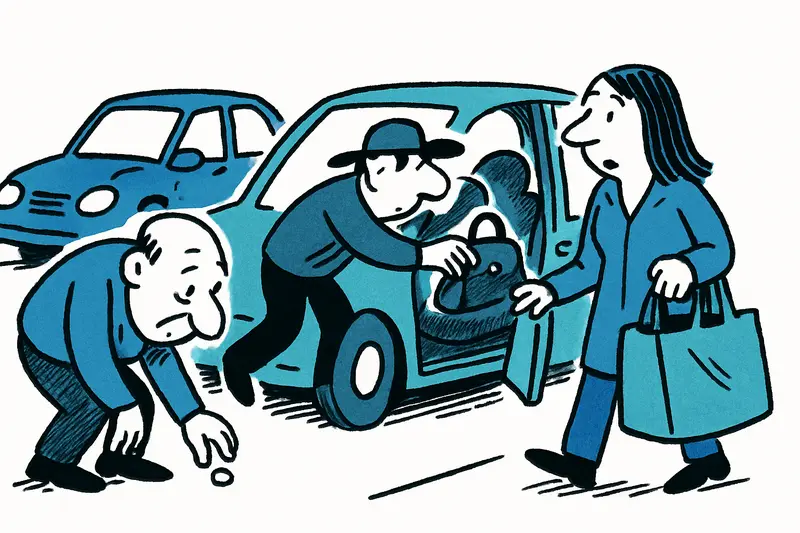
In the early morning on the car park of a large discount supermarket in Cala Rajada: cars line up along the usual parking bays, baguettes and lemons stick out of the shopping trolleys, seagulls circle and a light Tramontana breeze blows. Two men wander between the vehicles, suddenly throw coins on the ground in front of open doors and address the drivers. Whoever bends down is distracted for seconds — long enough for a bag to be taken from an unlocked car or a wallet to be stolen from an open handbag. Such scenes have worried residents in recent days, and they echo reports from nearby resorts, see Alert on the East Coast: Pickpockets in Cala Millor and Sa Coma — What to Do Now.
The tactic is simple and effective: distraction plus brief physical proximity. Social engineering techniques — deliberately triggering helpfulness or confusion — are used by perpetrators to steal their victims' attention. Particularly vulnerable are people who are alone and carrying bags, older persons or those who, stressed by shopping, turn their eyes away from the vehicle for a moment. Similar distraction techniques and evolving methods are described in New Tricks at Ballermann: How Pickpockets Exploit Playa de Palma — and What Actually Helps.
An objective analysis shows several reasons why the trick can succeed here: in the low season there is often a lack of uniformed presence, parking areas are confusing, and many people feel safe in their everyday neighbourhood and therefore become careless. Added to this are language barriers for tourists and the habit of keeping car or travel documents handy — ideal conditions for pickpockets.
What has so far been missing in the public debate: the discussion often remains limited to warnings and anecdotes. Three things are lacking: systematic counts of such incidents, clear prevention measures at the municipal level (for example coordinated video surveillance in parking areas or joint patrols), and information that reaches tourists in several languages, as highlighted by local reporting in nearby Cala Millor Carnations, Rosemary and Bags: Why Cala Millor Is on Alert Now. Without these elements much remains piecemeal.
A realistic everyday picture: an older gentleman picks up a coin, a young woman returns to the car carrying full shopping bags, opens the passenger door and briefly places her handbag on the seat. In those seconds an unremarkable person approaches, distracts her with a question — and two minutes later the handbag is gone. Such small sequences look harmless, but they are the basis of many thefts.
Concrete, immediately implementable measures for private individuals: always lock doors, even if you step out for a short moment; do not leave valuables visible in the car; carry cash, ID and cards in several, hard-to-reach places (inside jacket pockets, money belts); do not get out or open the door immediately when strangers address you; be suspicious if several people act at the same time. In case of acute danger call emergency number 112 immediately.
Practical suggestions for businesses and parking operators: display visible notices at entrances and exits that point out typical tricks; train staff to recognise and report suspicious behaviour; establish targeted partnerships with the local police to agree on regular presence times; improve lighting and position cameras to cover footpaths and entrances.
What the administration can do: more routine checks during quiet traffic times, an information campaign in multiple languages at tourist hubs, and a low-threshold reporting system for residents so that suspected cases can be recorded more quickly and reliably. Promoting local neighbourhood networks that quickly distribute warnings via messenger services is also worthwhile.
Missing points in the current approach: there is too little distinction between one-off warnings and structural prevention. A Facebook post helps in the short term, but it does not replace intentional safety planning by the municipality or cooperation with store chains. The role of parking design — sight lines, lighting, route guidance — is also often underestimated.
For those affected: file a police report, even if the material value is small. Reports create statistics that authorities can then include in prevention plans. Document the time, place, descriptions and, if possible, licence plates. If available, ask the store manager and neighbours whether cameras exist or if anyone saw anything.
In closing a clear appeal: vigilance is not paranoia, but common sense. The island thrives on community — and that very community helps make life difficult for criminals. Better to inform together, report more quickly, and implement simple changes where routine is lacking: better lighting, visible presence, clear notices. That way there's more room for the bite of bread and the lemon in the shopping basket — without returning to find your bag missing.
Conclusion: The coin distraction in parking bays is not a new crime, but it is a method that can be locally broken with simple measures. Either we keep reacting with alarm calls — or we organise the small, everyday protective measures that actually work.
Read, researched, and newly interpreted for you: Source
Similar News
Daniyella: A Voice That Fills Mallorca Evenings
She sings country, chart hits and classics — always with noticeable heart. Mallorca-based singer Daniyella brings repert...

Large Dogs in the Cabin: How Mallorca Travelers Now Board Stress-Free
A Swiss semi-private jet operator allows dogs up to 30 kg in the cabin. What this means for travelers and Mallorca — pra...
Cala Rajada in Transition: Demolition, Construction Noise and the Question of the Common Good
The demolition of the beach shack at Son Moll, the large harbour development plans and the noise disturbance raise the q...

Palma's Harbor: 13 Applicants, 5 in the Running – What the Selection Really Means
The port authority has selected five teams from 13 proposals to develop a master plan for the roughly 400,000 m² site. A...

Without insurance and deregistered: BMW seized in Palma — a symptom, not an exception
In Palma, a blue BMW with a British license plate was stopped: deregistered and without liability insurance. What the in...
More to explore
Discover more interesting content

Experience Mallorca's Best Beaches and Coves with SUP and Snorkeling

Spanish Cooking Workshop in Mallorca
