
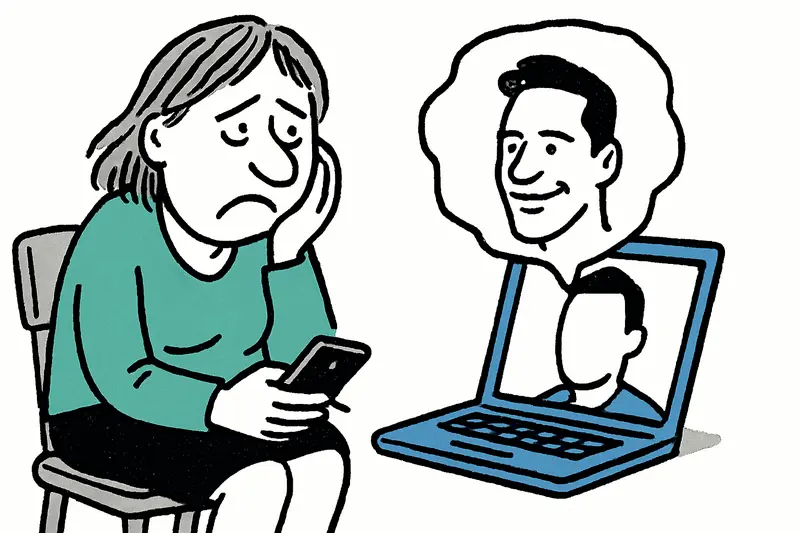
Online Love with a False Face: How a 'Nico Santos' Profile Cost a Woman Thousands
Online Love with a False Face: How a 'Nico Santos' Profile Cost a Woman Thousands
A woman from the Märkischer Kreis believed for years she was messaging a pop star raised in Mallorca — and subsequently transferred a five-figure sum. Why such cases work so well and how we can protect ourselves.
Online Love with a False Face: How a 'Nico Santos' Profile Cost a Woman Thousands
Police warning, personal emptiness and the question: What to do against perfidious love scams?
Key question: Why does an adult woman fall for an invented relationship offer for years — and what is missing in our protection system?
The criminal investigation department in Märkischer Kreis is investigating unknown suspects. A 36-year-old woman from North Rhine-Westphalia chatted for around three years with an account that presented itself as a well-known pop singer and transferred large sums several times during that period. Total: in the five-figure range. The trick is not new: perpetrators build a facade of closeness on social media profiles (for example, misleading rental offers on Facebook & Instagram), switch to private messengers and then ask for money — allegedly for plane tickets, legal problems or medical emergencies.
In short: perpetrators exploit emotions as leverage. That makes it harder than classic fraud, because the victims lose not only money but also time, hope and dignity.
Critical analysis: Technically, the means are simple. Images and biographical data of public figures can be copied quickly. Platforms allow anonymous accounts, verification mechanisms are patchy, and payment channels — bank transfers, money transfer apps, voucher codes — can be abused quickly. A crypto scheme in Palma that nearly swallowed €68,000 shows how quickly funds can vanish, and even calls in which scammers posed as bank employees have led to large losses in recent cases (a phone scam in which scammers posed as bank employees).
Socially, victims are usually emotionally isolated: new contacts, validation, the feeling of being part of something special. Added to that is a constant flood of 'success stories' about famous people on Instagram that simulate trust.
What is often missing in public discourse: an honest discussion about the social dimension of fraud victims. Too easily blame is assigned — 'how could she' — instead of asking how platform design, banks and authorities could work together to prevent harm or reverse transfers more quickly. The topic of prevention in schools and senior centers is also usually addressed only half-heartedly.
A scene from everyday life here on the island: On a windy morning on the Passeig Marítim in Palma a woman sits with coffee, the sea rustles, seagulls cry, her phone vibrates next to her — a new chat. That's how relationships are formed today: between espresso cups, bus noises and long phone calls that look like real closeness but may be operated by an unknown person on the other end.
Concrete approaches that can help immediately:
1) Personal checks: Before money flows: insist on a video call (not a photo, a live check), agree on shared live actions (e.g. a photo with a newspaper), involve skeptical friends.
2) Platforms and providers: Social media providers must process reports of fake accounts faster and give clearer indicators of verified profiles. An anonymous reporting function for suspicious payment requests would be helpful.
3) Banks and payment services: Banks should sharpen internal warning indicators: unusual recurring small transfers to new recipients, money flows to high-risk countries, use of voucher codes as indicators for fraud checks.
4) Authorities and civil society: Better networking between police, consumer centers and counseling services; quick routines for attempting to recover transfers; public prevention campaigns especially in communities with many single people or older residents — including on Mallorca.
What helps victims right now: file a report immediately (even if money has already been transferred), collect payment receipts, contact banks and dispute transfers, secure accounts and passwords, file a report with the platform. The criminal investigation department should be the first point of contact — in this case the investigation is underway in the Märkischer Kreis.
What could happen now on Mallorca: The island, with its many newcomers and tourists, is fertile ground for relationship fraud, as recent arrests, for example an arrest in Santanyí over alleged real estate fraud, show. More awareness work at citizen offices, neighborhood centers and language schools would help. Simple information evenings in community centers — with examples, not moral reproaches — could sensitize people before the first money is transferred.
Pointed conclusion: It's not only greed that makes these cases possible; it's the design of our digital intimacy — and our shy expectation that technology will protect us. As long as platforms, banks and authorities don't work together better, the risk remains high.
Reminder: suspicion is not a sign of bitterness but of reason. When the phone suddenly becomes the brake, you often have the best chance to prevent worse.
Frequently asked questions
How do romance scams usually work on social media in Mallorca?
What are the warning signs of an online love scam?
What should I do if I sent money to a scammer from Mallorca?
Why are people in Mallorca targeted by online relationship fraud?
How can I check if an online admirer is real before sending money?
Can banks in Mallorca stop romance scam payments in time?
What makes fake celebrity profiles so convincing online?
Are romance scams a problem for people living in Mallorca long term?
Similar News
Carriages Without Horses: Palma Plans E-Carriages – a Reality Check
Palma plans to switch to electric carriages in 2027. The prototype was shown near the cathedral. What is the technology ...
Record season, empty coffers: Who really benefits from the tourism boom?
Full hotels and more flights: the numbers sound impressive — yet many locals feel no benefit. A reality check with an ev...
Pool ordered for €46,000 – €23,000 paid, no work carried out: A fraud case in Palma
A homeowner in Palma transferred €23,000 for the construction of a pool. Weeks later it emerged that no building applica...
Summer greetings from the Pitiusas island: Gottschalk and Krüger enjoy the sun on Ibiza
A friendly photo of Thomas Gottschalk and Mike Krüger on Ibiza evokes memories of their shared film years and shows that...
Occupied in a Few Days: When Property in Mallorca Turns into a Dispute
Six young men were arrested in Palma after homeowners returned and could no longer open their own door. A case that rais...
More to explore
Discover more interesting content

Can Cap de Bou

Townhouse Lleo 72
