
'Only for tourists' on the storefront: Més stages protest against skyrocketing commercial rents
'Only for tourists' on the storefront: Més stages protest against skyrocketing commercial rents
With posters like 'For sale – only for tourists', Més per Palma turned a shopfront into a provocation. Who pays the price for rising commercial rents in Palma?
'Only for tourists' on the storefront: Més stages protest against skyrocketing commercial rents
Central question: Who owns Palma's shopping streets?
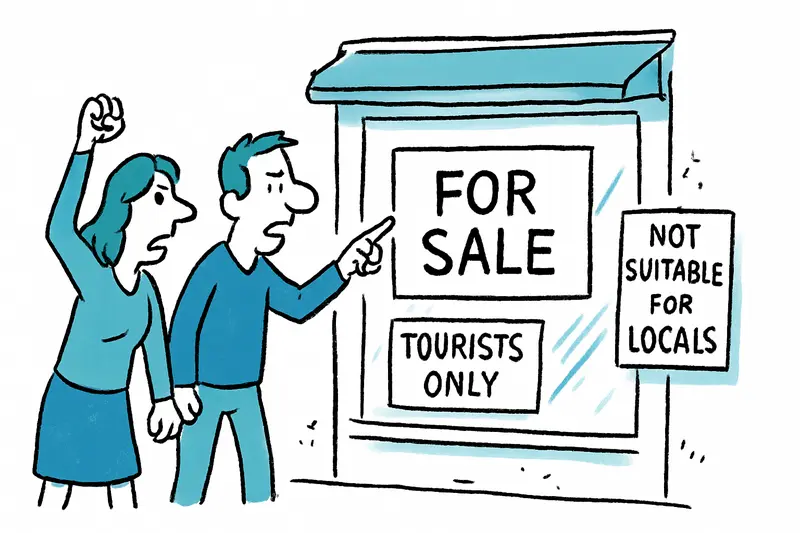
Who pays the price when shops in Palma are only profitable for holidaymakers? The ecologically and regionally oriented party Més per Palma raised this question with a conspicuous action in front of the former haberdashery 'Ca Donya Àngela': the shop windows were styled like a real estate agency, and signs with texts such as 'For sale – only for tourists' or 'For sale – not suitable for residents' hung on the facade (see Posters, Provocation, Polarization: How Mallorca's Streets Become a Campaign Ground).
Party representatives Neus Truyol and David Pujol stood in front of the transformed frontage and made clear what their concerns are: commercial rents in Palma continue to rise (see When Rent Eats More Than Profit: Palma's Small Shops on the Brink), traditional neighborhood shops are under pressure and are increasingly being replaced by franchise or tourist-oriented businesses. The shrinking supply affects not only the cityscape but also the provision of everyday goods and the social fabric of the neighborhoods.
The amounts asked for sound like a warning: in the Pere Garau neighborhood, a 180-square-meter shop is listed for 1,900 euros per month. A tiny 18-square-meter premises on a side street near Jesús costs 435 euros a month. Offers for 30 square meters on Argenteria street are already at 900 euros. And right in the center on Plaça Major, up to 7,000 euros are being asked for 160 square meters.
What is happening here is more than a numbers game. Commercial spaces are part of everyday life: the bar where the baker pours his coffee early in the morning, the locksmith, the small bookshop. When prices rise, the sounds of the street change: delivery vans instead of neighbors, air conditioners instead of conversations. On a morning in Pere Garau you hear market stalls, playing children and shop assistants bundling purchases. Such scenes are not neutral — they are social glue.
Viewed critically, Més's action is not an end in itself but a wake-up call. Nevertheless, the public debate often lacks a sober analysis of the causes: what role do rental strategies, speculation with commercial spaces, orientation toward seasonal demand and missing municipal instruments play? (Palma pulls the emergency brake: Short-term rentals, party boats and hostels to disappear) Who benefits, who loses, and what legal and planning options are available to the city administration?
Missing points in the debate include: transparent data on commercial lease agreements, binding rules for use-specific allocation of retail spaces, sanctions for long-term vacant properties and concrete support mechanisms for local small businesses. Without this information, the discussion remains at the level of outrage and symbols.
Concrete solutions that go beyond protest signs are possible and pragmatically implementable: mapping particularly at-risk commercial corridors (for example Argenteria, Plaça Major, Pere Garau) as a basis for measures; a temporary cap on rent increases in especially strained areas; tax incentives for landlords who rent long-term to local retailers; a municipal mediation and brokerage office for shop rents; a vacancy tax for commercial spaces that remain unlet for extended periods; and the examination of collective ownership models or cooperatives to secure retail spaces in the long term.
Operationally, Palma would benefit from more transparency: a public register of commercial rental prices that provides planners, policymakers and residents with a reliable data basis. In addition, the city could set up support programmes that guarantee favourable terms for founders and traditional craft businesses or assist with modernization costs.
An everyday scene from Palma’s streets makes the urgency visible: the owner of a small shoe shop in a side street looks skeptically at a new offer from a well-known chain two doors down. Traffic roars, tourists move on, the shop owner calculates quietly — for many the choice remains either to give up or to reorient the business toward tourists. This is not a theoretical problem; it is neighborhood design in real time.
Conclusion: The staging at 'Ca Donya Àngela' was a striking symbol. It shifts the perspective away from individual figures toward the question of how Palma wants to preserve local supplies and commercial diversity. If politics and administration do not soon provide concrete rules and instruments, high rents will replace what has previously made neighborhoods lively: not only shops, but places of everyday life. Més per Palma has made the problem visible — now proposals and implementation plans are needed, not more surprise at signs on the facade.
Frequently asked questions
When is the best time to visit Mallorca for warm weather and beach days?
What should I pack for a Mallorca trip?
Are Mallorca’s beaches suitable for swimming and family days?
What are top ways to enjoy Mallorca beyond the beach?
How can I get around Mallorca without renting a car?
Is Mallorca a safe destination for travelers?
What languages will I encounter in Mallorca and will English help me get around?
What are good day trips from Palma to get a fuller Mallorca experience?
Similar News
Finally Home: Mike and Leyla Heiter Buy Villa with Sea View in Mallorca
The reality TV couple Mike and Leyla Heiter have bought a house in Mallorca with a roof terrace and sea view. An Instagr...

Arrest after series in Palma: Who protects apartments from repeat offenders?
The National Police arrested a man in Palma who investigators say may have broken into several apartments. In one incide...
How a Teenager Without a Driver's License Stole a Rental Car — and What It Means for El Arenal
In El Arenal a minor took advantage of an unattended rental car with its engine running. Flight, climbing over walls and...
Three-ton llaut salvaged in Puerto Portals – volunteers clear microplastics from the harbor
During the weekend operation in Puerto Portals, divers pulled an approximately three-ton llaut from the harbor. Associat...
Naked Pillar in Bunyola: Why a Climbing Prank Is More Than an Accident
During the Sant‑Mateu verbena a 20‑year‑old fell at a protected wayside cross in Bunyola and pulled the stone cross off ...
More to explore
Discover more interesting content

Can Cap de Bou

Townhouse Lleo 72
