
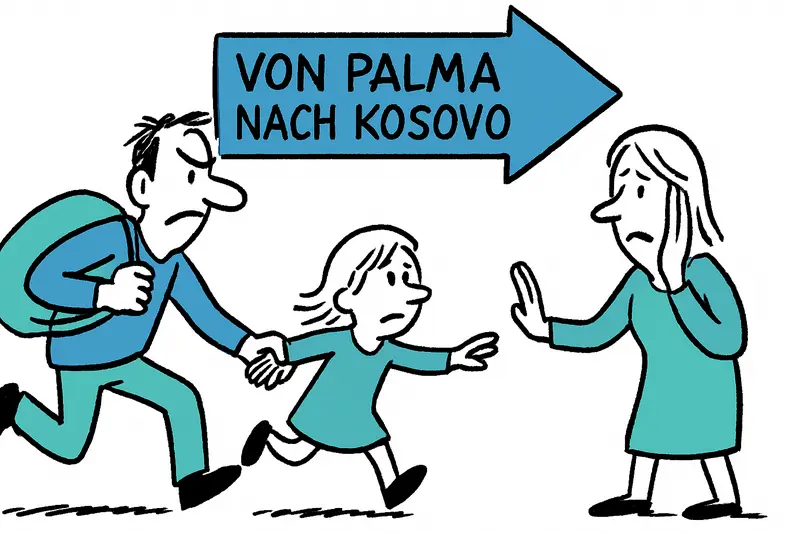
From Palma to Kosovo: How a Father’s Flight of Over 2,000 km Unfolded — and What We Must Learn
From Palma to Kosovo: How a Father’s Flight of Over 2,000 km Unfolded — and What We Must Learn
A six-year-old girl was accompanied from Mallorca to Kosovo before police intervened. Key question: How could a well-prepared escape work across Europe for so long?
From Palma to Kosovo: How a Father’s Flight of Over 2,000 km Unfolded — and What We Must Learn
Key question: How is it possible that a carefully planned flight with a child across Europe succeeds for months or weeks — and what is missing in the protection system?
Two weeks ago the story began with a custody handover in Palma. A German father picked up his six-year-old daughter and did not take her to school as agreed. Instead, the car disappeared; relatives alerted the mother, who filed a report. What followed reads like a professionally executed game of hide and seek: bank accounts were closed, social media profiles were deleted, appearance was changed multiple times. The child was temporarily transported in the trunk. A small tracking device in a backpack or envelope was apparently strategically moved to confuse ferry and border traces. The trail ended in Kosovo, where authorities finally arrested the man during a check. According to officials, the girl is well and back with her mother in Mallorca.
Brief analysis: The escape succeeded not in spite of, but because of a series of understandable gaps. Modern everyday technology and old practices — closed bank accounts, fake license plates, hiding in the trunk — combined to form a shell that was difficult to penetrate. The alleged trick with the tracker shows how perpetrators today use digital tools to mislead investigators, as seen in From Ballermann to Isalnita: How a Stolen Phone Can Disappear 4,000 km Away. At the same time, cooperation between European police services worked: video analysis, ferry data and banking movements in combination ultimately led to success, and this aligns with concerns raised in Frontex warning: When the Balearic Islands become more transit than destination — how Mallorca should respond. Without this networking, the outcome could have been different.
What is often missing in the public debate is the perspective of the affected mother and child in Mallorca: the return to Palma is not the end of the story, but a beginning with many questions — about safety, psychosocial support and possible further legal steps. Similar local cases, such as Riddle in Coll d'en Rebassa: Six-Year-Old Girl Found Ten Kilometers Away, show the follow-up challenges families face. There is also a lack of a systematic view of routine procedures during custody handovers. In everyday life we see at school gates in Palma how relaxed handovers are: parents with backpacks, the ringing of the school bell, vendors on the Passeig Mallorca selling croissants. This familiar picture must not obscure the high need for clear safety rules right there.
Concrete gaps that remain open: no uniform obligation to issue a short notice for cross-border departures after custody disputes; insufficient standards for documenting handovers; no mandatory police accompaniment for contentious handovers; and a legal gray zone regarding the use of private tracking devices. Added to this is the question of preventive communication with ferry companies and border authorities: how quickly and how completely are suspicious trips reported and checked?
What would help concretely now (actionable proposals): registration of all contested custody handovers with the Guardia Civil and the local Family Support Units; possible provision of police accompaniment for handovers with risk indicators, and recent incidents like Escape in Mallorca: Breakout from Police Vehicle Raises Questions in Llucmajor and Algaida underline the need; a hotline for schools so teachers receive immediate alerts if a child does not appear as expected; binding reporting chains between police services of EU member states and third countries that allow rapid checks of ferry tickets, banking movements and license plate queries; and a legal framework that regulates the handling of tracking devices in such cases (for example: centralized analysis instead of fragmented notifications).
Everyday scene: an early morning in Palma — the market criers at Plaça del Mercat call out, a moped hums by, parents stand in front of a school with the first sleep still in their eyes, someone pushes a pram down the Gran Vía. It is precisely here, between the smell of coffee and traffic noise, that handovers take place. A simple signal to schools or communities could make the difference: a short call, an SMS, a confirmed handover receipt — things that cost little but bring much security.
In closing: this case shows two sides. It reveals the imagination and determination of perpetrators who combine modern and old methods. And it shows that European cooperation works when technical traces are brought together and tips are taken seriously. But effective investigative work must not replace prevention. Those who see the school gates in Palma in the morning should not first think of fortification — but of practical protective mechanisms that do not stigmatize families yet better protect children.
Conclusion: The question remains whether the political and administrative authorities in Mallorca and Spain will draw the right lessons. Anyone who wants to prevent such a case from being carried 2,000 kilometres again in the future must work on handover protocols, information chains and simple everyday rules. Otherwise the street between school and home remains an invisible risk.
Frequently asked questions
What safety rules should govern custody handovers at Mallorca schools?
How do digital tools affect cross-border custody investigations in Europe, including Mallorca?
What role does European police cooperation play in resolving custody disputes involving Mallorca?
What gaps exist in handover procedures between Mallorca families and authorities?
What concrete steps can schools in Mallorca take to protect children during handovers?
Why do everyday scenes in Palma matter when discussing child safety during handovers?
What steps should a parent take if a child misses a handover or school in Mallorca due to a custody dispute?
What lessons can Mallorca and Spain draw to prevent long cross-border custody travels like the case from occurring again?
Similar News
From the Ruhr Area to the Tramuntana: Thorsten Legat and the FC Germania Mallorca Adventure
The former pro has not only taken the coaching role on Mallorca but also moved into a small island shared house, set amb...

Silent Conquest: What Mallorca's Wildlife Can Do Against Introduced Snakes
For years non-native snakes have been appearing on Mallorca. Who monitors the import routes, how effectively do authorit...
Stolen motorcycles in vacant factory: Guardia Civil finds 19 vehicles
In Inca, investigators discovered 19 motorcycles stolen between April and June. In an abandoned factory near Selva, many...
Storm in Majorca: 75 Responses, Uprooted Trees and Beached Boats – Who Will Draw the Lessons?
A sudden thunderstorm swept over the islands on Thursday evening, leaving uprooted trees, damaged boats and disrupted su...

Daily new boats: Mallorca and the Balearic Islands under pressure from rising arrivals from Algeria
For months, arrivals of boat migrants from Algeria have remained at a high level. Places are lacking, unaccompanied mino...
More to explore
Discover more interesting content

Boat Tour with BBQ along Es Trenc Beach

Private transfer from Mallorca Airport (PMI) to Pollensa
