
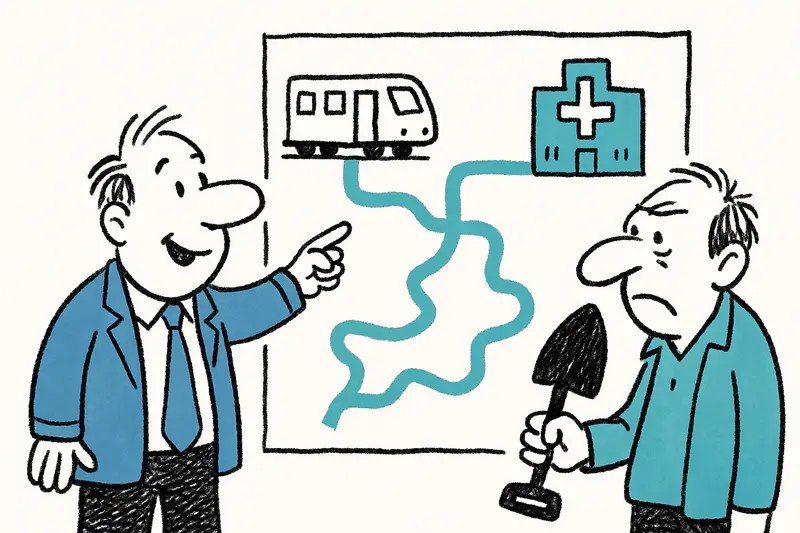
Metro to Son Espases: Tunnel or Branch? Palma's tricky transport decision
The government wants to extend the metro to Son Espases. But is money enough? Tunnel under the Eixample or a pragmatic branch at Son Castelló — Palma needs clear numbers, phased construction plans and more transparency for residents.
Metro to Son Espases: A step — but which one?
There are creaks and rattles sometimes early in the morning in Palma's streets: delivery vans, buses, the saw of a tradesman. Hardly anything is as Mallorcan as the debate about transport projects that have felt like they've been sitting in a drawer for decades. Now there's movement again: the government has announced it will extend the metro to the Son Espases hospital, as reported in Tunnel fantasy or construction reality? The metro plans for Son Espases under scrutiny. Nice — but because politics is rarely simple, the central question remains: tunnel under the Eixample or a branch at Son Castelló? Which option is more sensible, faster to fund and more socially acceptable?
Why the issue concerns more than just specialists
A direct metro connection would be a real gain for patients, carers and doctors. Son Espases lies outside the inner ring; in the morning you can easily find yourself stuck on Plaça d'Espanya, hearing only horns, air conditioners and the distant screech of a regular bus's brakes. An underground connection could significantly reduce waiting times, parking pressure and the annoying patient transports by taxi. Night shifts would also benefit: those working at night currently often find only sparse bus services.
The options: short, clear and with big differences
At the core are two options: Variant A would be a new tunnel from the Eixample directly to the hospital — elegant but technically complex, crossing densely built-up areas. Variant B is a branch from the existing M1 in the Son Castelló area that could run relatively straight to Son Espases. Both solutions are feasible, but the cost and timeframes differ significantly.
Money is the sticking point. The extension of the M1 to Parc Bit most recently cost almost €29 million, almost entirely covered by EU funding; an additional €9 million came from the island equalization fund. Similar or significantly higher sums are realistic for Son Espases — especially if a new tunnel under the Eixample is required. The central political decision is therefore: invest big and connect long-term — or act pragmatically, cheaply and quickly?
What is often overlooked in the debate
The public discussion neglects several important questions: How many passengers actually commute daily to the hospital? How can emergency access be secured during the construction phase without blocking vital rescue routes? What impact will the project have on parking in neighboring districts? And who will cover future operating and maintenance costs — the city, the island budget or again EU funding programmes? These are not glamorous topics, but they determine long-term success.
Opportunities and risks—taken objectively
The opportunities are concrete: more attractiveness of public transport, less CO2, less congestion in front of the hospital, relief for the Parc Bit area and better connections to planned lines like the route to Llucmajor. The risks are equally real: long construction times, construction noise, dust and restrictions for local businesses. Residents along potential routes fear lost parking spaces and daily detours during the construction phase — not exactly the best advertisement for a city administration juggling tourist flows and everyday problems.
Pragmatic steps: How Palma could proceed
My suggestions are local, sober and actionable: First, a robust feasibility study that clearly quantifies vehicle costs, expected passenger numbers, emergency concepts and follow-up costs. Second, a staged construction approach: initially test a branch at Son Castelló — significantly cheaper and quicker to implement — and only decide on an additional tunnel in a second phase if demand justifies it.
Third, invest in better bus lanes, increased frequency and a genuine express bus line in parallel; sometimes a bus can provide rapid relief before the diggers arrive. Fourth: transparency and noise protection. Residents need binding time windows for construction works, continuous noise measurements and a central contact person in the city administration. Fifth: strengthen Park-and-Ride at Son Castelló so that the city center is not further burdened by hospital visitors.
How does this fit into the existing network?
Palma already has commuter rail connections to Manacor, Sa Pobla and Inca as well as lines M1 and the seasonal M2, as discussed in M2 to Son Espases: Opportunity for Commuters — but Many Open Questions. Connecting Son Espases is not an isolated island project but part of a growing network — including planned routes to the airport and to Llucmajor. It is crucial that timetables, transfer times and ticket integration are considered from the start; the goal should be a well-connected journey from Plaça d'Espanya to the operating room, not an isolated track.
The timeline: hope meets reality
Officially, technical work is due to start "in the coming months." That sounds good, but it is usually the beginning of a long process: studies, tenders, permits, protests — and possibly legal proceedings. Realistically, it will be years before visible construction work and tangible improvements appear. Anyone seeking short-term relief should therefore also push for temporary bus solutions and local municipal measures.
In short: a metro connection to Son Espases brings many benefits — but only with clear numbers, a staged construction plan and serious noise protection for residents. Palma must now not only dream, but calculate, negotiate and communicate openly.
Frequently asked questions
Why is Palma considering a metro extension to Son Espases hospital?
What is the difference between the tunnel option and the Son Castelló branch for Son Espases?
How much could the Son Espases metro extension cost in Mallorca?
When could the metro to Son Espases start being built?
How would a metro connection to Son Espases help patients and hospital staff?
Will construction of the Son Espases metro affect traffic and parking in Palma?
Is Son Castelló the more practical route for the Palma metro extension?
What should residents in Palma expect if the Son Espases metro goes ahead?
Similar News

Autumn approaches on the island: Still sun, but a rain band will soon bring relief
The last warm days on Mallorca are still here – around 30°C by day, just under 20°C at night. According to AEMET, a rain...

TV documentary on the Mediterranean: How threatened is Mallorca really?
A new television documentary follows marine research off Mallorca and shows: sea temperatures are rising, and farmers ar...

After Ceuta: Intelligence Activities in Mallorca – A Reality Check
The CNI, National Police and Guardia Civil have intensified their surveillance in Mallorca. What does this mean for isla...
An evening that resonates: Hans Theessink in the Claustre of Llucmajor
With a guitar, dry humour and a voice that carries stories: Hans Theessink turned the Claustre de Sant Bonaventura in Ll...

Reality Check: Will Mallorca Become the Weather Laboratory of the Mediterranean?
A new TV documentary has the Mediterranean off Mallorca in its sights. What research shows — and what we on the coast st...
More to explore
Discover more interesting content

Can Cap de Bou

Townhouse Lleo 72
