
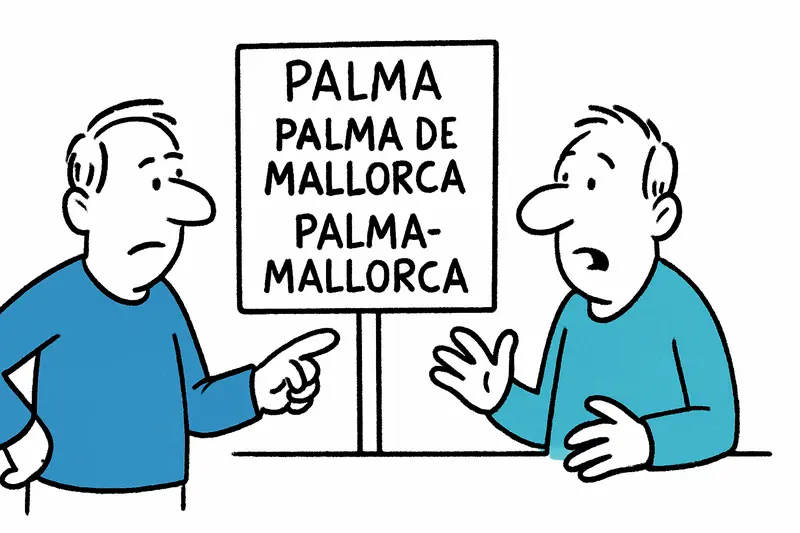
Palma, Palma de Mallorca, Palma‑Mallorca: What is it really about?
The debate over the city's name is more than grammar: it concerns identity, law and branding policy. A sober reality check with proposals on how both names can be used sensibly.
Palma, Palma de Mallorca, Palma‑Mallorca: What is it really about?
Key question: Do we have to commit to a single name for our capital – or should we learn to handle multiple names strategically?
The discussion is older than some residents who drink their café con leche every morning at the Plaça Major. What is new is that at the official level the Spanish central government and the airport operator Aena have suggested renaming the airport to “Palma‑Mallorca” (hyphen). At first glance a matter of orthography. On closer inspection, however, it is a matter with consequences: it is about perception, legal clarity and the use of an asset – the “Mallorca” brand.
Critical analysis
Naming policy is rarely only symbolism. Names are signposts for administration, tourism, business and commerce. If an airport is called “Palma‑Mallorca” in future, it will influence how the city appears in flight schedules, booking portals and the media. That can be useful: “Mallorca” works internationally as a quick marker. Nevertheless, this must not obscure the fact that an official decision has administrative consequences – from signage to forms to legal documents.
What is really problematic is how emotional the debate is conducted. For many, “Palma” is part of everyday life – street names, conversations in the Mercat d’Olivar, the sound of buses on the Avinguda Jaume III. “Palma de Mallorca” is suitable for external marketing. Fighting one or using it solely for political instrumentalization helps nobody.
What is missing in the public discourse
The following is often overlooked: first, the voices of small business owners on the Carrer de Sant Miquel or the students at the University of Palma. Second, a legal inventory: what consequences would an official renaming actually have for ID documents, land registers and administrative records? Third, the question of a long‑term brand strategy for the island region that links sustainability, quality of life and cultural heritage – and not just tourist numbers.
Everyday scene
Early in the morning, when the market at the Plaça de la Llotja is still quieting down and the garbage truck hums under the plane trees, you don't hear debates about prepositions but people unpacking their deliveries or taking the tram to Son Espases on their way to work. For them the name is a footnote – what matters is that transport connections work, permits are clear and the neighborhood remains livable.
Concrete solutions
1) Clear brand definition: A simple rule can help – “Palma” remains the official place name in local administration; “Palma de Mallorca” or “Palma‑Mallorca” is used where international recognition is desired (airport, international communication, tourism promotion).
2) Establishment of a brand and naming office: A committee made up of representatives from the town hall, the Consell, the chamber of commerce, the university and citizen initiatives to develop usage rules, protection mechanisms and a guideline paper.
3) Legal inventory and transition plan: Plan technical adjustments (signs, registers, forms) early so that costs and confusion are limited.
4) Citizen participation: Public workshops in neighborhoods such as Santa Catalina or El Terreno to include residents' perspectives.
5) Use of brand architecture: Instead of erasing one name, both names can function complementarily. The airport hyphen can serve as a connecting element without replacing local identity.
Pithy conclusion
We should stop treating a preposition like a barricade. The question is less who wins and more how we reconcile the intangible capital “Mallorca” with the local identity “Palma.” A pragmatic set of rules that creates legal certainty, protects quality of life and manages the brand consistently will achieve more than symbolic quarrels. And: before authorities push through resolutions, a look at everyday island reality – the deliveries at the Mercat, the bus timetables, the school routes – would be advisable. Names are important. Even more important is what happens behind them.
Frequently asked questions
What’s the best time to visit Mallorca for sunny beach days?
Is it safe to swim in Mallorca year-round?
What should I pack for a Mallorca trip in spring or summer?
What’s the best way to get around Mallorca to see multiple towns?
What are must-see sights in Palma for a short visit?
Is Alcúdia’s old town worth visiting on Mallorca?
Which Mallorca beaches are family-friendly?
What makes a day trip to Sóller special, and how do I get there from Palma?
Similar News
Warning to Bathers: Nipping Fish in Cala Major and Other Coves — a Reality Check
In Cala Major and several beaches around Mallorca, bathers report painful “nips”. Who are the animals, why are they gett...
Rental Car Theft in El Arenal: What This Incident Reveals About Our Gaps
A teenager steals a running rental car in El Arenal, flees on foot, climbs over walls and is caught by the Guardia Civil...
Red Rope in Palma's Library: What Helps Against Selfie Tourism — and What's Missing
Palma's city library cordoned off an area with a red rope to keep selfie tourism away from reading and working activitie...
Fort San Carlos: Museum, Harbor Dispute — and a Conflict That Demands Answers
The military museum at Fort San Carlos sits right on Palma's harbor, with unexpectedly quiet rooms filled with cannons a...
Old Town Under Pressure: When a Doorway Becomes a Sleeping and Shower Place
For months a woman has been living with a parasol, a clothes rack and personal belongings next to the social welfare off...
More to explore
Discover more interesting content

Can Cap de Bou

Townhouse Lleo 72
