
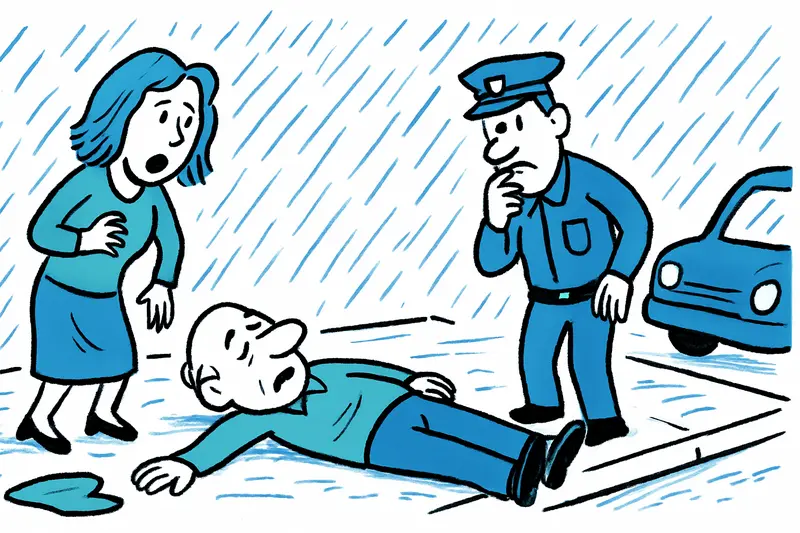
Sudden drama on Paseo Mallorca: a death in the rain – and the questions that remain
During heavy November rain a 69-year-old collapsed on the Paseo Mallorca and died. Investigators are seeking witnesses — and the city must address emergency preparedness.
Sudden drama on Paseo Mallorca
It was one of those November mornings when the rain transformed the city in seconds: cold water drumming on the asphalt, shutters rattling, and the smell of wet stone in the air — scenes similar to those described in a report on a sudden storm in Palma. Around 9:30 a.m. passersby reported a man who had collapsed next to the Torrent Riera on the Paseo Mallorca, as noted in a local report: man collapsed on Paseo Mallorca during heavy rain. Paramedics and emergency doctors arrived quickly, but their resuscitation efforts were unsuccessful.
Who was the man — and could he have been saved?
Authorities give the victim's age as 69; the name has not yet been released. Hardly anything affects the neighborhood as directly as a sudden death in the middle of the commute to work. The central question now appearing in many conversations: would faster help have changed the outcome? Or was it a medical emergency that could not have been influenced?
Eyewitnesses describe short but hectic scenes: a woman with a red umbrella called emergency services, a young man immediately began first aid until the rescue teams arrived. Such spontaneous helpers are typical for the area — cafes are opening, delivery workers squeeze through, and neighbors know each other. Still, the question remains whether there are enough automated external defibrillators (AEDs) or clearly marked locations where first responders can act quickly.
Police secure the area — investigations are ongoing
The National Police cordoned off the area, questioned residents and shopkeepers and reviewed possible video recordings from surveillance cameras. The body was transferred to the forensic institute that same morning; an autopsy should clarify whether a heart attack, a fall or other causes led to the death. According to initial information, there are no indications of third-party involvement.
For people on site, impressions remained: wet jackets hanging at doors, fog on eyeglass lenses, taxi drivers describing how visibility was "like behind a curtain." All of this highlights how weather phenomena change everyday life and the risk situation — especially in busy places like the Paseo. A recent storm alert for Mallorca has underlined the challenges that heavy rain and reduced visibility pose to the city.
What is often overlooked in public debate
Reporting understandably focuses on the individual case. Less attention is given to systemic questions: Are life-saving devices easily accessible at central points in the city? Are there enough defibrillators in the city center and are they clearly signposted? How well trained are business owners and municipal employees in first aid? And how effective is the communication of emergency services in weather conditions with reduced visibility?
Another often overlooked dimension is spatial design: smooth slabs, slippery manhole covers, lowered curbs and unsecured stairs can make falls more likely. Simply put: if footpaths are not sufficiently swept or cleaned, heavy rain increases the risk of accidents — especially for older people.
Concrete approaches that could help
Rather than speak only of fate, it is worthwhile to consider concrete improvements. In the short term, the city administration could install better signage for AED locations and additional public defibrillators in heavily frequented areas such as the Paseo Mallorca, and provide clear public information on how to use them (see the guide on using a defibrillator). Businesses and cafes could be encouraged to train staff in first aid — perhaps through local campaigns in cooperation with relief organizations, for example offering Spanish Red Cross first aid training.
In the medium term, technical and infrastructural measures would be sensible: non-slip surfaces at particularly vulnerable spots, better drainage to prevent aquaplaning on walkways, and clearer street and weather signals for pedestrians. And: more visible information on how to act in an emergency — simple reminders at bus stops or in shop windows are often enough.
What remains — and how we can respond as a community
The investigations will hopefully provide more clarity soon. Until then, respect for those who helped and sympathy for the relatives of the deceased are due. But Mallorca is more than just a holiday destination: it is a community where solidarity matters. A bit more first aid knowledge, an accessiblely placed defibrillator, and an eye for slippery spots can make the difference.
The National Police continue to ask for information from witnesses or people with recordings. If you were nearby today or saw anything, please get in touch — every tip counts. And when you walk along the Paseo tomorrow, listen to the rattle of the shutters, smell the wet stone — and look at each other for a moment. Sometimes a brief glance is enough to notice that someone needs help.
Frequently asked questions
Is it safe to walk around Palma during heavy rain?
What should I do if someone collapses in Mallorca?
Are defibrillators easy to find in Palma?
Does rain in Mallorca make accidents more likely?
What happened on Paseo Mallorca in Palma?
Why are sidewalks in Mallorca a concern during storms?
What does the police investigation look for after a sudden death in Palma?
When is the weather in Mallorca most challenging for pedestrians?
Similar News

When coercive fines aren't enough: Could holiday rental owners soon face prosecution?
The island administration is stepping up action against unauthorized holiday rentals: high daily coercive fines up to €5...

Palma Airport on an Expansion Course — Who Decides How Much Growth the Island Needs?
Aena and Madrid are planning multi-million euro investments for Son Sant Joan and project higher capacities. Concern is ...
Who Gets Left Out? Why Overbookings Will Hit Many Mallorca Travelers This Summer
On hot check-in days at Son Sant Joan, frustrated travelers pile up. New figures from Reclamador.es show that a large sh...
When the Handyman Came: How an Engagement Ring Disappeared in Mallorca and What It Says About Trust
During a repair in Andratx a highly personal engagement ring went missing — a case that calls not only for punishment bu...
How Burglars Test Fincas in Mallorca — and What You Can Do About It
The Spanish National Police warn of a simple but effective trick: small markings on doors reveal whether a finca is occu...
More to explore
Discover more interesting content

Can Cap de Bou

Townhouse Lleo 72
