
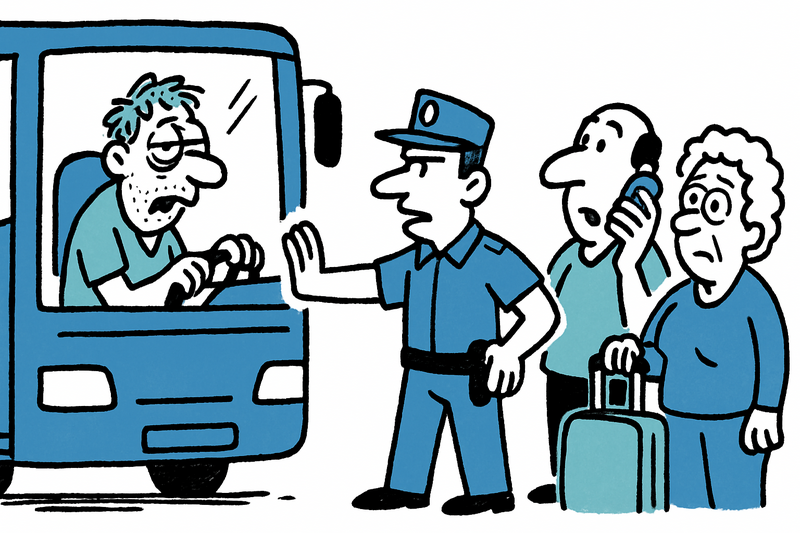
Palma: TIB Line 104 Bus Driver Allegedly Under the Influence of Drugs – Stop at Plaza del Progreso
An intercity bus on TIB line 104 was stopped yesterday at the Plaza del Progreso after passengers reported erratic driving. A drug test on the driver came back positive. Why incidents like this can happen and what measures are now needed.
Between suitcases, heat shimmer and flashing lights: a full bus comes to a standstill
It was one of those oppressively hot August afternoons in Palma: the sun pressed down on the tarmac, seagulls circled, and isolated murmurs echoed through the streets around the Plaza del Progreso. At around 5:15 p.m., an intercity bus on TIB line 104 suddenly stopped — not for technical reasons, but because passengers alerted the Guardia Civil, as reported in TIB bus driver tested positive: Line 104 bus in Palma stopped. Suitcases were quickly on the pavement, people smoked nervously, a few children fussed, and a siren cut into the otherwise routine soundscape of the city.
How did this happen?
The accounts of the roughly 80 passengers are similar: sudden accelerations, abrupt lane changes, "bad turns," as an elderly woman put it. Such observations prompted several passengers to call the emergency services rather than quietly get off. On site, the Guardia Civil subjected the driver to a drug test — the result was positive, according to Conductor de TIB da positivo: autobús de la línea 104 detenido en Palma. Shortly afterward a replacement driver took over and the journey toward Palma continued.
The central question: How could this happen?
The events raise a simple but pressing question: how can a driver, apparently under the influence of drugs, operate a fully occupied line bus on a route between Magaluf and Palma without anyone intervening earlier? There are several possible reasons: insufficient checks, flexible working hours, precarious shift schedules, lack of information or simply the fact that a single moment of human inattention is enough. It remains unclear how often random tests are carried out for TIB drivers and whether there are preventive conversations or support offers for employees who show warning signs.
What does the law say — and what happens next?
Driving under the influence of drugs is not a trivial offense in Spain. See the DGT page on alcohol and drugs for legal details. In addition to immediate measures such as license suspension, fines and criminal investigations may follow. In practical terms, positive rapid tests often lead to more detailed examinations and potential court proceedings. For the passengers, relief remained that the police responded and the journey was secured. But relief alone is not an answer to a structural problem.
What is often overlooked
Public discussion quickly focuses on blaming personnel management. Two things are often forgotten: first, passengers are frequently the first to report dangerous behavior — they are important observers and part of the safety chain. Second, many transport operators and municipal authorities lack a preventive concept that links medical care, regular testing and support for affected employees.
Practical steps that could help
Some pragmatic proposals to reduce the likelihood of such incidents: regular, unannounced drug tests combined with medical checkups; clearly regulated rest periods and shift schedules to counteract fatigue; anonymous reporting channels for passengers; greater presence of enforcement officers on key routes and stops; training for staff on how to deal with colleagues at risk and a binding rehabilitation offer instead of only sanctions. Technical measures such as onboard cameras and telematics data analysis could also help detect anomalies early.
What the scene at Plaza del Progreso reveals
Yesterday's incident revealed something typical for Mallorca: a mix of pragmatism and brief agitation. A commuter checked the time, a tourist looked around bewildered for onward travel, and the Guardia Civil worked with routine. But beneath the surface remains the question whether our local transport system is doing enough to eliminate such risks. If the answer is "not enough," employers, authorities and society must make improvements.
If you were affected yesterday or have information, it is advisable to inform the Guardia Civil. For the more than 80 people on board, the story will hopefully end with an administrative procedure against the driver — but the real task now lies with those responsible: ensuring that safe mobility on Mallorca is not the exception but the rule.
Frequently asked questions
What should I do if my bus in Mallorca is being driven unsafely?
Can a bus driver in Spain be tested for drugs during a journey?
Is it safe to take the TIB 104 bus from Magaluf to Palma?
What happens if a bus driver in Mallorca fails a drug test?
What is Plaza del Progreso in Palma known for?
How common are drug tests for public transport drivers in Mallorca?
What signs might suggest a bus driver is impaired?
What should passengers on Mallorca buses do during an emergency?
Similar News
When coercive fines aren't enough: Could holiday rental owners soon face prosecution?
The island administration is stepping up action against unauthorized holiday rentals: high daily coercive fines up to €5...

Palma Airport on an Expansion Course — Who Decides How Much Growth the Island Needs?
Aena and Madrid are planning multi-million euro investments for Son Sant Joan and project higher capacities. Concern is ...
Who Gets Left Out? Why Overbookings Will Hit Many Mallorca Travelers This Summer
On hot check-in days at Son Sant Joan, frustrated travelers pile up. New figures from Reclamador.es show that a large sh...
When the Handyman Came: How an Engagement Ring Disappeared in Mallorca and What It Says About Trust
During a repair in Andratx a highly personal engagement ring went missing — a case that calls not only for punishment bu...
How Burglars Test Fincas in Mallorca — and What You Can Do About It
The Spanish National Police warn of a simple but effective trick: small markings on doors reveal whether a finca is occu...
More to explore
Discover more interesting content

Can Cap de Bou

Townhouse Lleo 72
