
Palmanova: Bathers rescue unconscious man — but questions remain
Palmanova: Bathers rescue unconscious man — but questions remain
In the morning, an approximately 65-year-old man was pulled unconscious from the water off the coast of Palmanova. Rescuers and unidentified bathers performed resuscitation for over 90 minutes before the man was taken to hospital. A good outcome — but what would need to change so such an operation doesn't hang by a thread?
Palmanova: Bathers rescue unconscious man — but questions remain
How safe are our beaches when every minute counts?
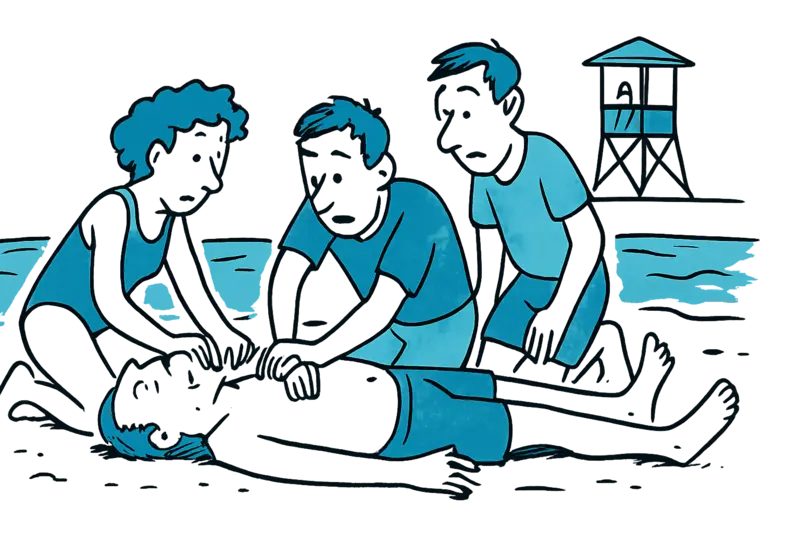
On the morning of an ordinary late-summer day, holidaymakers on the beach at Palmanova noticed a man floating motionless in the water. He was around his mid-60s and, according to witnesses, showed no reaction. People on the shore shouted for help; lifeguards in the watchtower called back immediately. Bathers pulled the man ashore. A long, exhausting resuscitation began on site.
The facts are few but clear: no measurable pulse when found, immediate cardiopulmonary resuscitation (CPR), involvement of lifeguards, police officers and emergency medical services. The measures lasted more than 90 minutes, after which the man was stabilised and taken to a hospital. That he was taken away alive is a stroke of luck — also a success for the spontaneous helpers and the professional responders; contrasting outcomes are documented in Cardiac Arrest on Can Picafort Beach: Questions Remain and Ideas for the Future.
Key question: Could fewer onlookers, delayed resuscitation or missing equipment have meant the difference between life and death?
The scene on the beach is familiar to everyone: rows of parasols, children building sandcastles, the faint hum of scooters on the promenade. Between them sits a watchtower, its occupants scanning the sea. In Palmanova these observers apparently acted correctly; nevertheless the incident shows how fragile the system is when everything has to go right — quick discovery, immediate action, endurance during resuscitation.
Critical analysis quickly gets to the point: lifesaving minutes are limited. That people worked on a patient for over 90 minutes speaks for professionalism and determination, but also for gaps. Why does a resuscitation take so long? Because resuscitation is not a short burst of effort but requires endurance, equipment and a clear procedure. If a defibrillator was missing or not quickly accessible, the risk increases significantly.
Public debate often lacks concrete discussion about practical equipment and simple prevention; similar calls followed the Critical Bathing Incident at Arenal: Call for Better Protective Measures. There is much talk about accident statistics, less about the availability of automated external defibrillators (AEDs) on beaches, multilingual signage or easily accessible first aid courses for tourists, hotel staff and beach vendors. It is also rarely asked whether watchtowers should be staffed more consistently, even outside the high season.
A everyday scene: on a late-summer morning a vendor sits at the edge of the promenade selling ice cream. She has experienced many summer seasons here. When guests ask her what to do in an emergency, she hesitates. Her hesitation is worrying, as shown by the Fatal Rescue Attempt in Son Bauló: What Must Change on Our Beaches. Too few people in Mallorca know the sequence: check the scene, call emergency services, check breathing, start chest compressions. Simple actions like these could save lives until the professionals arrive.
Concrete solutions that could be implemented quickly: first, more AED stations on busy beaches, clearly visible and weatherproof. Second, clearer, multilingual signage at access points and entrances with emergency numbers and basic instructions for resuscitation. Third, low-threshold training: short, free CPR courses for hotel staff, beach vendors and volunteers — with certified instructors and flexible times.
Fourth, a review of watchtower staffing and deployment plans: are towers unmanned at certain times of day? Are lifeguards given sufficient break rotations so that no one burns out during long operations? Fifth, better coordination between lifeguards, police and emergency services so that no time is lost during transport and handover.
Many demands sound banal but are effective. An easily reachable AED on the beach plus a few people who do not look away dramatically increases the chance of survival. Authorities could also start a small information campaign: a two-minute video in hotels, flyers in several languages, notices in taxis and at bus stops.
The incident in Palmanova also shows a strength of our island: the willingness to help. Strangers went into the water, civilians pulled the man ashore and stayed involved in the rescue. This solidarity is a valuable resource that we should use better — through training, technology and organisation; lessons from other cases are summarised in Playa de Muro: Seconds That Saved a Life — and What We Must Learn.
Conclusion: It is impressive that the man arrived at the hospital alive. But impressive must not be equated with satisfied. Such operations must not depend on luck. More AEDs, more training, clearer signs and an honest review of watchtower staffing would prevent the luck of Palmanova from running out next time.
The beach still smells faintly of sunscreen and sea; in people's ears remains the whisper of those who asked whether anyone felt a pulse. The answer to the guiding question is therefore not just a number — it is a responsibility: we can now set the course so that help arrives faster, safer and more reliably.
Frequently asked questions
What should I know about beach safety on Mallorca's Palmanova?
Are AEDs available on Mallorca beaches?
How should tourists respond during a beach emergency in Mallorca?
Should beach watchtowers in Mallorca be staffed year-round?
What practical steps could improve emergency response on Mallorca beaches?
How do lifeguards, police, and EMS coordinate during Mallorca beach rescues?
Is late-summer still a good time for beach visits in Mallorca if safety is a concern?
What should visitors carry or know to stay prepared on Mallorca beaches?
Similar News
Arrests after Beach Thefts: How Safe Are Mallorca's Beaches Really?
After a large-scale operation, 19 suspects were arrested. The case raises questions: why were thieves able to strike for...
No more tap water in Cala Millor – what happens when the tap runs dry?
Sant Llorenç del Cardassar has cut fresh water services at beaches due to the drought and issued further usage bans. Who...
Trash everywhere at Consell–Alaró station: Why the mess doesn't just disappear
The station between Consell and Alaró is full of bottles, bags and littered fences. Who is responsible remains unclear —...

When coercive fines aren't enough: Could holiday rental owners soon face prosecution?
The island administration is stepping up action against unauthorized holiday rentals: high daily coercive fines up to €5...

Palma Airport on an Expansion Course — Who Decides How Much Growth the Island Needs?
Aena and Madrid are planning multi-million euro investments for Son Sant Joan and project higher capacities. Concern is ...
More to explore
Discover more interesting content

Can Cap de Bou

Townhouse Lleo 72
