
Up to 400 euros a month: When parking spaces in Palma become a luxury
Up to 400 euros a month: When parking spaces in Palma become a luxury
Parking spaces in Palma's old town are scarce — rents have risen significantly over a decade. Who pays, who is left out, and what can the city do?
Up to 400 euros a month: When parking spaces in Palma become a luxury
Key question
How does Palma deal with a market in which simple parking spaces become a scarce and expensive resource — and who pays the price?
Critical analysis
In the narrow streets around La Seu and the Llotja, parking spaces are becoming rarer, and those that are available now cost significantly more than before. Inner-city parking has become much more expensive over the past ten years; in some micro-neighbourhoods monthly rents for a single space reach levels reminiscent of rents for small apartments. The usual causes are known: more people, more vehicles, limited space. But that is only half the story. Crucially, available spaces are systematically turning into private property or being converted into uses that ignore public demand, as in luxury conversions in Camp d'en Serralta. Added to this is a buyer profile with strong purchasing power that is willing to pay above-average prices — which further increases market pressure, as discussed in Palma at Two Prices: Why the Same Square Meter Can Suddenly Be Luxury.
What's missing in the public discourse
Many debates remain superficial: rising prices are discussed, but not their distributional effects. There is no clear accounting of how rising parking costs affect commuters, families with children, delivery services and tradespeople. Nor is there systematic recording of how many parking spaces actually serve residential needs and how many are in the hands of investors or holiday-home owners. Without these data, policy remains reactive rather than steering, evidenced by recent shifts toward towing fees and the expansion of ORA parking zones.
Everyday scene in Palma
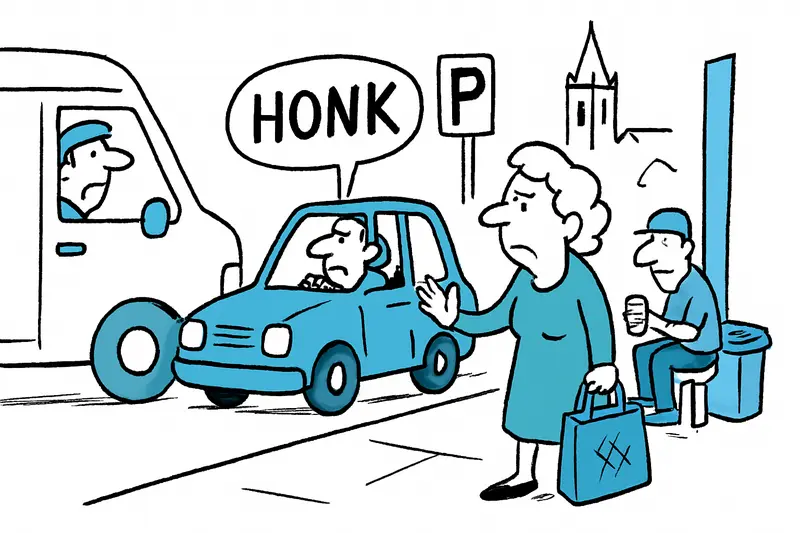
A morning on Calle Sant Feliu: delivery vans manoeuvre, an elderly woman with a shopping bag searches in vain for a short gap, a taxi driver honks, bins block a narrow spot. On the side a janitor pours coffee into a paper cup as the church bells of the nearby parish ring twice. This is everyday practice, similar to the parking chaos at Son Espases: people need short, accessible parking spaces — not financial hurdles.
Concrete solutions
1) Map the parking stock: The Ajuntament should, in cooperation with the Consell, create a transparent inventory of all private and public parking spaces. Who owns how many spaces? Which areas are unused in the long term? Such data enable targeted measures.
2) Usage conditions on sale: When public or community parking spaces are converted into private areas, contractual conditions could apply, such as occupancy quotas for residents or time limits on renting to outsiders.
3) Tax incentives to eliminate long-term vacancy: Owners of vacant garages who do not make their spaces available to the market could be motivated to offer them through graduated property taxes.
4) Expand park-and-ride and shuttles: Increase capacity on the city outskirts and offer reliable shuttle connections to the old town. This reduces inner-city pressure without having to ban cars entirely.
5) Promote shared parking solutions: Cooperative or neighborhood models for communal use of garages could be supported through tax incentives.
6) Planning regulations: Require stricter minimum numbers of private parking spaces for new buildings — or alternatively a financial contribution that flows into public parking construction.
7) Short-term rules for short-term rental of parking spaces: Platforms that temporarily broker parking spots should have clearer registration obligations and transparency rules so that usage does not flow into speculative channels.
Why this matters
Rising parking prices are not an abstract market issue. They change who can remain in the city, how small businesses operate and how lively neighbourhoods stay. If parking spaces become a private matter for affluent buyers, displacement threatens not only housing but also the street scene: less neighborhood life, more traffic searching for spaces and longer delivery routes.
Concise conclusion
Palma urgently needs a combined strategy of data, regulatory access and pragmatic incentives. Only in this way can it be prevented that simple parking gaps become a privilege. The clock is ticking: if nothing is done, those who live, work and enliven the city daily with their cars, shopping and prams will end up paying the price.
Frequently asked questions
What is Mallorca’s weather like throughout the year?
When is the best time to swim in Mallorca?
What should I pack for a Mallorca trip?
Is a car necessary to explore Mallorca or can I use public transport?
What are some must-do outdoor activities in Mallorca?
Is Mallorca a good destination for families?
Are there notable cultural or food experiences to seek in Mallorca?
What are some scenic day trips from Palma, Mallorca?
Similar News
Golden October: Island pleasures instead of a winter coat – Mallorca stays warm
A late-summer remnant in October: Up to 27 °C, pleasant water temperatures around 22–24 °C and sunny days – ideal for be...

Son Sant Joan Control Center: What Questions Remain When the Island's 'Brain' Relocates
The air traffic control center in Palma manages the airspace over the Balearic Islands. With the planned move to Son Bon...
Son Gotleu under pressure: Why many rental cars were broken into in recent weeks
Residents in Son Gotleu have experienced a series of break-ins of parked cars in recent weeks. A reality check: what is ...
From Jungle Camp to Hotel Stage: Julian F. M. Stoeckel Delights in Camp de Mar
Berlin entertainer Julian F. M. Stoeckel performed two evenings in the atrium of The Camp de Mar Hotel & Resort and prov...
Man hides under bus in Cales de Mallorca: Why did the rescue take so long?
On Passeig Manacor a man stopped a bus, climbed underneath it and caused a traffic jam and a tense police operation. Wha...
More to explore
Discover more interesting content

Can Cap de Bou

Townhouse Lleo 72
