
Few Visitors on the Paseo Marítimo: Up to a 30 Percent Drop — and What Needs to Happen Now
Few Visitors on the Paseo Marítimo: Up to a 30 Percent Drop — and What Needs to Happen Now
This summer on the Paseo Marítimo ended markedly weaker than usual: businesses report revenue losses of up to 30 percent. Causes: fewer parking spaces, almost no night transport, and years of construction. A situational check with practical solutions.
Few Visitors on the Paseo Marítimo: Up to a 30 Percent Drop — and What Needs to Happen Now
Why full terraces are no longer a given and how Palma can respond
Key question: Why did significantly fewer people visit Palma’s waterfront boulevard this summer — and is this a temporary problem or the start of a lasting shift in visitors and revenue?
The hard numbers are on the table: several restaurants and leisure providers on the Paseo Marítimo report summer revenue declines of up to 30 percent. Business owners say that terraces remained half-empty on many evenings or were not opened at all because costs no longer added up. Some venues have reduced their opening days to cushion losses. The drop was particularly noticeable in August.
What is behind this? The explanation that operators consistently give sounds banal and is at the same time very specific to Mallorca: there are too few parking spaces, public transport is practically non-existent at night, and taxis are hard to get during peak times. For visitors who arrive by car or want to return home late, the Paseo is often the less convenient choice. When getting there becomes a lottery, the terrace becomes secondary.
Another factor is the structural redesign of recent years: the Paseo was transformed into a pedestrian- and cyclist-friendly strip. More green spaces, wider sidewalks, the relocated bike lane and new playgrounds have changed the appearance — to the advantage of walkers and families. For many businesses, however, this meant significantly fewer parking spaces directly on the promenade. That has an impact in a city where tourists and day visitors seek uncomplicated ways to arrive.
What is missing in the public debate: the problems are not just a "parking problem" or a "taxi problem." They are a bundle of planning issues, operational realities and service practices. Three points are missing from the discussion:
1. Concrete figures on modal split and night-time offerings: There is hardly any up-to-date, publicly available data on how many visitors arrive by car, taxi, bus or bicycle at which times. Without this basis, measures are often shots in the dark.
2. More flexible rules for businesses in construction zones: Operators in construction zones on the Paseo need transitional rules — for example temporary delivery and parking spaces, reduced fees or eased outdoor dining licenses.
3. Night mobility as part of tourism infrastructure: If buses and taxis largely disappear after 11 p.m., the night-time audience shifts as well, a pattern described in Paseo Marítimo: Trash, Noise and the Smell of Urine – How Much Nightlife Can the Promenade Handle? This affects not only the Paseo but also clubs, restaurants and airport traffic.
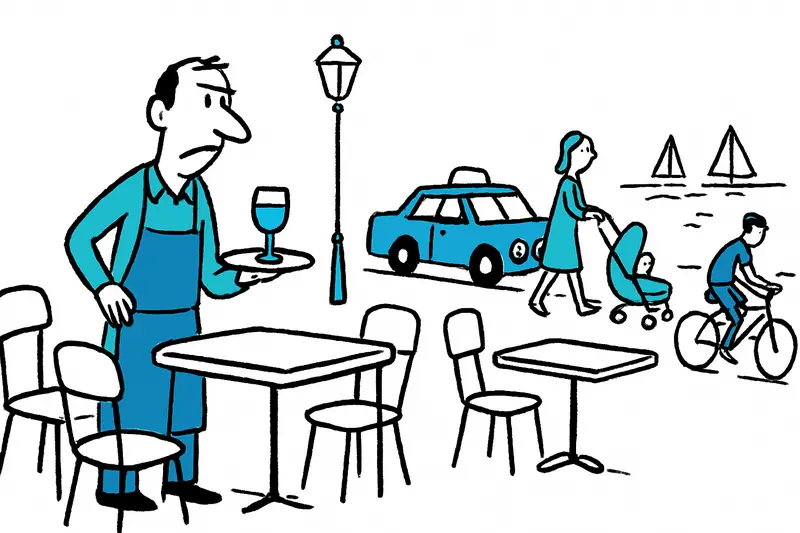
An everyday scene from Palma: It is evening, dusk falls over the boats in the harbor. In some sections of the Paseo tables are set up with chairs, lamps flicker, cutlery clatters sporadically. The waiter looks toward the main road where cars crawl in stop-and-go looking for a parking space. A family with a stroller turns toward the new playground, two cyclists ride past. A taxi rank remains empty. This picture repeats on many evenings — and it is enough to noticeably pull down the season's balance.
Concrete solutions that could take effect quickly:
- Park-and-ride on the city outskirts with regular shuttles to the harbor: Large parking areas outside the city center combined with a free or low-cost shuttle, especially in the evenings.
- Night bus lines and special services during peak season: Subsidies for operators or temporary lines in August/September so that guests can return safely and predictably.
- Temporary short-term parking zones and delivery windows: Flexible rules for deliveries and short-term parking at defined times so that businesses can be supplied and guests can be dropped off briefly.
- Incentives for restaurants to actively animate the area: Seasonal reductions in terrace or license fees to make opening on additional evenings more attractive.
- Better data and a round table: City authorities, taxi companies, bus operators, restaurateur associations and residents should share seasonal figures and jointly test measurable measures.
These proposals are not miracle cures. But they have one thing in common: they address the real obstacles — access, mobility, operating costs. Those who only complain about "fewer parking spaces" overlook that mobility policy, business support and seasonal traffic planning must work together.
Conclusion: Palma has rebuilt the Paseo in recent years — the result is more urban, greener and friendlier to pedestrians. However, the math for the gastronomy sector is not currently adding up. If urban planning and business do not come together more closely, the promenade risks losing its former attraction in the long term. Pragmatic, quickly implementable measures and realistic tests are needed in the next season. Otherwise the empty tables will become the norm — and that would be a loss for the people who live here and for the city that would miss the Paseo.
Frequently asked questions
What is the best time to visit Mallorca for warm weather and fewer crowds?
What should I pack for a trip to Mallorca?
Are Mallorca beaches suitable for swimming year-round?
What are the top natural sights to explore in Mallorca?
Is public transport enough to explore Mallorca, or is a rental car better?
What family-friendly activities does Mallorca offer?
Where can I experience Mallorcan culture beyond the beaches?
How can I plan a day trip from Palma to explore the island?
Similar News
Unknown Suitcase Stops Ibiza Jet: Why a Security Gap Sent Travelers into the Night
A Eurowings flight from Ibiza to Düsseldorf had to divert to Toulouse because a checked bag could not be linked to any p...

Dusseldorf–Palma: Eurowings' most-flown route strengthens Mallorca's summer heart
The Dusseldorf–Palma connection was Eurowings' top route in summer. A look from the Paseo reveals what that means for th...

Enric Mas wins the Vuelta – Mallorca celebrates the long-awaited home victory
Mallorcan Enric Mas has won the 82nd Vuelta – the first Spanish overall winner since 2014. The streets of Palma are stil...

Palma: Car Flips Over – Seniors Rescued, Questions About Traffic Safety
On a major arterial road in Palma, a car flipped onto its roof after a heavy collision. An elderly couple was freed and ...
Calvià opts for style over rowdiness – a plan for year-round, diversified tourism
Calvià wants to shake off Ballermann images by 2030 and boost hiking, sports, culture and gastronomy tourism. Hotels, th...
More to explore
Discover more interesting content

Can Cap de Bou

Townhouse Lleo 72
