
Too heavy for the driver's license: 55 061‑KTW are in workshops in Mallorca
Early in the morning dozens of white patient transport vehicles with warm engines stood inside a workshop hall – not because of an accident, but because 55 new 061‑KTW exceed the legal weight limit of 3,500 kg. People who only have a standard car driving licence will no longer be permitted to drive them in future.
Too much weight, big consequences: 55 061‑KTW in Palma's workshops
The early light falls through the hall door, somewhere a mosquito chirps, and in the distance I can hear the ferry to Alcúdia sounding its horn. In the workshop, 55 white patient transport vehicles stand side by side, engines still warm, a hint of diesel in the air. No crash, no accident — the reason is a simple number: the unladen weight is over 3,500 kilograms. For many drivers this means going forward: no longer authorised to drive with a standard car driving licence. More information about driving licences can be found in our article Krankenwagen auf Mallorca: Im Dezember mit Provisorien.
The central question
How could this happen — and who is responsible? This is not an academic fine point but a practical problem for everyday life in Mallorca. Narrow village streets in Santanyí, steep access roads in Deià or the dense traffic on the MA‑20 require flexible deployments. If suddenly more staff need a C1 licence class or parts must be removed from vehicles, there are technical, personnel and financial consequences, which are also addressed in Neue Krankenwagen, leere Sitze.
What is happening in the workshops?
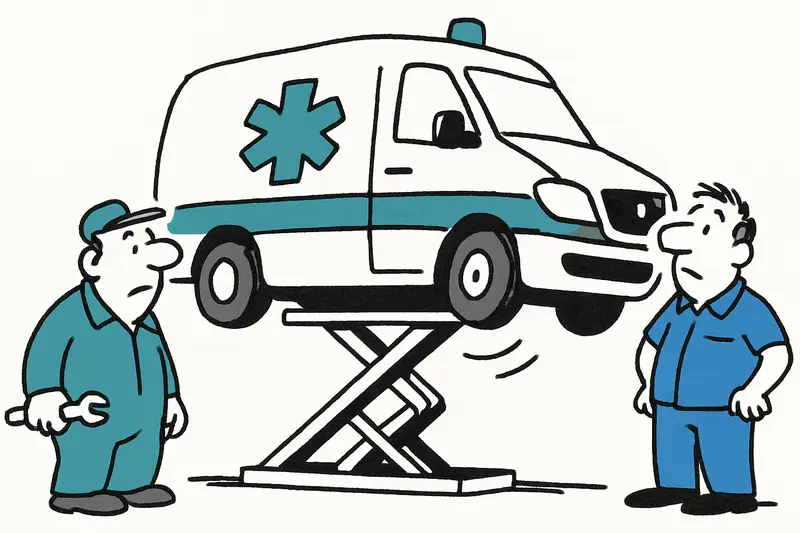
Mechanics work with focused movements: a ratchet clicks, a cordless drill whirs, a hydraulic lift raises the vehicle slightly. The goal is simple and pragmatic — reduce weight so the unladen weight falls back under 3,500 kg. Seats, reinforcements and comfort modules are carefully removed, inventoried and stored. Each vehicle requires several hours, some longer, depending on equipment. The removed parts remain on the island until drivers have a higher licence or another solution is found. Another article that deals with the challenges of the licence shortage is Wenn neue Rettungswagen Steine im Weg sind.
Not all vehicles are affected
It is important to emphasise: this concerns the KTW for planned transports — patients to appointments or transfers between clinics. The emergency ambulances (RTW) remain untouched and ready for use. That reassures the control centres somewhat, because on Mallorca every minute counts — whether the Tramuntana wind slows the MA‑10 or the coast is clogged during rush hour. Information about the availability of the new patient transport vehicles can be found in our article on the key issue: Schlüssel fehlen, Wagen stehen.
Aspects that received little discussion
The public quickly focused on licences and workshops. Three problems, however, received little attention: first, procurement policy. Tenders must include precise weight specifications and strike a balance between patient comfort and legal limits. Second, the liability question. Who is liable if a manufacturer delivers vehicles that later prove to be too heavy for the intended group of drivers? Third, the ecological balance. Removed modules are transported, stored and later reinstalled — additional logistics effort and emissions that are hardly mentioned. In addition, there are currently more than 350 drivers in the Balearic Islands without a driving licence, which complicates the situation. Further details can be found in our article Mehr als 350 ohne Führerschein auf den Balearen.
Concrete opportunities and approaches to solutions
The situation is annoying, but not hopeless. Some pragmatic steps are possible now:
1. Immediate: transparent inventory — All affected vehicles must be documented, removed parts recorded and stored centrally on the island. This prevents chaos and allows timely decisions.
2. Short term: training drive — The Balearic employment service SOIB could offer further training courses for the C1 class. Mobile training in Palma, Inca and Manacor would make participation easier for drivers from rural areas. That costs money, but is often faster than ordering new vehicles.
3. Medium term: revise procurement processes — Future tenders must set realistic weight specifications, optional equipment packages and pre‑weighing procedures before series production. Spot checks at initial acceptance should become mandatory.
4. Long term: promote lightweight construction and modularity — Manufacturers should offer alternative materials and modular components that maintain comfort for patients but are lighter. Grant programmes from the Balearic government could financially support such innovations.
What does this mean for patients and staff?
For most patients little will change: appointments are generally kept, slight delays are possible. For drivers, however, the changes mean more bureaucracy, additional driving lessons and a period of uncertainty. At the same time the situation also holds an opportunity: better control over equipment, clearer processes in the management of vehicles and personnel — provided authorities, manufacturers and service providers now pull together.
You can see workshop doors standing open, mechanics in T‑shirts, the quiet clinking of tools on concrete and the sea on the horizon, stoically still sparkling. The interim solution is pragmatic; the real task remains: to design tenders and inspection processes so that such surprises do not become the norm.
A sober look: technical trouble, organisational work — and the question of how the next generation of rescue vehicles can be designed to be lighter and more modular.
Frequently asked questions
Why are some patient transport vehicles in Mallorca being kept in workshops?
Can you drive a patient transport vehicle in Mallorca with a normal car licence?
Are all ambulances in Mallorca affected by the weight issue?
Will hospital appointments in Mallorca be cancelled because of the ambulance situation?
What is being removed from the patient transport vehicles in Mallorca?
Why is the driver shortage in Mallorca making the vehicle problem worse?
What is the long-term solution for patient transport vehicles in Mallorca?
What does this mean for transport in Palma, Inca and Manacor?
Similar News
After Being Admitted to Hospital Again: Heinz Hoenig and the Questions We Should Ask in Mallorca
Long-time Mallorca resident Heinz Hoenig was admitted to hospital again. A clear “what next?” is missing from the covera...
Yellow Alert: Is Mallorca Prepared for the Next Rain Band?
Aemet has issued a yellow alert for the south, southwest and the island's interior. Thunderstorms and heavy rain are for...
Kegel brothers trial postponed: Why Mallorca must wait for a verdict
The trial of 13 German holidaymakers will not begin until May 2028. The long wait raises questions — for victims, defend...
Chaos on Palma's Runway: Why the Summer at the Airport Was So Disrupted
This summer laid bare where Palma airport is faltering: only just over half of departures were on time and seven percent...
Cocaine Offer on Ham Street: Why the Open Trade Should Ring Alarm Bells
In the middle of Pare Bartomeu Salvà a tourist was offered a packet of cocaine as part of a sunglasses deal. A short int...
More to explore
Discover more interesting content

Can Cap de Bou

Townhouse Lleo 72
