
Pickpockets Caught at the Cathedral — What Palma's Streets Really Need to Be Protected
Pickpockets Caught at the Cathedral — What Palma's Streets Really Need to Be Protected
The Policía Nacional and the Policía Local arrested three alleged pickpockets posing as tourists around Palma Cathedral. A reality check: Why arrests alone are not enough.
Pickpockets Caught at the Cathedral — What Palma's Streets Really Need to Be Protected
Key question: Are arrests enough, or must the city and tourism sector respond differently to coordinated gangs?
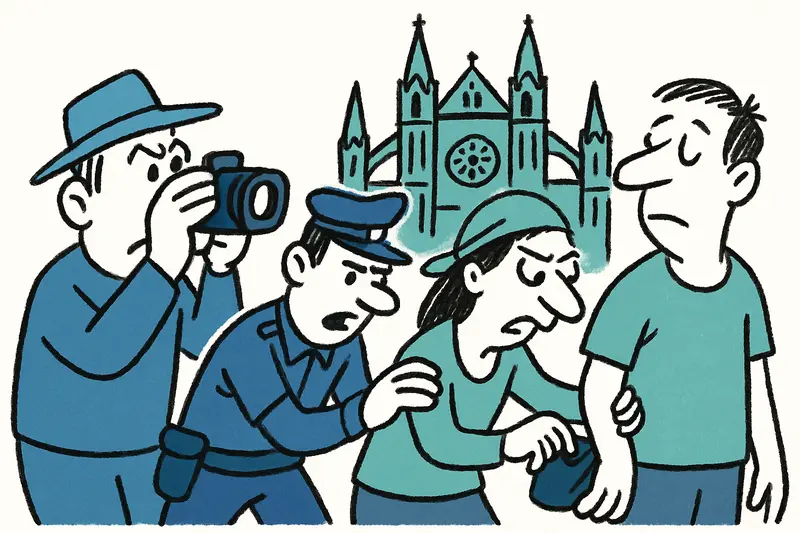
Yesterday and the day before, uniformed and plainclothes officers walked together through the streets around Palma Cathedral and revealed what many here have sensed for some time: well-rehearsed groups operate in the narrow alleys and on the busy squares, deliberately targeting travelers. The Policía Nacional and the Policía Local carried out a joint operation and arrested three suspects — two women and one man, who according to the police are Romanian nationals. The detainees are accused of belonging to a criminal organization and theft.
The scene on site looks familiar: tourists with cameras in front of the cathedral, vendors at La Seu, coach groups on the steps. Exactly where the crowd's attention is divided, the perpetrators acted according to the investigations. They dressed to appear like other holidaymakers and worked in a division of labor — the classic split between distraction, grab and escape that professionals use.
Critical analysis
Arrests are important. But they are a reaction to the symptom, not an answer to the cause. Such gangs move on if the environment offers favorable conditions: dense crowds, confusing alleys, international visitors who display their valuables openly. Most victims are tourists — people in a foreign city, distracted by the view of the cathedral or the glow of the street lamps in the evening. Video footage has captured interventions in tight spots, for example when an attentive passerby stopped a suspected pickpocket at Mercat de l'Olivar.
What is often missing in public discourse is a sober debate about prevention. It is not enough to show a short-term presence on site and then disappear again. We need sustainable strategies that connect the police, city administration, trade associations and the hotel industry.
What usually does not come up in the discussion
First: language barriers. Information in several languages is often missing at airports, train stations and in hotels. Second: training for shop staff so that suspicious situations are recognized more quickly. Third: simple guidance for visitors — not just prohibition signs, but concrete behavioral rules on how to secure cameras, wallets and phones. Fourth: coordinated use of data between police and local businesses, without violating data protection, to detect patterns early.
Everyday scene from Palma
Imagine: it's late morning, the sun is already warm over the Plaça de la Seu; a group of Japanese tourists waits for their guide, a mother feeds pigeons, a street musician tunes a guitar. Between people's feet, thieves weave who look as inconspicuous as another holidaymaker with a sun hat. It is precisely this mix of the familiar and the foreign that makes the situation treacherous.
Concrete solutions
- More visible and plainclothes patrols in shifts that cover peak visiting times, especially around the cathedral and popular shopping streets.
- Information campaigns in multiple languages at key points: airport, port, bus station, hotels and tourist offices. Short and concise: how to protect documents, how to act if you suspect something.
- Cooperation with business owners, such as calls from vendors in s'Hort del Rei who warn of recurring pickpocketing: simple reporting channels for suspicious individuals, routine training for staff to recognize offender patterns.
- Technical aids: watch out for open bags, use RFID-blocking wallets, advice on secure ways to carry backpacks.
Conclusion
The arrest of three suspects is a step forward — it temporarily removes the opportunity for a gang to act. Local episodes, like a pickpocketing chase that ended at a traffic light near Bellver, show the issue is broader and recurring. But for Palma to become permanently safer, we need more than operations: a networked prevention strategy that informs tourists, brings businesses and police together, and makes typical Mallorcan places like the Plaça de la Seu once again places where people can walk without fear.
Frequently asked questions
Why is pickpocketing such a problem around Palma Cathedral?
What should tourists in Mallorca do to avoid pickpockets?
Are plainclothes police useful against pickpockets in Palma?
What places in Palma are most affected by pickpockets?
Is Palma Cathedral safe to visit as a tourist?
What kind of pickpocket tactics are used in Palma?
How can businesses in Palma help prevent pickpocketing?
What is the best time to be extra careful in Palma’s tourist areas?
Similar News

Nipping Sea Creatures: Why Bathers in Cala Major and Elsewhere Should Be Cautious
In Cala Major, bathers have reported being nipped by small fish. What is behind it, how can problems be avoided — and wh...

Forced eviction in Santa Catalina: When a 65-year-old slept in her car and showered on the beach — a question of responsibility
The story of Pilar López from Santa Catalina represents a problem affecting many Mallorcans: How can an island with a bo...
New traffic rules from October 1: What Mallorca visitors and locals need to know
From October 1, 2026, Spain will implement far-reaching changes to traffic regulations. Important for Mallorca: greater ...

More water than last year: Mallorca's reservoirs breathe easier
September rain refilled the Tramuntana's reserves: overall fill around 35 percent, Cúber at 40.42 percent, Gorg Blau at ...

Three Luxury Hotels in Banyalbufar: Lots of Money, Many Questions
A Danish investor plans three exclusive accommodations in Banyalbufar — including the historic Son Valentí. The announce...
More to explore
Discover more interesting content

Can Cap de Bou

Townhouse Lleo 72
