
Port d'Alcúdia: Streets Dug Up, Millions Invested – But What Does It Mean for Local People?
Port d'Alcúdia: Streets Dug Up, Millions Invested – But What Does It Mean for Local People?
Excavators are back in Port d'Alcúdia: concrete-fibre sewer pipes on the Carretera de Artà are being replaced with PVC, millions are being spent on surfacing works and the redesign of Pere Mas i Reus avenue. Why the investment is necessary — and where residents' everyday lives are stumbling.
Port d'Alcúdia: Streets Dug Up, Millions Invested – But What Does It Mean for Local People?
Key question: Who really benefits from the ongoing construction works in Port d'Alcúdia — and who pays the price when traffic lights, delivery vans and construction noise dictate everyday life?
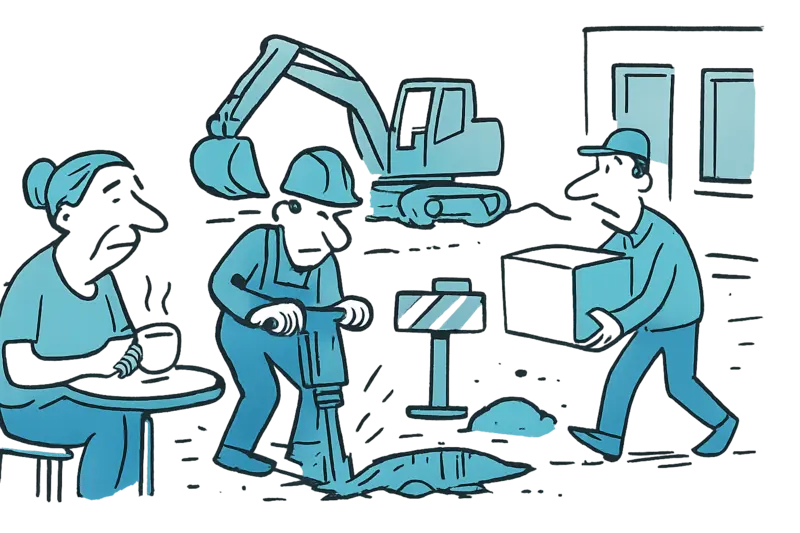
On a cool October morning, when the fishermen are still mending nets and the ice-cream sellers are opening their coolers, another sound suddenly emerges: hydraulic breakers, bulldozers, the beeping of a reversing vehicle. The Carretera de Artà, the main artery through the town's tourist core, has been torn up again — part of the winter works in Port d'Alcúdia and Colònia de Sant Jordi. Workers are exposing old cement-fibre pipes and replacing parts of the system; PVC is planned as the replacement material. At the same time, crews are lifting the pavement at beach access points, and further back the Pere Mas i Reus avenue is getting a new look.
The raw numbers are on the table: €1.9 million is budgeted for renewing the sewer system on the Carretera de Artà; the funds come from the tourism tax. A further €6 million is going into surfacing works for the beach access routes, and another €6 million is planned for redesigning the avenue. Overall, the municipality is carrying out around 35 construction projects — an investment volume that many residents recall seeing only rarely, similar to Mallorca road network investments until 2026. This sits alongside wider proposals such as €525 million for Balearic ports.
Critical analysis: Lots of money does not automatically guarantee smooth processes. The work began in 2025, was interrupted because of the summer season, and has now resumed, as with construction on the harbor promenade. Stopping and restarting is expensive and brings double burdens: residents and businesses do not experience a short but a prolonged construction phase. Hotels and restaurants along the Carretera de Artà quietly complain that uncertain access delays deliveries; for older people a stroll along the promenade suddenly becomes difficult.
Two points have been missing so far in the public debate: first, the question of long-term resilience. Replacing cement-fibre pipes with PVC may make sense in the short term, but how long will these pipes last under salty sea air and changing loads? Second, there is often a lack of clear communication about phases, diversions and emergency access. A notice at the school entrance or a digital construction log could help avoid frustration and lost customers.
Everyday scene: Opposite the roadworks sits the owner of a small café, rhythmically drying cups. She waves to me while a delivery driver balances step by step toward the entrance because the nearest parking space is blocked by construction fences. Children jump over puddles, dogs sniff curiously at new barrier posts. Everyday life and infrastructure investment sit very close to one another.
Concrete solutions, not pipe dreams: First, phased planning with transparent time windows and clear responsibilities — citizens must know on which date which junction will be reopened. Second, temporary loading zones and prioritisation of emergency routes: a routine check of emergency plans before construction starts reduces risks for medical interventions. Third, inspect less visible techniques: where possible, use trenchless methods to avoid unnecessary surface damage. Fourth, a quality check of the pipe materials used and a small long-term study on corrosion resistance directly in the marine environment — this protects future household budgets.
Additionally: a small fund for immediately affected small businesses could offset liquidity shortfalls when deliveries are delayed or outdoor seating is lost. And: modernise construction communication — live construction updates on the municipal website, additional signs in several languages, and a hotline for spontaneous problems would help both residents and tourists alike.
Summarised conclusion: Yes, the money is available, and many works are long overdue. But investment without a plan is just a pile of public spending. Port d'Alcúdia needs not only excavators but a combination of good technology, reliable organisation and consideration for everyday life. Otherwise what remains is a lot of asphalted pride and an entire summer in which local people had to live with detours and noise for months.
Who benefits in the end? The answer depends on whether the next phase of work is smartly timed — and whether the administration is prepared to distribute the burdens fairly: between tourists, entrepreneurs and the people who live here. The construction sites cannot be wished away. But they can be planned better.
Frequently asked questions
How will ongoing roadworks in Port d'Alcúdia affect locals and visitors?
Are PVC pipes a good long-term choice for Port d'Alcúdia's sewer upgrade?
How is construction communication being improved in Port d'Alcúdia?
What planning improvements could reduce disruption during Port d'Alcúdia's works?
Is there support planned for businesses affected by Port d'Alcúdia roadworks?
Which areas in Port d'Alcúdia are most affected by the roadworks?
How extensive are the Port d'Alcúdia construction projects and what money is involved?
What can residents expect regarding timelines and completion of Port d'Alcúdia's works?
Similar News

After TV Feature: Why the Unsolved Bierkönig Case in Mallorca Raises Questions Again
The murders of Manfred Meisel, his son Patrick and an employee remain an open case. A nationwide TV program has brought ...

Uninvited Guest in Santanyí: 20-Year-Old Climbs Over Terrace into Stranger's Hotel Room
In Santanyí an intoxicated 20-year-old German gained access to an occupied hotel room through the sliding door, jumped o...

Superyacht "Nord" off Andratx: What does it mean for Mallorca?
The 142-metre superyacht "Nord" recently anchored off Port d'Andratx. Why does a single vessel trigger debates about own...

New Hope in an Old Case: What the Search for Meisel's Murderer Can Achieve Now
Nearly three decades after the murder of Manfred Meisel at a finca near S'Aranjassa, a TV manhunt is once again focusing...

Fake Emails and €320,000: How Trust in the Fruit Trade Was Abused
Three men posed as a Mallorcan fruit supplier and induced a German company to transfer €320,000. A court hearing shows h...
More to explore
Discover more interesting content

Can Cap de Bou

Townhouse Lleo 72
