
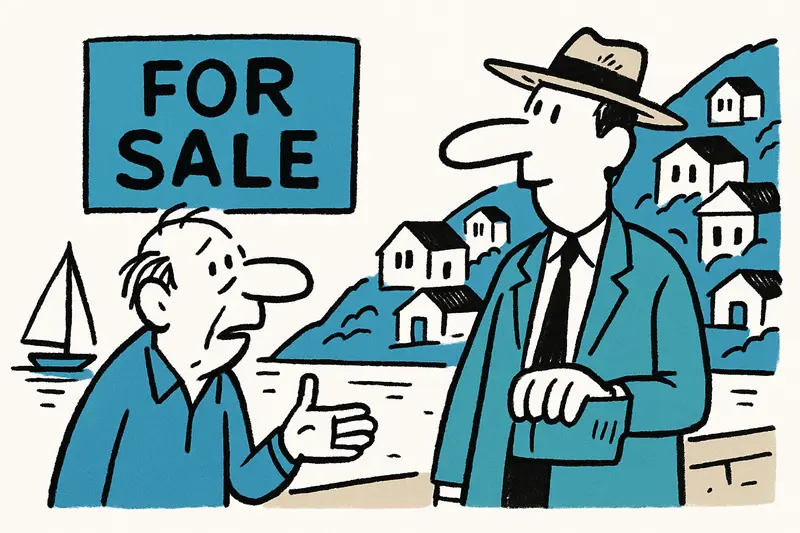
Port d'Andratx and the Dream of a Second Home: Who Owns the Island?
Port d'Andratx and the Dream of a Second Home: Who Owns the Island?
New notary statistics: In some Mallorcan municipalities most purchases are made by people who live here less than half the year. A reality check on what this means for neighborhoods, rents and everyday life.
Port d'Andratx and the Dream of a Second Home: Who Owns the Island?
Key question
Who really benefits from a property market in which a large share of buyers do not live permanently in the Balearics — and what price does the island pay for it?
Critical analysis of the numbers
The latest figures from the Spanish notary show a clear pattern: many property purchases in Mallorca are made by people who do not meet Spain's definition of residents, as highlighted in New notary figures show: 42% of property purchases in the Balearic Islands go to foreigners. Concretely, this creates a split market. On one side are high-priced second-home purchases, particularly concentrated in places like Port d'Andratx, Santanyí, Calvià or Pollença, a dynamic explored in When Villages Become Seasonal Backdrops: Why Second Homes Dominate in Mallorca. In Port d'Andratx the share of non-resident buyers is around 90 percent according to the figures — a value that can hardly be read as anything other than a massive inflow of capital without permanent integration into the local economy.
At the same time, almost one in six purchases is carried out by legal entities; in Sa Pobla, for example, companies were responsible for over 40 percent of transactions. Such structures change supply, prices and forms of use — housing is treated more as an investment than as a place to live.
What is missing in the public debate
There is much talk about rising prices, but often too little about the mechanisms behind them: empty second homes, pressure on long-term rentals, the influence of company purchases on neighborhoods, an issue analysed in Part-time Villages: How Second Homes Are Hollowing Out Mallorca's Communities. Also underexposed is the question of how tax systems and registration rules work: anyone who spends less than 183 days in the country is not considered a tax resident — this affects whether and how municipalities can realize revenue from tourism, property taxes or capital gains sales.
Transparency must also be part of the debate: who really owns the seaside villas when purchase contracts are carried out through companies? And what role do intermediaries and international notarial flows play in obscuring the ultimate economic owners, as discussed in Why so much property buying in Mallorca is paid in cash — and what that means for the island?
Everyday scene from Port d'Andratx
A Tuesday morning in the harbor: the sailboats lie still, the fishmonger on the corner empties his crates, two pensioners sit with espresso in front of the café on the square, flipping through the newspaper. Real estate signs hang on some houses, luxury inquiries arrive by email — and yet many villas close their shutters in the afternoon because the owners are not on site. The village breathes differently: tourist groups during the day, quiet in the evening, in some streets an almost complete absence of neighbors who would help shape the district.
Concrete solutions
What can be done locally and regionally? Here are six pragmatic ideas that authorities, municipalities and citizen groups should consider:
1) Tighten transparency requirements: Clearer registration of beneficial owners, including for purchases made through companies. Public registers would make speculation more difficult.
2) Purpose and documentation requirements: For certain subsidies or rezonings, use as a primary residence could be required for a defined period — coupled with clawback rules if conditions are not met.
3) Vacancy tax: Municipalities could consider imposing a levy on properties declared as second homes and left empty for long periods — revenue would go to social housing or rental subsidies.
4) Support for resident buyers: Grants or tax relief for first-time buyers who take up permanent residence on the islands, tied to proof requirements (employment contract, children's school attendance).
5) Control over corporate buyers: Restrictions or reporting obligations for company purchases of residential properties in particularly sensitive municipalities to make pure investment vehicles harder to use.
6) Strengthen local planning authority: Municipalities should have more levers over land use and housing supply — for example through mandates for affordable housing in new development projects.
Why this matters
These measures are not attacks on property, but attempts to restore balance: an island needs people who work here, raise children, and enliven clubs and associations. If property is mainly an investment, part of community life withers — and that is felt not only in rent levels, but in schools, bus routes and small shops.
Concise conclusion
The notary figures are a wake-up call. Port d'Andratx or Santanyí may be perfect for investors — but they pose risks for the local community. Politicians and civil society must now work on transparency, incentives for residents and clearer regulation of corporate buyers. Otherwise Mallorca risks trading parts of its vibrant everyday life for a pretty but empty postcard image.
Frequently asked questions
Why are property prices in Mallorca so high in places like Port d'Andratx?
Can foreigners buy property in Mallorca?
How does buying a second home affect everyday life in Mallorca?
What does it mean if a property buyer is not a tax resident in Spain?
Why are some Mallorca homes bought through companies?
Is Port d'Andratx mostly a place for holiday homes now?
What can Mallorca municipalities do about empty second homes?
Which Mallorca areas are most associated with high-end second-home buying?
Similar News
Why the End of "Los Últimos Mohicanos" Is More Than the Closing of a Bar
With squealing tires and one last glass, an icon on the Palma–Manacor expressway closes. Why the demise of this German b...

Protest camp on Plaza España: Who asks for solutions to the right to housing?
Around 30 activists set up a tent camp on Palma's Plaza España to push for stronger tenant rights. Our analysis asks: Ar...

In the Name of a Gang: Alleged Extortion in El Molinar and What It Reveals About the Protection of Sex Workers
A man is accused of posing as a member of the Hells Angels and extorting two women at accommodation in El Molinar. The s...

When Chile Meets the Mediterranean: A New Flavor at Can Bordoy
At Can Bordoy in Palma's old town, Chilean chef Jhonatan Maldonado combines Patagonian seafood with Mediterranean island...

End of an Era on the Ma-15: Why the Biker Hangout at Son Gual Is More Than Just a Restaurant
"Los Últimos Mohicanos" closes unexpectedly. A meeting place for motorcyclists on the Palma–Algaida border is disappeari...
More to explore
Discover more interesting content

Can Cap de Bou

Townhouse Lleo 72
