
Toxic Beach Visitors: Portuguese Man‑of‑War Approaches – How Prepared Is Mallorca?
Toxic Beach Visitors: Portuguese Man‑of‑War Approaches – How Prepared Is Mallorca?
Portuguese man‑of‑wars are being spotted more often off Spain's coasts. Key question: Are Mallorca's beaches sufficiently prepared — for bathers and rescue teams?
Toxic Beach Visitors: Portuguese Man‑of‑War Approaches – How Prepared Is Mallorca?
Key question: How well are Mallorca's beaches and rescue services prepared for the Portuguese man‑of‑war, and what is missing from the public debate to keep bathers safe?
In recent days, buoys, nets and the usual swallows along the Paseo Marítimo haven't muted the scene: the smell of coffee mixes with salty air, fishermen mend nets in the harbor, and a lifeguard on the promenade shades his eyes as he scans the horizon. But the sea is bringing more than wind and waves right now: specimens of the Portuguese man‑of‑war have reappeared off the Canaries, and there have also been sightings around Mallorca in recent years.
The animals, often referred to as jellyfish, are actually colonies of individual organisms—siphonophores—with long tentacles that can cause painful stings. Important to know: detached tentacles remain active. In isolated cases, stings have caused such severe pain that people sought medical guidance on jellyfish stings.
Critical analysis: what works and what doesn't
Basic equipment on busy beaches works: lifeguard towers, radios, first‑aid kits. But there are gaps. First: information. Warning signs are often only in Spanish and are installed hesitantly, if at all. Many tourists do not read or do not understand the notices. Second: first aid is inconsistent. Different municipalities use different practices for treating jellyfish stings—this creates uncertainty among rescuers and frustration for those affected. Third: reporting channels. Sightings are still too often announced by chance on social media instead of through standardized reporting systems that automatically inform lifeguards and beach operators.
What's missing from the public debate
There is a lack of clear data on incidents, uniform first‑responder rules, and a visible, multilingual warning policy during the high season. People talk a lot about individual sightings but little about which beaches are particularly vulnerable—such as coves where currents push debris ashore. The workload of lifeguards outside the peak season is also a taboo: they often work reduced shifts even though weather conditions can lead to jellyfish accumulations.
Concrete solutions
1) Uniform notices: clear, highly visible signs at beach access points in Spanish, English and German, plus pictograms. 2) Standardized first‑aid protocols for jellyfish stings, coordinated with health centers: uniform kits in lifeguard towers (gloves, tweezers, saline solution or seawater supply, covering materials). 3) Reporting platform: a simple sighting report function that sends SMS/push notifications to beach guards and the municipality. 4) Early detection: cooperation with meteorological services for current and yellow warnings for wind and seas; use of drones for rapid overview at exposed coves. 5) Education: short information leaflets in hotels and tourist offices, and regular training sessions for rescue teams outside the summer season.
Everyday scene as a warning
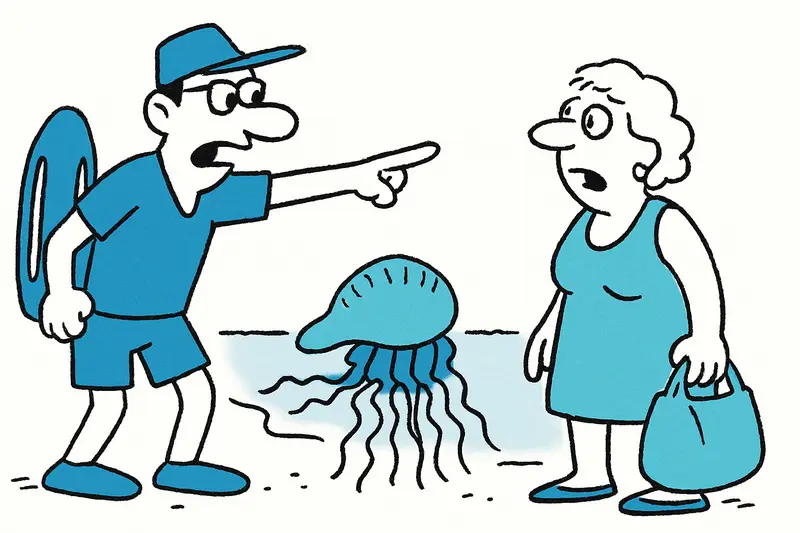
A Tuesday morning in Cala Major: an older woman with a shopping bag stops when a lifeguard raises the orange signal booklet. He explains in a low voice that a net is hanging at the north point and that people should not enter the water today. The woman nods, lifts her bag higher and continues along the shore path. Small scenes like this show: information helps—if it is available on site and understandable.
Communicate balanced risks
It is important not to cause panic. The Portuguese man‑of‑war does not arrive at every beach every day. It follows currents and can disappear quickly, especially in the cooler Mediterranean waters. Still, a single incident can seriously injure a person. Authorities and tourism officials should inform calmly but clearly: avoid downplaying the risk, but don't sensationalize it.
Who pays when beaches are closed?
Beach closures along Spain's Mediterranean coast hit hotels, equipment rental businesses and small vendors. A transparent communication strategy helps mitigate economic damage: early warnings, alternative beach recommendations and up‑to‑date information for tourist groups reduce frustration and surprises.
Concrete proposal for the coming season: pilot project on three beaches (one urban beach, one tourist beach and one small cove): install multilingual information boards, introduce a sighting hotline, and provide two additional weeks of first‑aid training for rescue teams. Evaluate afterward, with costs shared between the municipality, the tourism board and insurers.
Concise conclusion
The key question remains open, but not hopeless: Mallorca has the infrastructure to cope with the man‑of‑war. What is missing is coordination, standardization and clear, multilingual information. If we better inform promenades, train rescuers and report sightings systematically, the risk can be significantly reduced—without turning a day at the beach into a catastrophe.
Anyone walking by the sea should stay alert, respect lifeguards' instructions and report sightings. And municipalities? A look at the signage during the next coffee on the Passeig Mallorca often tells more about preparedness than a press release.
Frequently asked questions
How safe are beaches in Mallorca when Portuguese man-of-war appear?
What should I do if I get stung by a Portuguese man-of-war in Mallorca?
Are jellyfish warnings on Mallorca beaches easy for tourists to understand?
When are Portuguese man-of-war more likely to show up near Mallorca?
Which Mallorca beaches are more vulnerable to jellyfish or man-of-war sightings?
How do lifeguards in Mallorca deal with Portuguese man-of-war sightings?
Are beach closures for jellyfish or man-of-war a problem for Mallorca tourism?
What would improve Portuguese man-of-war preparedness in Mallorca?
Similar News

Released with Conditions: The Plus Ultra Suspicion and a Mallorcan Finca as Residence
A Dutch entrepreneur, sought in connection with the Plus Ultra case, was extradited to Spain after his arrest in Germany...

Haute Nuit in Puerto Portals: Fashion, Art and Indulgence by the Water
On October 2 the Lobster Club in Puerto Portals will be transformed into a stage for curated fashion, art and culinary e...
Magaluf: Watchtower Alarm – Lifeguards Pull Unconscious Beachgoer from the Water
After a drama in the late afternoon, two lifeguards at Magaluf beach rescued an unconscious 44-year-old man. He was stab...
Turquoise in the City: How dangerous is the color play of the Sa Riera?
The Sa Riera in Palma suddenly turned turquoise — a pretty motif, but behind the effect lies a discharge of saline waste...

Jeckliner at Sunnesching: Cologne spirit sets sail from Palma
In September 2027 the Mein Schiff 2 briefly becomes a floating carnival stage: four days with Cologne bands, comedy and ...
More to explore
Discover more interesting content

Can Cap de Bou

Townhouse Lleo 72
