
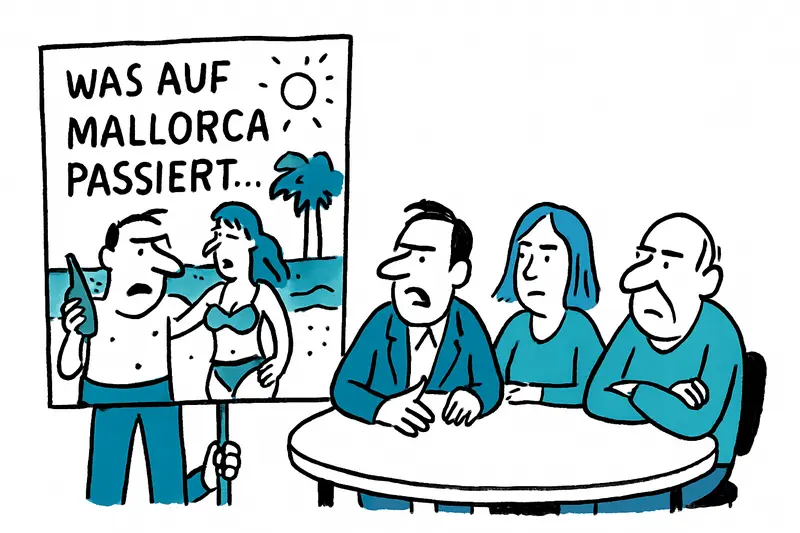
Poster for "What Happens in Mallorca..." Sparks Outrage in Capdepera — Why the Problem Runs Deeper
A hotel banner openly promotes excesses at Cala Agulla. Capdepera convenes a roundtable. Advertising that encourages disorder meets poor coordination — and tired neighbors.
Poster for "What Happens in Mallorca..." Sparks Outrage in Capdepera — Why the Problem Runs Deeper
Key question: Is advertising allowed to portray a travel destination as a free pass for excessive behavior — and who stops it when the municipality is left on its own?
Critical analysis
Tensions in Capdepera are high. The municipality has had a difficult May, the police reported weekend interventions, and now a banner hangs on a hotel with slogans like "What happens in Mallorca stays in Mallorca" and "Everything is consumed in Mallorca." Such messages imply the island is a space without rules, echoing recent controversies such as Posters, Provocation, Polarization: How Mallorca's Streets Become a Campaign Ground. Advertising effects and reality are drifting apart: while marketing lures visitors, municipalities, environmental and regulatory authorities face the task of protecting land and residents. This is not just a cosmetic issue; the message normalizes alcohol excesses, loud parties and disrespectful behavior in a protected natural area like Cala Agulla.
What is missing in the public discourse
So far the debate has focused a lot on individual incidents: parties, riots, single banners. Rarely does it consider the causal chain: How do advertising messages influence regulatory action? Who checks whether a poster violates existing advertising or equality rules? And: where is the obligation for big companies to respect local protection rules? Practically no one is calling for binding rules for tourism advertising or sanctions when commercial messages contribute to inciting illegal behavior — concerns similar to those raised in the Poster Dispute in the Balearic Islands: How Much Provocation Can Public Space Tolerate?. The void is then filled by the streets — residents, beach cleaners and already overburdened local officials.
Everyday scene at Cala Agulla
You only need to go to the bus stop at Cala Agulla on a Saturday night to see the situation: tour buses unload groups, young people carry coolers and Bluetooth speakers, the air smells of barbecue smoke and sunscreen. A patrol circles the car park while beach-cleaning machines collect empty cans early in the morning. Applause for the scene is rare. Neighbors in Cala Rajada report repeated sleep loss, trash spots on the promenade and taxis weaving to pick up groups. These details are not sensational — they are the everyday chaos that emerges when rules are enforced only sporadically.
Concrete solutions
Capdepera reacted correctly by convening a "Roundtable on transforming the destination and against excess tourism" for June 25. However, clear measures must follow quickly:
1) Advertising law review and guidelines: Municipalities, together with the Balearic tourism authority, should develop binding advertising rules. Advertising that encourages excessive alcohol consumption or illegal behavior must be prohibited and subject to fines.
2) Permits for hotel advertising: Local building permits and advertising applications must in future also assess social impacts. A banner that harms residents or incites criminal behavior must not be approved.
3) Coordinated deployment plans: Police, Guardia Civil official website, environmental wardens and municipal inspectors need coordinated weekend plans. Mobile units on access roads and limits on group sizes at the beach could help.
4) Sanctions against organizers and merchants: Deterrent fines for organizers who hold illegal parties, and for vendors who sell alcohol to minors or obviously intoxicated persons.
5) Prevention instead of only repression: Information campaigns in multiple languages at the airport, car rental stations and with property managers: clear codes of conduct, environmental information and notices about fines — before the party starts.
6) Involvement of the hotel industry: Hotels and event organizers should be bound by conditions: no external banners that encourage excesses, a guest code of conduct, and penalty clauses in hotel contracts for breaches.
Why this matters
This is not about moralizing against tourists. It is about protecting nature, nighttime peace and the sense of safety of the people who live here. Such goals cannot be achieved with lip service or sporadic criticism of advertising. If an advertising message suggests rules are merely recommendations, they become meaningless in everyday life.
Concise conclusion
Capdepera responded appropriately: remove the banner, initiate a review, convene a roundtable. That is not enough. Binding advertising rules, reliable coordination between authorities and sanctioning instruments against organizers are needed. Otherwise it will remain a weekly cleaning schedule and the tired voice of the residents. In short: if advertising is taken seriously, its consequences must be regulated. Mallorca must not be a slogan, but a vibrant place with rules.
Frequently asked questions
Why did the Mallorca poster in Capdepera cause such outrage?
Is it legal in Mallorca to advertise partying and alcohol excess?
What problems are residents in Cala Rajada and Cala Agulla dealing with at night?
What should I know before visiting Cala Agulla in Mallorca at the weekend?
When is Mallorca most affected by excess tourism and party crowds?
What measures are being discussed in Capdepera to reduce tourism excess?
Why do local authorities in Mallorca struggle to control party tourism?
How can hotels in Mallorca avoid advertising that upsets local residents?
Similar News
2.1 tonnes of cocaine on sailing yacht off Spain's coast – a reality check for the coastguard
A 14-metre yacht was seized with 2.1 tonnes of cocaine. Who monitors the ports, how does the international hunt succeed ...

Heat Bonus in Mallorca: 100 Euros Extra for Outdoor Staff at MarSenses
MarSenses pays employees who worked outdoors in August an extra €100 as recognition. Lighter uniforms, reduced hours for...

Renovating in Mallorca: What You Really Can Do Without Neighbour Consent
Many think they can do whatever they want in their apartment. That's partly true — but only as long as structural elemen...
Cafetería San Siro: A Meeting Place on Schinken Street Since 1966
In the middle of Schinken Street, Cafetería San Siro has been offering Mallorcan hospitality for more than six decades —...

From Ballermann to Prison: What the Verdict Against the Femina Operator Means for Palma
The Munich Regional Court convicted a German operator for subsidy fraud. What does the verdict mean for the Femina Club,...
More to explore
Discover more interesting content

Can Cap de Bou

Townhouse Lleo 72
