
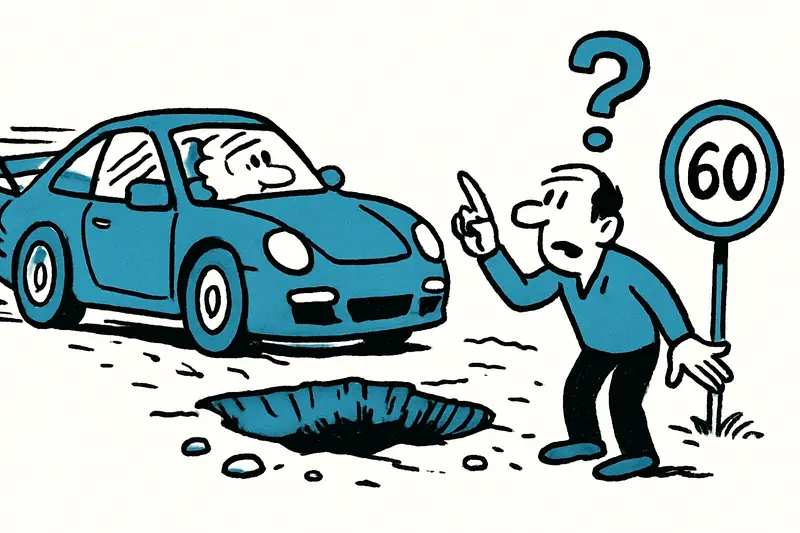
Pothole, Speed, Question Mark: How Safe Are Mallorca's Rally Stages Really?
Pothole, Speed, Question Mark: How Safe Are Mallorca's Rally Stages Really?
New clues about a pothole and excessive speed have emerged in the fatal Porsche crash on the MA‑10. What does this say about course safety and the role of the 'Zero Car'? A reality check with concrete demands.
Pothole, Speed, Question Mark: How Safe Are Mallorca's Rally Stages Really?
New clues about the fatal Porsche crash on the MA‑10 raise practical and organizational questions
On Friday a white Porsche 911 GT3 RS went off the MA‑10 at kilometre 10 in the Tramuntana mountains and plunged down an embankment. The driver, the 63‑year‑old co‑founder of the restaurant chain L’Osteria, was killed. His passenger, 39‑year‑old racer Christina Ettel, survived with serious injuries and, according to her own statement, remains in intensive care. She suffered fractures to the first cervical vertebra and the fourth thoracic vertebra, plus a compression injury to the third thoracic vertebra and a liver contusion. The Guardia Civil is currently investigating the circumstances of the accident.
The event was a rally in which the crashed car was acting as a so‑called Zero Car (start number 000): a lead vehicle that drives the route shortly before the registered competitors to identify potential hazards. Here lies the odd paradox: a vehicle intended to rule out risks has itself been fatally involved in an accident.
Early indications suggest that an irregularity in the asphalt immediately before a right‑hand bend may have affected the vehicle's control. Excessive speed is also being considered. Weather is currently being ruled out. The remaining rally stages were cancelled after the crash while further checks are carried out.
Key question: Is current practice at rallies in Mallorca sufficient to protect lives — even for vehicles deployed to anticipate hazards?
A sober analysis reveals several problem areas: the MA‑10 is a scenic but winding connection between Pollença and Lluc. Narrow stretches, walls, drop‑offs and tight escape areas are part of daily life for residents and visitors. On many sections the road surface is older; cracks and breakouts appear more quickly after hot summers or heavy rain. For events that operate at high speeds, this is an increased risk.
Responsibilities need clarification: island roads are usually managed by the Consell, while state roads fall under the Ministerio. Before a motorsport event, routes must be inspected and, if necessary, repaired. Organisers rightly point out that required permits and safety standards should be in place. But the fact that a lead vehicle crashed shows that formalities completed on paper do not automatically equal practical safety.
What has been missing in the public debate so far is a clear account of the specific checks carried out beforehand. Were detailed measurement protocols of the road surface produced? Were visual inspections made immediately before the start by technical teams? How often are temporary barriers, catch fences or additional warning signs placed on tight corners? And: what speed range do Zero Cars operate within — are there binding limits?
An everyday observation: on a cool October afternoon on the MA‑10 you see mountain bikers, island residents with pickup beds, tourist minibuses and occasionally racing cars testing the route. The mix of recreational traffic and racing activity demands strict separation and control. Otherwise it remains a dangerous mash‑up.
Concrete solutions that can be implemented without long political wrangling:
1.) Mandatory checklist and documented reconnaissance: Each stage should have a standardized checklist for road surface, guardrail and obstacle inspection, signed by those responsible and available digitally.
2.) Speed rule for Zero Cars: Lead vehicles should have binding maximum speeds and a mandatory telemetry log that, if needed, shows how fast and where the vehicle was driving.
3.) Short‑term road repairs: Small potholes or breakouts must be repaired before a competitive stage takes place. If that is not possible, the route must be altered or cancelled.
4.) Technical protections at critical points: Mobile catch nets, additional warning signs and temporary edge reinforcements at known danger spots.
5.) Independent investigation: An external expert report, published and transparent to the public, prevents speculation and creates learning material for future events.
This is not a wishlist but pragmatic measures that already help in comparable regions: transparency, documented rules and technically simple interventions significantly reduce risks.
Those thinking now of the bereaved are right: the entrepreneur leaves behind a wife and four children; family and friends are mourning. The racer has publicly thanked helpers, the organiser and supporters. Both require sensitivity in the debate: criticism of processes must not turn into voyeurism.
Pointed conclusion: if a car meant to warn of dangers becomes a deadly trap itself, then this is not solely the driver's misfortune. It is an alarm signal for organisational gaps. Mallorca is a stretch of road, houses, olive groves and human lives — and precisely for that reason we must insist at every rally that safety is not just a formality, but something to be checked, documented and changed until it works.
Frequently asked questions
How safe are Mallorca rally stages for locals and visitors?
What pre-rally road checks are recommended for Mallorca stages?
Should Zero Cars have speed limits in Mallorca rallies?
Why is independent investigation important after a Mallorca rally incident?
What practical safety measures could Mallorca rally organizers implement to reduce risk?
Who is responsible for road safety on Mallorca rally routes?
What challenges do Mallorca's MA-10 road conditions pose for rally safety?
How can safety measures protect both racing activity and residents on Mallorca roads?
Similar News
Lifesaving at Palma Provincial Court: Forensic Doctor Begins Resuscitation, SAMU Transports Man to Hospital
On Monday a 53-year-old man suffered cardiac arrest at the Palma provincial court on Avinguda d'Alemanya. An on-duty for...

Lured to Palma with a Fake Job Offer – Forced into Prostitution: What Is Missing from the Debate?
A young woman from South America traveled to Palma hoping for work — instead of a restaurant job she faced sexual exploi...
When the Old Town Sleeps — and Some Remain on the Street
At night Palma's Old Town grows livelier, its alleys filling with visitors. At the same time, more and more people are l...
After Accident in the Tramuntana: Mourning — and the Question of Rally Safety
The death of Klaus Rader at the Rally 550 Challenge Mallorca has shaken island residents and participants. His wife aske...
Does Pedro Sánchez Have Better Odds in New Elections? A Reality Check from Mallorca
Sánchez weathers setbacks, forms tactical coalitions — but is that enough in new elections? A critical look with an ever...
More to explore
Discover more interesting content

Can Cap de Bou

Townhouse Lleo 72
