
Lifesaving at Palma Provincial Court: Forensic Doctor Begins Resuscitation, SAMU Transports Man to Hospital
Lifesaving at Palma Provincial Court: Forensic Doctor Begins Resuscitation, SAMU Transports Man to Hospital
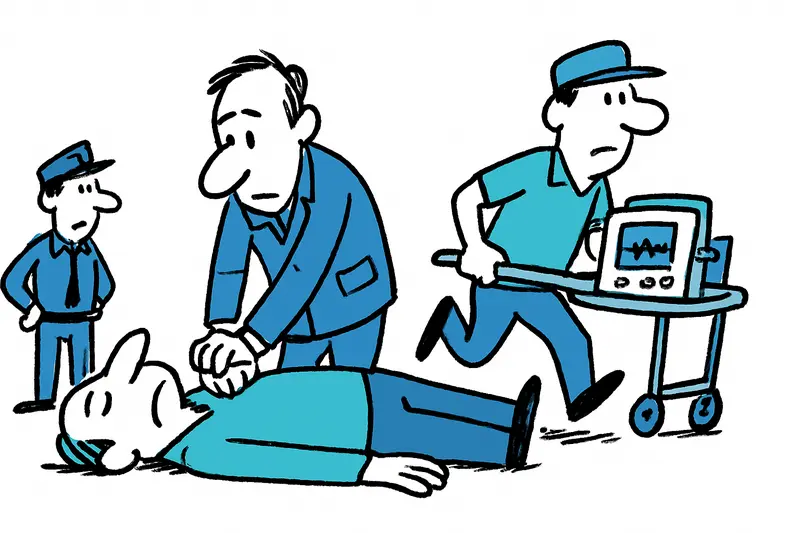
On Monday a 53-year-old man suffered cardiac arrest at the Palma provincial court on Avinguda d'Alemanya. An on-duty forensic doctor immediately began resuscitation; SAMU 061 later took over and brought the man, stabilized, to the intensive care unit.
Lifesaving at Palma Provincial Court: Forensic Doctor Begins Resuscitation, SAMU Transports Man to Hospital
An incident in the morning shows how quick action can save lives
Last Monday at around 10 a.m., a 53-year-old man collapsed in the Palma provincial court. He was on the second floor of the building on Avinguda d'Alemanya, suddenly sank to the floor and lost consciousness — a classic cardiac arrest.
The first minutes decided: a forensic doctor on duty in the building reacted without hesitation. He began cardiopulmonary resuscitation and thus provided the vital bridge until the emergency services arrived. Such unexpected acts of heroism aren't seen every day on the island, as occurred in Port d'Andratx: Tourist Resuscitated by Bystanders and Police After Cardiac Arrest, but they do occur in public buildings — and then every minute counts.
Shortly thereafter, a team from the medical emergency service SAMU 061 arrived. Equipped with an external defibrillator, the team worked closely together with the already ongoing CPR efforts. The local police were also on site to secure the area and clear access routes.
The paramedics had to work persistently: they continued resuscitation for more than half an hour. Finally they managed to restore circulation; the patient was stabilized and taken to the intensive care unit of a nearby hospital. At that point all involved had the same goal: to hand the man over alive to the emergency services.
Such operations are a reminder of the importance of well-functioning chains of responsibility; cases like Cardiac Arrest on Can Picafort Beach: Questions Remain and Ideas for the Future have raised similar issues. An on-duty physician in the building, an easily reachable emergency service, clearly regulated access routes — all of this together makes the difference. On Avinguda d'Alemanya, where lawyers, judges and visitors often stream through in the mornings, it was this cooperation that apparently led to success.
And it's a reminder to all of us: basic resuscitation skills and the proper use of defibrillators can save lives. In a small neighborhood café or in front of the court building — anyone can help when the situation demands it. In Mallorca there are courses and initiatives where one can learn these techniques in a few hours; anyone with time should consider taking them. The issue of tourist safety and preparedness is also discussed in Cardiac Arrest in Caimari: Are Mallorca's Villages Prepared for Medical Emergencies Involving Tourists?.
In the end, gratitude remains: for the quick action of the forensic doctor, for the professional work of SAMU 061 and for the police officers who enabled the procedures. The hope now is that the man brought in remains stable in hospital and recovers. Similar tragedies and their aftermath are examined in Playa de Palma: Death at Balneario 2 – How good is Mallorca's help for people in need?.
In a small scene in front of the court portal one could later hear everyday life again: footsteps on the steps, the clatter of briefcases, a barista heating up his machine — and the quiet knowledge that in the morning people had worked together to save a life.
Frequently asked questions
How did a forensic doctor help during a cardiac arrest at Palma's provincial court?
How do access routes and police support help emergency rescues in public buildings in Mallorca?
Can residents of Mallorca learn CPR and how accessible are defibrillators?
What equipment is used during a cardiac arrest by Mallorca emergency services?
What does this Palma incident illustrate about patient outcomes after cardiac arrest in Mallorca?
Why are basic resuscitation skills important for residents of Mallorca?
How do authorities coordinate during medical emergencies in public buildings in Mallorca?
What practical steps can Mallorca communities take to improve outcomes in medical emergencies?
Similar News
Lured to Palma with a Fake Job Offer – Forced into Prostitution: What Is Missing from the Debate?
A young woman from South America traveled to Palma hoping for work — instead of a restaurant job she faced sexual exploi...
When the Old Town Sleeps — and Some Remain on the Street
At night Palma's Old Town grows livelier, its alleys filling with visitors. At the same time, more and more people are l...
After Accident in the Tramuntana: Mourning — and the Question of Rally Safety
The death of Klaus Rader at the Rally 550 Challenge Mallorca has shaken island residents and participants. His wife aske...
Does Pedro Sánchez Have Better Odds in New Elections? A Reality Check from Mallorca
Sánchez weathers setbacks, forms tactical coalitions — but is that enough in new elections? A critical look with an ever...
Ses Salines Celebrates Art: ArtinSal Turns the Village into a Gallery
More than 70 artists, open houses, music on the Plaça Sant Bartomeu and the Església Vella as an exhibition space: Artin...
More to explore
Discover more interesting content

Can Cap de Bou

Townhouse Lleo 72
