
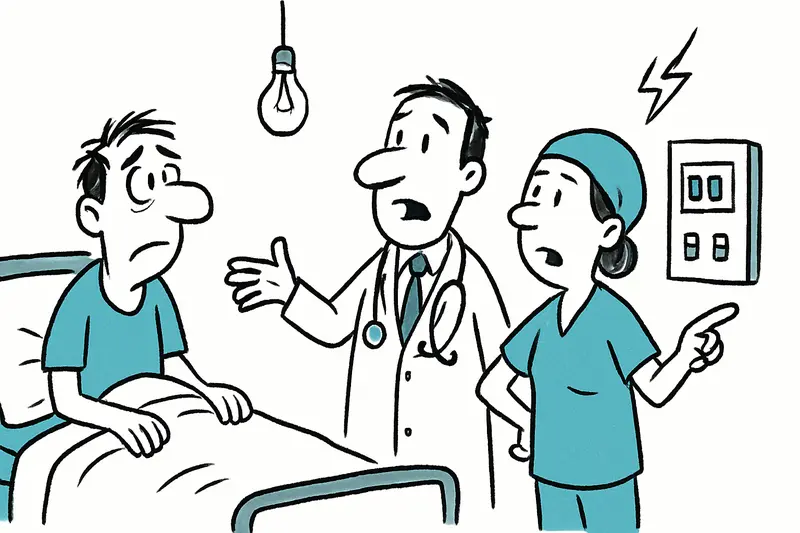
Power outages in Manacor: What happens in the hospital when the lights go out?
Power outages in Manacor: What happens in the hospital when the lights go out?
Repeated power outages at Manacor Hospital during the switchover to a new electrical system are causing unrest. We ask: How safe are patients and how transparent are the works being carried out?
Power outages in Manacor: What happens in the hospital when the lights go out?
Main question: Are patients sufficiently protected during the switch to the new power system?
Over the weekend the lights at Manacor Hospital have been flickering repeatedly, with reports of short shutdowns circulating among relatives and staff. The official reason is: the power supply is being gradually switched to a new system. This is part of a major upgrade, budgeted at 59 million euros for the Balearic Islands. It sounds technical – for people on the wards it means uncertainty. And that is exactly the question we must ask: How well are emergency plans, backup systems and communication organized?
On the forecourt of the emergency department you can hear the clicking of radios in the morning, the smell of fresh coffee from the machine next to the staff room and the distant wail of a siren from an ambulance. Nurses push files, a delivery van maneuvers at the entrance. Such everyday scenes are perfectly normal – until a planned switch-over is due. Then the routine start of a shift becomes more strenuous: additional checks on monitors, manual switching of devices, brief interruptions during procedures. These scenes describe practiced handling of small disruptions; the bigger concern, however, is longer or unplanned outages.
Brief technical analysis: switching a main power supply is not a trivial lamp replacement. It involves transformers, sub-distributions and the handover from primary to secondary supply paths. Hospitals usually operate with redundant systems – UPS (uninterruptible power supplies), diesel generators, automatic transfer switches. What matters is how often and for how long the primary supply is intentionally interrupted, and whether these interruptions can be bridged under normal operations. The public descriptions often lack the necessary precision here: When exactly will the switching occur? Which areas are affected? How long does the switchover take?
What has hardly appeared in the public debate so far are the details of the risk assessment for critical areas such as the intensive care unit, operating theatres and laboratories. A breakdown of whether these are planned, tested sequences or ad-hoc works would also be important. Transparency is not a luxury but a matter of safety. Relatives want to know whether dialysis is running, whether scheduled surgeries are postponed and how long recovery rooms might be affected.
Concrete solutions that could be implemented immediately: first, a clear, daily switching schedule on the hospital website and posted at the main entrance; second, a hotline or brief WhatsApp updates for relatives of inpatients; third, prioritization of critical areas during switching and the use of separate generators for the ICU and operating theatres. Fourth: small but effective drills with staff that simulate a power failure so procedures become automatic; fifth: independent checks, for example by technical inspectors from the island government, before the system goes fully operational.
Financial question marks remain: 59 million euros is given as the total amount for the upgrade. What portion of that goes specifically to the electrical main supply, to emergency generators or to fire protection technology remains unclear. A transparent breakdown of costs would build trust – especially if parts of the regular hospital operation are affected.
Cooperation with emergency services and surrounding health centers also deserves attention. In the event of longer outages it must be clear where critically ill patients can be transferred without further delay; for instance, recent coverage shows that Gynecologist Shortage in Manacor: Emergency Births at Night Rerouted to Palma. Local doctors and nursing services should be involved in the planning; an empty patient transfer vehicle helps nobody.
A practical example: for a planned switch-over late in the evening, elective procedures could be moved to the morning while emergencies such as stroke or heart attack continue to be treated without restriction. Such measures do require lead time, but they cost less than the chaos caused by unplanned postponements.
Also missing from the discussion is the perspective of the staff; reporting such as Hospital Manacor: When the Night Becomes a Risk highlights how nurses and doctors experience the strain directly: more calls with relatives, extra documentation, constant checking of alarm and monitoring systems. A short anonymous survey among staff would show where levers for quick improvements lie.
Conclusion: The technical modernization of Manacor Hospital is necessary and the right decision in the long term. In the short term, however, safety and transparency must not be sacrificed. If switching schedules are publicly available, communication channels work and critical areas are prioritized, inconveniences can be minimized. Otherwise the feeling remains: big money, but too little visible caution. And that is a bill you do not want to pay in a hospital.
Immediate concrete measures we expect: public switching times, clear responsibilities, tested emergency power procedures, information channels for relatives, and a breakdown of investments within the 59-million renovation.
Frequently asked questions
Are patients at Manacor Hospital safe during power cuts?
Why is Manacor Hospital flickering during the power switch-over?
What backup power systems do hospitals in Mallorca use during outages?
Will scheduled operations at Manacor Hospital be affected by the power upgrade?
How long do power interruptions at Manacor Hospital usually last?
What should relatives know if their family member is in Manacor Hospital during a blackout?
What is the 59 million euro upgrade for hospitals in Mallorca?
How should Manacor Hospital communicate during planned power switches?
Similar News
German tourist dies in Sa Calobra – a reality check for emergencies on Mallorca's beaches
A 40-year-old tourist died at the Torrent de Pareis. The emergency call, a doctor who happened to be present, a defibril...
Deadly Tractor Accident in Bunyola: What Needs to Be Done Now
In a work accident on an estate near Bunyola, a roughly 40-year-old man lost his life. His wife and a small child were o...
Head-first dive into the shallow part of Cala Fonoll: An accident and the unresolved question of responsibility
A young tourist dove into Cala Fonoll and was seriously injured. Key question: Why are clear warning signs missing at da...
Mistaken identity with fatal consequences: Brutal assault in S'Aranjassa — what's missing in the follow-up?
At S'Aranjassa a visitor to a finca was tied up, beaten and thrown out of a van. Three men have been arrested, including...

High heel slips, car accelerates: accident on Camí de Son Hugo
A woman lost a high-heeled shoe on the forecourt of the sports facility at Camí de Son Hugo. The car accelerated, mounte...
More to explore
Discover more interesting content

Can Cap de Bou

Townhouse Lleo 72
