
Private Ambulance in Mallorca: Why a Father Had to Pay €695 Out of Pocket
A German holidaymaker paid €1,095 after an emergency involving his nine-month-old son. His health insurer reimbursed only €400. This article explains who is liable in such situations and how to protect yourself.
Private Ambulance in Mallorca: Why a Father Had to Pay €695 Out of Pocket
One night, a sick infant, an expensive surprise — and open questions for hotels, emergency services and insurers
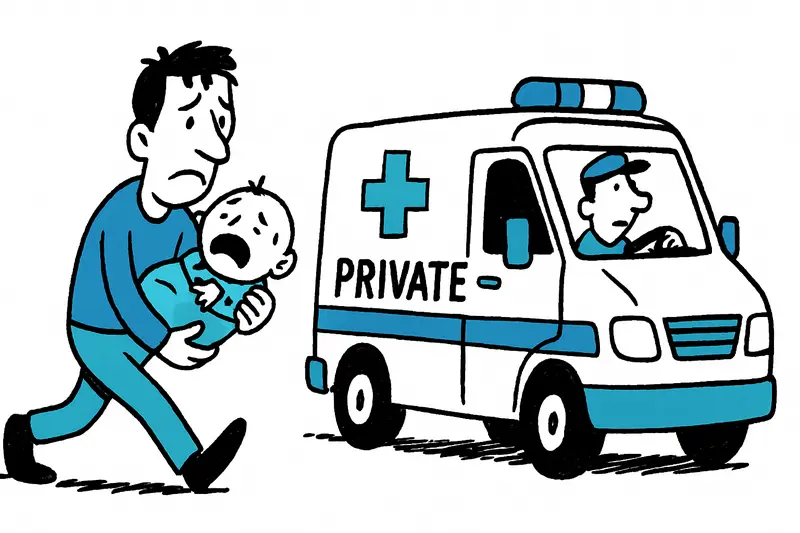
It is shortly after three in the morning. In a hotel corridor near Palma a young father walks into the cold night with his crying nine-month-old son. A hotel doctor is on site, the emergency call has been made — a few minutes later an ambulance arrives. Siren, blue lights, the smell of disinfectant. The father assumes the public emergency service has come. Only in the vehicle does he learn: this is a private ambulance. In the end the driver demands €1,095, which he pays immediately with a credit card. The German health insurer recognises the transport as medically necessary but reimburses only €400. Result: €695 remains the parents' burden.
Key question: Who bears the costs when a private emergency service attends during a holiday — and could the parents have prevented this?
In short: the European Health Insurance Card (EHIC) applies to medically necessary treatments within the public health system. It does not automatically cover private providers. This is not an abstract rule but, in this case, the reason for the billing gap. Insurers reimburse according to the rates of the Spanish public system; private providers often charge market rates that are significantly higher.
Critical analysis: three factors combined here. First: an information gap in the acute situation. At night, under stress and with a sick baby, a family can hardly assess the local market structure. Second: the decision-making authority of the attending doctor. If the hotel physician requests a private provider, the family's choice is effectively limited. Third: lack of price transparency and no obligation for private providers to inform beforehand. Someone reacting in panic is unlikely to sign a cost estimate first.
What is often missing from public debate is the question of responsibility at the interface between hotel, doctor and emergency service. Hoteliers and private doctors make decisions that can have financial consequences for guests. This practice is rarely discussed, even though a few rules could create a lot of clarity.
Everyday scene in Mallorca: on the promenade in Palma you hear scooters in the afternoon, palm leaves rustle, excursion boats chug across the harbour basin. Travellers stroll with prams along the Passeig Marítim. But the same people can stand in a hotel corridor at night and need an ambulance. The island lives from tourism; at the same time, medical infrastructure during peak times can operate differently than at home.
Concrete solutions for those affected and for those responsible:
For travellers: 1) Always carry the EHIC and have the number of your travel insurance ready. 2) When calling emergency services or speaking to a doctor, explicitly request a public ambulance; call 112 and, if necessary, point out that only a state/public ambulance is acceptable. 3) If you are admitted to a vehicle, ask immediately whether it is a private service and what costs will be incurred; demand itemised receipts and detailed service descriptions. 4) Document credit card charges, keep receipts and request an English or Spanish description of services. 5) If in doubt, report the incident directly to your insurer and to the European Consumer Centre; they can carry out legal checks and provide support.
For hotels and doctors on site: 1) Create emergency protocols that prioritise the option of a public ambulance and inform families about possible costs. 2) Train night staff: how to communicate transparently in an emergency. 3) Cooperate with local health authorities and display a list of accredited public emergency services.
For authorities and providers: Require clear rules on price transparency for private emergency services. Private providers should be obliged to briefly explain costs in English/German at the scene and to hand over a written invoice with service codes. Insurers, in turn, could provide clearly labelled information for policyholders about what the EHIC covers and where additional protection is needed.
What to do now: the parents should collect all documents, report the incident to their insurer and simultaneously file a complaint with the European Consumer Centre and the local health authorities. An additional review by consumer protection agencies often helps to achieve a subsequent payment or reimbursement from the private provider.
Conclusion: the decision about which emergency service you get while on holiday is not always made by those affected. Mallorca is an island that sleeps at night and wakes up in the morning; in between, a small difference in the choice of provider can mean hundreds of euros. Those who live here or host guests should take responsibility: create transparency, offer alternatives and inform travellers. For panicked families this is not a theoretical debate but real money — and a nuisance that could be avoided.
Frequently asked questions
What is the best time to visit Mallorca for good weather and fewer crowds?
Are Mallorca beaches suitable for swimming year-round?
What should I pack for a spring trip to Mallorca?
What are must-do activities for a first-time visitor to Mallorca?
What is the Mallorca climate like across the seasons?
How easy is it to get around Mallorca using public transport?
Is Mallorca a safe destination for travelers?
What local foods should I try on a Mallorca trip?
Similar News
After a Powerbank Fire on a Plane: What Mallorca Travelers Need to Know
A powerbank fire on board makes clear: batteries belong in carry-on luggage — and travelers, airports and airlines must ...
Fire in Can Pastilla: Supermarket behind hotel burns down completely – a reality check
A small supermarket behind a hotel in Can Pastilla burned down completely in the early morning hours. Why a second water...
Real estate boom in Mallorca: 66 new estate agencies — who is being built for?
In the first nine months of 2026, 66 new real estate intermediaries were registered in Mallorca's commercial register. A...
Palma at the Capacity Limit: Who Plans for Peak Days?
Four cruise ships, kilometer-long traffic jams in front of shopping centers and full car parks: the long weekend showed ...
When Palma Overflows: Why the Long Weekend Brings the City to a Standstill
Four cruise ships, overfilled parking garages and a two-kilometre traffic back-up in front of the Fan entrance: who is r...
More to explore
Discover more interesting content

Can Cap de Bou

Townhouse Lleo 72
