
When Palma Overflows: Why the Long Weekend Brings the City to a Standstill
When Palma Overflows: Why the Long Weekend Brings the City to a Standstill
Four cruise ships, overfilled parking garages and a two-kilometre traffic back-up in front of the Fan entrance: who is responsible — visitors, the port or the city administration?
When Palma Overflows: Why the Long Weekend Brings the City to a Standstill
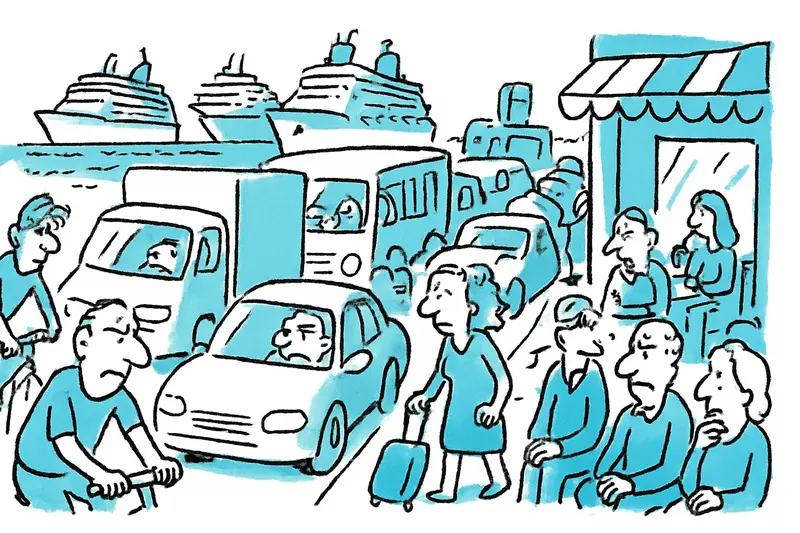
On the Saturday before the national holiday Palma noticeably filled up. Thousands of people took advantage of the long weekend; in the old town visitors jostled between cafés and souvenir stalls, queues formed at parking garages, and traffic on the highway to the airport slowed — at one point even for around two kilometres toward the Fan shopping centre. Four cruise ships were docked in the port at the same time, as reported in Four Cruise Giants, One Old Town: Palma Struggles with the Tourist Flood, which further exacerbated the situation.
Main question
Why does Palma repeatedly reach its capacity limits on such days, and who must act so that residents and guests do not end up in chaos?
There are several levels on which the problem becomes visible. In the short term, the concentration of events, holidays and cruise ship schedules creates a peak demand for parking spaces, taxis and public transport. The infrastructure is still designed for heavy car use: narrow old-town streets, limited parking areas and too few continuous bus or shuttle services to bring large groups from the port into the centre. When four large ships call in one morning, that means many hundreds of additional passengers who cannot all fit into the city streets at once.
Another element is information management. Many visitors orient themselves on site, park where space seems available, and thus trigger chain reactions: blocked access roads, queues in front of parking garages and overloaded approach roads. Around Paseo Mallorca and Parc de la Mar this was clearly noticeable, as described in Palma in a weather jam: When gray days roll over the city: cars pushed along, delivery vans found almost no unloading zones, and footpaths turned into trampling routes.
What is often missing in public debate is the perspective of everyday practicality: How do emergency access routes work if a rescue team has to get to the centre? How do shop owners and residents actually experience such days? Often simple disruptions — delayed buses, clogged access points — escalate because there is a lack of clear coordination.
Missing points in the debate
Three important questions appear too rarely in discussions: first, coordinated port and city management for cruise arrivals; second, real, available alternatives to private car use during peak times; and third, transparent real-time data on parking and transport capacities that is accessible to both residents and visitors. Without this information, many drivers make spontaneous decisions — and that drives congestion further.
An everyday scene: at Parc de la Mar older Mallorcans sit on the benches, watch the pigeons and shake their heads while travellers with wheeled suitcases must share the narrow promenade at their feet. On Paseo Mallorca a delivery van beeps while reversing, a taxi driver calls out, and the street noise drowns out the conversation on the café terrace. Small scenes that together show a city under pressure.
Concrete solutions
Measures are needed in the short and medium term. Short-term helpful measures would include:
- Coordination of cruise arrivals: By staggering arrival times, peaks could be smoothed. The port authority and the city should consider closer coordination here, as highlighted in Port of Palma Under Pressure: New Harbor Fees Threaten 500 Jobs and the Harbor's Identity.
- Temporary park-and-ride offers: Shuttle buses from the city outskirts or from large parking lots to the port and the old town, especially on weekends with high traffic volumes.
- Real-time information: Signs on approach roads and a simple app or hotline showing free parking spaces and recommended routes would reduce spontaneous drives.
- Priority for residents and emergency routes: Clear signage, access controls and temporary parking bans at critical points prevent chaos.
In the medium term, options to consider include expanding public transport during peak times, financial incentives for cruise operators to stagger their arrival times, and a longer-term master plan for mobility in Palma that also prioritises residents' needs.
Conclusion
Palma is a magnet on certain days — this is good for the economy, but problematic when the city reaches its limits, as asked in Mallorca at the Limit: Will This Weekend Break the Visitor Maximum?. Anyone who wants to steer tourist flows responsibly must now provide visible coordination: between the port, the city administration and transport operators, with clear information for everyone, and with options that make the car a less necessary choice. Otherwise the next national holiday will again be a test in which the city comes to a standstill.
Frequently asked questions
Why does Palma de Mallorca often hit capacity on long weekends and cruise ship days?
What short-term steps could help ease congestion in Palma during peak times?
How can visitors get around Palma without relying on a car during peak periods?
What role do port authorities and the city play in managing cruise ship arrivals?
Is real-time information on parking and routes available for visitors in Palma?
What signs indicate Palma is under pressure on a peak day?
What should residents and local businesses do to cope with peak congestion?
Is there a long-term plan to reduce car dependence in Palma?
Similar News

After the Fatal Rally Crash: A Reality Check for Mallorca
The death of L’Osteria co-founder Klaus Rader at the Rally 550 Challenge raises questions about safety on Mallorca's cou...
Who really protects Mallorca's coasts? A reality check after the viral beach video
A viral online video compared developed coasts in Turkey with Mallorca's beaches and praised the island. A good moment t...

Arenal: How Two Strangers Stole Jewelry from a 91‑Year‑Old — and What We Should Learn
In El Arenal two young women managed to gain the trust of a 91‑year‑old and steal jewelry from her apartment. A family f...

Cool Night, Mild Days: Autumn Shows on Mallorca – Good for Land and People
The Tramuntana brought the coldest night in months: around 8 °C, 11–12 °C in the lowlands. Daytime temperatures rise aga...

Llucmajor bets on a new waste contract – is it enough to end the waste crisis?
The municipality of Llucmajor has signed a €36.6 million contract with Urbaser for eight years. After summers of overflo...
More to explore
Discover more interesting content

Can Cap de Bou

Townhouse Lleo 72
