

Palma at the Capacity Limit: Who Plans for Peak Days?
Palma at the Capacity Limit: Who Plans for Peak Days?
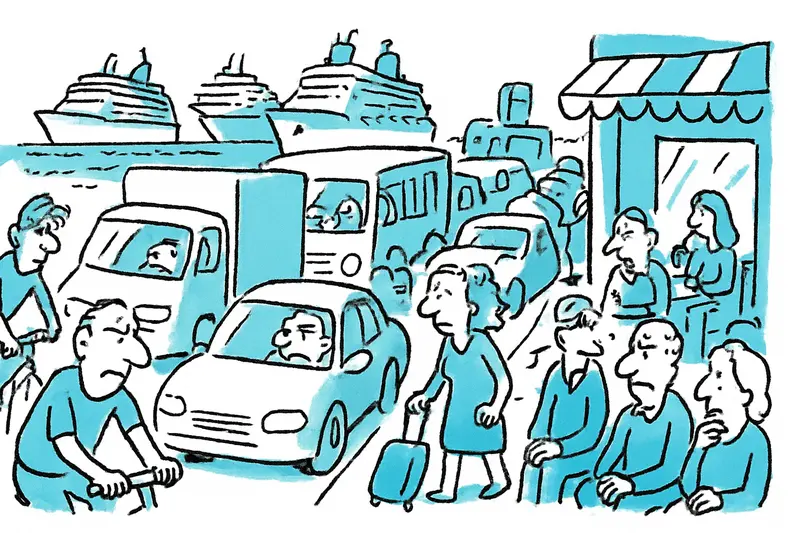
Four cruise ships, kilometer-long traffic jams in front of shopping centers and full car parks: the long weekend showed how quickly Palma's infrastructure reaches its limits. An assessment of what is missing in everyday life and how the city could better prepare for such days.
Palma at the capacity limit: Who plans for peak days?
Guiding question: How can Palma deal with such visitor peaks in the future without residents, shopkeepers and guests getting stuck in traffic?
What was noticeable on Saturday
The autumn Sunday smelled of sea and an open old town, but the quiet postcard idyll did not last long. Already in the morning cars queued in front of the car parks around the city centre, at Parc de la Mar and along the Paseo Mallorca the search for parking quickly turned into a test of patience. Traffic backed up on the highway to the airport toward the Fan shopping centre: a metal queue about two kilometres long formed before the exit. At the same time, four cruise ships were docked in the port and the old town filled up in a very short time.
Critical analysis
Days like this are not an exception but a pattern. Holidays and long weekends draw many people into the city at the same time — residents, day visitors from the ships, Cruise Boom 2025: Numbers Celebrate, Residents Take Stock, shopping tourists. Palma's streets, car parks and pedestrian zones are designed for regular operation, not necessarily for simultaneous peak loads. The result: overcrowded access roads, blocked emergency routes, frustrated drivers and retailers who see customers but suffer from delivery problems.
What is often missing in the public debate
We talk a lot about visitor numbers, less about how they arrive and leave. The debate often stays at the general "more or less tourism" and misses the operational questions: Are there coordinated berth schedules for cruise ships that stagger arrival times through Ports de les Illes Balears? Are parking areas and temporary shuttle services planned to absorb peak loads? How good is the communication with commuters and people who have to work on the holiday? And finally: what price do residents pay on days when the city becomes a transit zone?
An everyday scene that many know
At Parc de la Mar there is hardly any space left on the promenade: a babble of voices, the rattle of suitcase wheels, an ice-cream seller hastily fetching more stock. An older neighbour who usually visits the Sunday market avoids the crowds and says she prefers to go to another place "when everything is this full." This small scene stands for the everyday life of many residents on such peak days.
Concrete solution approaches
- Coordinated cruise schedules: the port authority and the city could jointly plan berth times so that several large ships do not flood the main access roads at the same time. Temporal staggering reduces shock waves in inner-city traffic.
- Temporary shuttle systems: on heavily frequented days shuttle buses bring visitors directly from peripheral car parks or from the cruise terminal to the city centre at fixed intervals. Less search traffic means less congestion.
- Digital parking and traffic information: real-time displays at the most important access points and on a city app showing available parking spaces, shuttle frequencies and detours. Clear information prevents pointless trips into the city centre.
- Parking management with reservations: for holidays car parks could offer partially reservable spaces — for residents, suppliers and visitors with time slots.
- Traffic control and short-term measures: mobile parking attendants, temporary no-parking zones and optimised traffic light phases at critical junctions help to stabilise traffic flow.
- Better coordination with retail and gastronomy: plan delivery times more flexibly on peak days so that deliveries do not get stuck during rush periods.
Why this matters
It is not just about comfort. If traffic and parking problems become routine, residents' quality of life suffers, the local economy loses reliability, and the environment is more heavily burdened. Staggered arrivals and departures are a win-win for everyone: less stress, fewer emissions, more stable business conditions.
Conclusion
Palma has the tourist appeal — that is clear. But attractiveness alone does not solve logistical bottlenecks. Those who want real relief must talk about schedules, infrastructure and information instead of just numbers. In the short term, shuttle buses, digital traffic information and targeted parking management help. In the medium term, coordinated port and city planning is needed. If the city addresses these points, long queues in front of car parks and on the highway will less often become a Sunday routine.
Frequently asked questions
Why does Palma experience peak-day traffic on holidays and weekends?
How can Palma improve parking and real-time traffic information to ease crowding?
Should Palma coordinate cruise ship arrivals to reduce traffic in the city?
What happens at Parc de la Mar on Palma's peak days, and how can access be improved?
How can Palma's shops coordinate deliveries on busy days to avoid delays?
Are temporary shuttle services effective for Palma on busy days?
When is Palma busiest and how should visitors plan?
How can Palma protect residents' quality of life during peak days?
Similar News
When Palma Overflows: Why the Long Weekend Brings the City to a Standstill
Four cruise ships, overfilled parking garages and a two-kilometre traffic back-up in front of the Fan entrance: who is r...

After the Fatal Rally Crash: A Reality Check for Mallorca
The death of L’Osteria co-founder Klaus Rader at the Rally 550 Challenge raises questions about safety on Mallorca's cou...

Who really protects Mallorca's coasts? A reality check after the viral beach video
A viral online video compared developed coasts in Turkey with Mallorca's beaches and praised the island. A good moment t...

Arenal: How Two Strangers Stole Jewelry from a 91‑Year‑Old — and What We Should Learn
In El Arenal two young women managed to gain the trust of a 91‑year‑old and steal jewelry from her apartment. A family f...

Cool Night, Mild Days: Autumn Shows on Mallorca – Good for Land and People
The Tramuntana brought the coldest night in months: around 8 °C, 11–12 °C in the lowlands. Daytime temperatures rise aga...
More to explore
Discover more interesting content

Can Cap de Bou

Townhouse Lleo 72
