
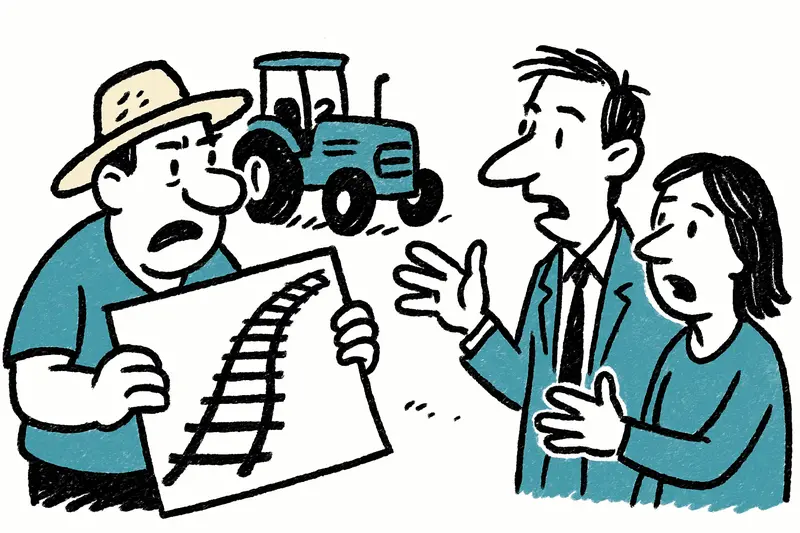
Rail to Alcudia: Between Train Tickets and Furrows – Sa Pobla Demands Answers
The planned rail connection from Palma to Alcudia is meeting strong resistance in Sa Pobla. The government will review objections until mid-September — enough time for technical clarification, but also for concrete compromises. Which solutions could protect fields, irrigation and everyday life?
Rail to Alcudia: Between Train Tickets and Furrows – Sa Pobla Demands Answers
Anyone who walked across the Plaça de sa Vila yesterday heard more than conversations: the hoof-like sounds of tractors, occasional laughter, a dog guarding the market stalls, and again and again the question on people's faces: how much will a rail line change our lives? The Balearic government has announced that it will review all objections to the new rail line to Alcudia until mid-September, as reported in When Tracks Cross the Fields: Sa Pobla Pushes Back Against Rail Plans. This deadline gives time — but is it enough to thoroughly clarify technical, social and ecological issues?
The sober planning — and what it does not show
About 17 kilometres of track are planned, six stations, construction start in 2028. On paper this means: fewer cars on the coastal road, faster connections to Palma and a more attractive arrival for tourists, a promise debated in analyses like New Palma–Calvià Rail Link: Beacon of Hope or Costly Mammoth Project?. But the project affects a landscape that is not empty: fields, old dry-stone walls, irrigation ditches and paths that have been used by agricultural machinery for generations. "If the track goes through here, my olive trees won't be the same anymore," said a farmer's wife at the market — not a dramatic sentence, but everyday life suddenly called into question.
The key question
The central question is: how can a public transport project be implemented without destroying people's livelihoods and the functionality of agricultural land? This is not purely a technical task, as seen in discussions about other projects such as New Rail Link to Calvià: Opportunity or Traffic Illusion?. It's about water, access for tractors, noise during harvest times and the loss of micro-landscapes that on maps often appear only as thin lines.
Aspects that are often overlooked
At town hall events, maps, cross-sections and noise studies are shown. Less attention is given to:
Hydrology: irrigation ditches and drains are lifelines here. Interventions in these structures can change the groundwater level and the accessibility of water for plots.
Accessibility: small farm tracks that today take tractors and trailers can become unusable due to barriers or missing over- or underpasses.
Cultural materials: dry-stone walls, old paths, local biotopes — they are not just decoration but part of a functioning agricultural system.
These elements cause real concern in the communities because they cannot be "compensated" as easily as square metres of land.
Specifically: what matters now — and what options exist
The review of objections must not be merely a formal act, and lessons from proposals like New train connection to Calvià: opportunity or pipe dream? illustrate the necessary depth. Concretely required would be:
1) Independent hydrological reports — examined by experts who know the local irrigation systems. Not only general statements, but parcel-by-parcel analyses for affected areas.
2) Alternative route planning — where possible examine deviations that affect less arable land; also consider short tunnel sections or ramps to preserve access routes.
3) Technical solutions at crossings — underpasses and overpasses for agricultural machinery, water-permeable culverts for drainage, noise protection specifically for harvest periods.
4) Legally binding compensation measures — compensation areas are good, but quality matters: equivalent soils, accessible plots, rapid implementation.
5) Construction phases and time windows — works outside sensitive periods (sowing, harvest) to avoid crop losses.
6) Local oversight bodies — composed of farmers, municipal councillors and independent experts to monitor construction sites and compensation measures.
Why transparency is more than a PR word now
The government has set the formal deadline. What now counts is not only the number of objections, but how they are handled. Transparency means: access to full reports, traceable decision-making processes and clear commitments that are binding before construction begins. Otherwise, there is a risk of "on-paper" compromises that have little effect locally.
A pragmatic appeal
This is not about preventing progress. A rail to Alcudia can make sense — for the climate, tourism and less congestion. But progress that removes fields, water and access routes without offering real alternatives creates losers. The balance lies in technical adjustments, reliable compensation measures and genuine dialogue.
I will continue to be present in the coming weeks in Sa Pobla, at field edges and at information events. Not out of sensationalism, but because here it will be decided how we build future infrastructure: as a benefit for all or as a train that rattles past old shepherd paths and makes them disappear.
Frequently asked questions
What would a new rail line to Alcudia mean for Mallorca's traffic and travel times?
When could construction on the Alcudia rail project start in Mallorca?
Why are farmers in Sa Pobla worried about the planned rail line?
What are the main environmental issues with the new rail line near Alcudia?
Could the Alcudia rail route be changed to protect farmland in Mallorca?
What compensation should Mallorca landowners expect if rail construction affects their plots?
Why is transparency important for the rail project to Alcudia?
How could rail construction affect daily life in Sa Pobla?
Similar News
Why Mallorca Has Become So Terribly Expensive — A Reality Check
Rents are exploding, staple food prices are rising, wages are lagging behind. A look at the causes, what is missing from...
When Paradise Becomes Unaffordable
Hotel rooms, paella and the weekly grocery shop: Mallorca is becoming more expensive for many. Who pays the bill — guest...
End at Ballermann: What Is Lost with the Dino Mini Golf at Playa de Palma
On October 25 the dinosaur mini-golf course at Playa de Palma will close after more than 30 years. Why the city is recla...
Expensive Address Calvià: What Does First Place Mean for Mallorca?
The National Institute of Statistics (INE) ranks Calvià as Spain’s most expensive municipality for property purchases. W...
Emergency over Spain: Ryanair Dublin–Tenerife flight diverted to Santiago after medical emergency
A Ryanair flight from Dublin to Tenerife was diverted to Santiago de Compostela due to a passenger's acute health proble...
More to explore
Discover more interesting content

Can Cap de Bou

Townhouse Lleo 72
