
Red Flag at the Airport: Why a Sparkasse Campaign Caused Such a Stir
Red Flag at the Airport: Why a Sparkasse Campaign Caused Such a Stir
Why were many islanders puzzled by an oversized German-language advertisement on the airport parking garage? A reality check on language, responsibilities and sensitivity to the local.
Red Flag at the Airport: Why a Sparkasse Campaign Caused Such a Stir
Key question: How can an advertising poster for a money transfer app at the airport be so off the mark?
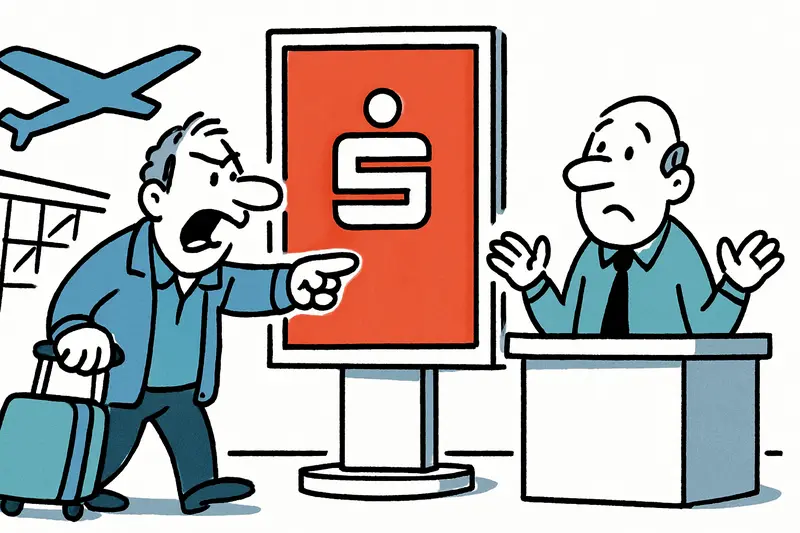
In the early morning, when rolling suitcases clatter across the concrete of the parking garage and taxi drivers at the exit sort out their first fares, a red billboard hung in the Palma airport car park that irritated many passers-by. Not because the color was wrong, but because the message appeared in only one language and the island's name — which many locals find grating — was reduced to a casual abbreviation, an issue echoed in Posters, Provocation, Polarization: How Mallorca's Streets Become a Campaign Ground.
The problem is not only aesthetic. Advertising at an international hub has reach. It signals whom one considers the target audience. In this case, a purely German-language address was chosen. In Mallorca, where Catalan as well as Spanish are present as official languages and where a significant portion of the population comes from different countries, this triggered distrust: Who is speaking for whom, and who decides on the tone, a question raised also by incidents such as 'Germany should buy Mallorca': A post from Biberach that provokes more than laughter?
Added to this is the question of who controls the airport spaces: operators like Aena manage the premises and allocate advertising surfaces. Local politicians in the Balearics voiced substantive concerns, but they do not directly decide on the allocations. This exact contrast — local sensitivity versus centrally managed marketing — intensifies the debate, similar to other public frictions reported elsewhere such as the Carry-On Dispute at the Emergency Exit: Why a Loud Row Reveals More Than Bad Manners.
Critically analysed, this means: a private-sector campaign used public space without any apparent compensation for linguistic and cultural diversity. The reaction from the regional parliament and the tourism department reflected a deeper tension — namely the question of respect for local culture and control over the images communicated about the island.
What is noticeably missing in the public discussion is a concrete engagement with rules: Which criteria apply when major advertising spaces at the airport are awarded? Are there guidelines on language, on consideration for local culture, or on minimising stereotypes? These questions were discussed emotionally but have so far received little administrative answer.
Also rarely considered is the perspective of travellers and the small businesses around the airport. Hoteliers, taxi operators and kiosk owners have an interest in a nuanced external representation of the island. A striking motif that highlights or ridicules a particular group can harm these players — even if it draws short-term attention.
A perfectly normal scenario: a café owner on Plaça Espanya fills cups in the morning, hears the headlines on the radio and shakes her head. A taxi driver at the terminal exit recounts how guests from various countries ask for local directions. Such observations show that local perception is multi-layered and cannot be dealt with by one-way advertising.
Practical solutions that are workable:
1) An allocation catalogue for airport advertising: Public operators should set binding criteria: multilingualism for certain surface sizes, a ban on obvious distortions of place names, and a review mechanism for cultural sensitivities.
2) Local advisory board: A voluntary board made up of municipal representatives, tourism stakeholders and linguists could review advertising applications in advance. It costs little and prevents many mistakes.
3) Transparency requirement: Anyone renting a very large space should disclose which audience is being targeted and why a particular language was chosen. In short: more accountability.
4) Language guidelines: Clear recommendations on when Catalan/Spanish should at least be used in addition. This is not a demand for equal treatment of every language, but a minimum degree of respect for local identity.
5) Sensitisation of advertisers: Small workshops or information sheets from tourism associations could alert advertisers early in the process, before expensive motifs are printed.
The island does not need to institutionalise every criticism immediately, but it should not duck away either. Airports are shop windows — and they reflect what a region wants to stand for. A red billboard can trigger debates; what matters is using those debates to establish new rules and better communication.
Conclusion: The incident at the parking garage was more than a faux pas. It showed how unequal power relations between centralised space allocation and local identity lead to irritations. If Mallorca does not want the island reduced to a casual shorthand, outrage alone will not help. What is needed are rules, good judgement and a measure of tact — before the next oversized motif goes up.
Frequently asked questions
When is the best time to visit Mallorca for good weather?
What kind of weather should I expect in Mallorca in summer?
Can you swim in the sea in Mallorca outside summer?
What should I pack for a holiday in Mallorca?
Is Palma de Mallorca good for a city break?
What is Sóller like for visitors to Mallorca?
Is Valldemossa worth visiting on a trip to Mallorca?
What is the weather like in Mallorca in spring?
Similar News

From the Ruhr Area to the Tramuntana: Thorsten Legat and the FC Germania Mallorca Adventure
The former pro has not only taken the coaching role on Mallorca but also moved into a small island shared house, set amb...

Silent Conquest: What Mallorca's Wildlife Can Do Against Introduced Snakes
For years non-native snakes have been appearing on Mallorca. Who monitors the import routes, how effectively do authorit...

Stolen motorcycles in vacant factory: Guardia Civil finds 19 vehicles
In Inca, investigators discovered 19 motorcycles stolen between April and June. In an abandoned factory near Selva, many...
Storm in Majorca: 75 Responses, Uprooted Trees and Beached Boats – Who Will Draw the Lessons?
A sudden thunderstorm swept over the islands on Thursday evening, leaving uprooted trees, damaged boats and disrupted su...

Daily new boats: Mallorca and the Balearic Islands under pressure from rising arrivals from Algeria
For months, arrivals of boat migrants from Algeria have remained at a high level. Places are lacking, unaccompanied mino...
More to explore
Discover more interesting content

Boat Tour with BBQ along Es Trenc Beach

Private transfer from Mallorca Airport (PMI) to Pollensa
