
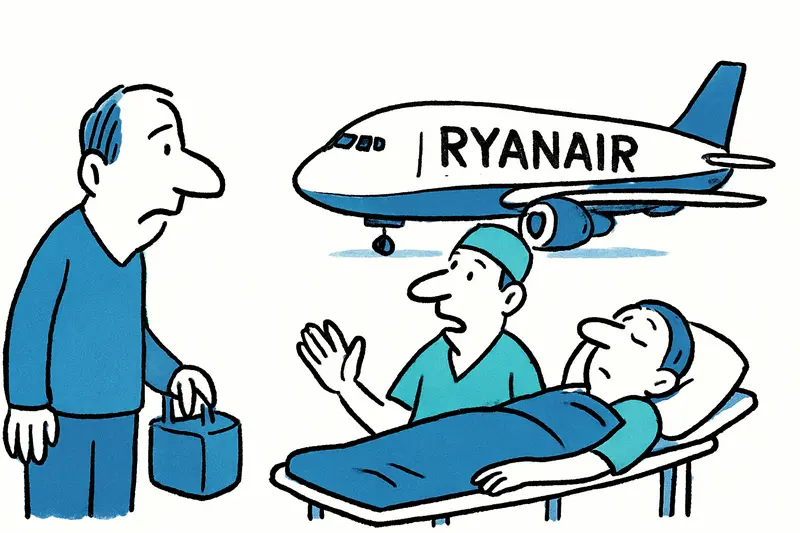
Emergency over Spain: Ryanair Dublin–Tenerife flight diverted to Santiago after medical emergency
A Ryanair flight from Dublin to Tenerife was diverted to Santiago de Compostela due to a passenger's acute health problem. Why such maneuvers increasingly affect other flights — and what needs to improve.
Emergency over Spain: Ryanair Dublin–Tenerife flight diverted to Santiago after medical emergency
Why does an otherwise routine scheduled flight suddenly end up on another island, and what does that mean for passengers?
A flight from Dublin to Tenerife did not land where most passengers had planned this week. Due to a medical emergency on board, the aircraft was diverted to Santiago de Compostela, the descent was accelerated and the flight was given priority so the affected person could receive medical care quickly. Air traffic control coordinated the response on the ground, and another incoming jet had to alter its approach to make room for the emergency.
Key question: How well is our air traffic system prepared for such acute medical incidents, and why do other flights then feel the consequences?
The situation shows two sides: first, the strength of the system. Pilots and controllers made swift decisions, runway clearance was expedited and emergency services were waiting on the ground. Such procedures save lives — you see that at airports every day, for example in Palma when the runway at Son Sant Joan hums and people in the arrivals area café wait for their luggage. Stories such as Back after takeoff: What a 'toilet problem' reveals about flight safety highlight how safety protocols work in practice. On the other hand, cascade effects occur: diversions, delays for other aircraft and uncertainty for travelers who suddenly miss connections and often receive only sparse information.
Critical analysis: The response was correct, but the incident exposes structural weaknesses. Emergencies remain individual cases, but they challenge the interfaces between airlines, air traffic control, airport rescue services and health providers. Particularly notable is the lag in communication with passengers. In many cases people on board only know that “medical assistance” is required, without a time frame or clear information about procedures. On the apron this leads to frustration, at the airport to long waits and for connecting passengers to missed connections.
What is often missing from public debate: transparent figures and follow-up. How often are flights diverted within Spain? For instance, When the Toilet Became a Flight Risk: Ryanair Plane Turned Back After Takeoff and Landed Safely in Lanzarote recounts a recent diversion. What costs do passengers incur, who covers transport and accommodation when a flight ends far away? The debate often swings between praise for rapid rescue and frustration over organizational consequences. It is also rarely discussed whether aircraft are sufficiently medically equipped and how well crew members are trained for serious emergencies.
A local scene: On the Paseo Marítimo in Palma, residents sit with a view of the runway, hear the roar of the engines and speak quietly about flight delays. A young father stops his stroller at the roadside, points to a plane and says, “You always hope nothing happens, but if it does, everything should happen quickly.” That concern is shared by many travelers — they want safety and clear rules; local coverage such as Frightening Seconds over Palma: Two Flight Attendants Injured reflects how incidents affect both crew and passengers.
Concrete, pragmatic and locally implementable solutions: First, a uniform obligation for airlines to inform passengers in cases of diversions due to medical emergencies, including clear guidance on onward travel and accommodation for affected passengers. Second, comprehensive on-board telemedicine modules and regular training sessions for cabin crew so that first aid is not left to chance. Third, improved interfaces between air traffic controllers and regional emergency services: standardized procedures for prioritization and ground coordination could minimize delays to other flights. Fourth, public statistics on medical incidents in civil aviation so debates are based on data rather than isolated cases.
For Mallorca this has a very concrete aspect: Son Sant Joan is a hub, and in autumn, when the weather is milder and aircraft approach the island, travelers feel every minute change. Authorities, airlines and airport operators should plan closer emergency exercises here — in real conditions, not just on paper.
Conclusion: The rapid intervention in this case was necessary and correct. At the same time, praise must not obscure the fact that transparency, clear passenger information and standardized medical equipment on board are lacking. Anyone standing at the terminal in Palma watching a jet turn should not also have to struggle with bureaucratic questions. Quick aid and a humane, comprehensible organization on the ground belong together.
Frequently asked questions
What is the best time to visit Mallorca for pleasant weather and fewer crowds?
Can I swim in Mallorca year-round, or is it seasonal?
What should I pack for a trip to Mallorca?
What are the most popular activities to do in Mallorca?
Is Mallorca safe for travelers, including families and solo visitors?
How should I get around Mallorca?
Do I need to book accommodations in advance for Mallorca?
Are day trips or nearby excursions worth it from Mallorca?
Similar News
Expensive Address Calvià: What Does First Place Mean for Mallorca?
The National Institute of Statistics (INE) ranks Calvià as Spain’s most expensive municipality for property purchases. W...
Ten Years in a Tent: A Couple in Son Verí and the Gaps in the Housing Market
A British couple has lived for around ten years in a makeshift shelter near Son Verí. Their story is not an isolated cas...

After the Storm: Golden October Brings Warm Days and Sea Bathing in Mallorca
After heavy rain the weather on Mallorca is settling. Sun, mild air and 24°C water lure people once more to beaches and ...
Cracks in the La Seu Staircase: Who Really Protects Palma's Heart?
For months a cavity opened beneath the historic staircase to the cathedral; experts have now started probing. Why was ac...
Housing shortage in Palma: Protest camp between endurance and exhaustion
For weeks, 40–50 tents have stood on the Plaça d'Espanya. The protesters are debating how long to hold out — and demand ...
More to explore
Discover more interesting content

Can Cap de Bou

Townhouse Lleo 72
